
Venetian Grosso (Matapan)
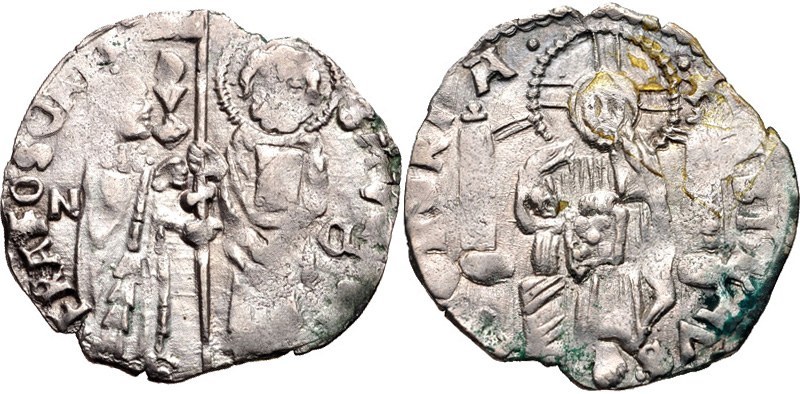
High-purity silver Grosso of medieval Venice: the Doge kneeling before St. Mark on the obverse, an enthroned Christ on the reverse.
- Country
- Italy (Venice)
- Denomination
- Grosso
- Metal
- Silver
Got a coin like this?
Identify any coin from a photo, free.
Overview
The Venetian Grosso, popularly nicknamed the matapan, was a high-quality silver coin issued by the Republic of Venice from the late 12th century into the 14th century. Struck from nearly pure silver, it became one of the most trusted trade coins of the medieval Mediterranean and helped anchor Venice's commercial dominance in the Levant.
The design is highly formulaic and instantly recognizable. One face shows two standing figures: the Doge of Venice receiving a banner or staff from Saint Mark, the city's patron. The other face shows Christ enthroned, holding a Gospel book. The example photographed here shows these characteristic standing and seated figures with clear religious iconography on both sides.
Because the type stayed visually consistent across many successive doges, individual coins are usually attributed by the Doge's name in the obverse legend rather than by any change in the imagery.
History & Background
Venice introduced the Grosso around the 1190s, traditionally under Doge Enrico Dandolo, as international trade demanded a reliable, high-value silver piece larger than the small pennies (denari) then in circulation. Its consistent weight and fine silver made it a standard unit for commerce with Byzantium and the eastern Mediterranean.
The iconography deliberately echoed Byzantine models: the enthroned Christ recalls the figures on Byzantine gold and silver coinage, signaling that the Grosso was meant to compete in the same trade networks. The Doge-and-Saint-Mark scene asserted Venetian civic and religious identity on a coin used far beyond the lagoon.
The Grosso circulated for roughly a century and a half before debasement, changing bullion values, and the rise of the gold ducat gradually reduced its role. Later doges issued Grossi of varying weight and fineness, and production of the classic type wound down during the 14th century, though the design influenced later Venetian and imitative coinages around the Adriatic and Aegean.
How to Identify
Look for a small, thin silver coin, typically around 20–22 mm in diameter and roughly 2 grams, struck in high-purity silver that often survives with a bright or lightly toned surface. The flan is usually slightly cupped or dished, a legacy of the Byzantine-inspired striking style.
The defining feature is the pair of standing figures on one side — the Doge on the left holding a long staff or banner, and Saint Mark on the right, with a vertical inscription running between them. The opposite side shows Christ seated on a throne facing forward, holding a book, flanked by abbreviated Greek-style religious lettering (often IC XC).
Attribution to a specific Doge relies on reading the Latin legend beside the Doge's figure, which names the ruler; the saint's side typically reads S · M · VENETI (Saint Mark of Venice). Because the imagery repeats across reigns, the legend is the key to dating an individual coin.
Value & Collectibility
As a genuinely medieval silver trade coin with strong historical appeal, the Grosso is collectible but not rare in absolute terms — many thousands survive. Common doges in worn or average condition are generally affordable entry points into medieval coinage, while sharp, well-centered, high-grade examples and scarcer or short-reigned doges command clear premiums.
Condition, centering, and full legibility of the legend (which identifies the Doge) drive value more than the type itself. Bright original silver with complete inscriptions is worth substantially more than corroded, clipped, or off-center pieces.
Because values swing widely by Doge, grade, and eye appeal, treat any single figure with caution and compare recent auction results for the same Doge and condition rather than relying on a catalog headline price.
Frequently asked questions
Why is it called a "matapan"?
"Matapan" is a traditional nickname for the Venetian silver Grosso, used widely in the medieval Mediterranean trade world. The formal name is simply Grosso; both terms refer to the same high-purity silver coin.
Who are the figures on the coin?
One side shows the Doge of Venice receiving a staff or banner from Saint Mark, the city's patron saint. The other side shows Christ enthroned holding a Gospel book, an image borrowed from Byzantine coinage.
How do I tell which Doge issued my Grosso?
The Doge is named in the Latin legend running alongside his standing figure. Since the imagery stayed the same across many reigns, reading that inscription is the only reliable way to attribute and date the coin.
Is a Grosso made of real silver?
Yes. The classic Grosso was struck in nearly pure silver, which is a large part of why it was so widely trusted in medieval trade. Later issues could be lighter or less fine as debasement set in.
Venetian Grosso (Matapan) guides
In-depth guides for identifying, valuing, and collecting Venetian Grosso (Matapan).
Other coins you may enjoy
Gustav I Silver Coin
c. 1521–1560
Livonian Order Schilling
c. 1410–1415
Transylvanian Ducat of Catherine of Brandenburg
1630
Eric XIV Silver Coin
c. 1560–1568 (this example c. 1565)
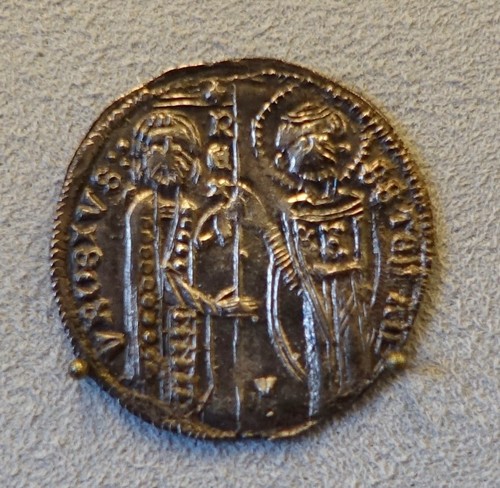
Matapan (Serbian imitation)
1243-1276
Real (Medieval)
13th–14th century
Hryvnia
Medieval (c. 11th-13th century)
Byzantine Follis
641 AD
Akçe
Late 14th-Early 15th century
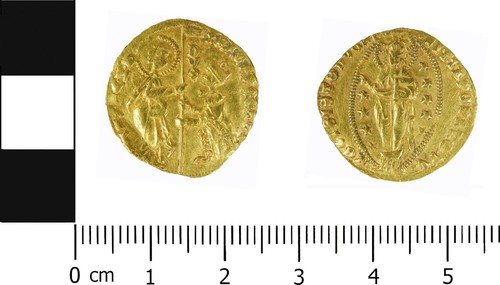
Venetian Ducat
Medieval (c. 1284 onward)
Denier of Charles the Bald
c. 840–877
Denier of Charlemagne
c. 790–814 AD