
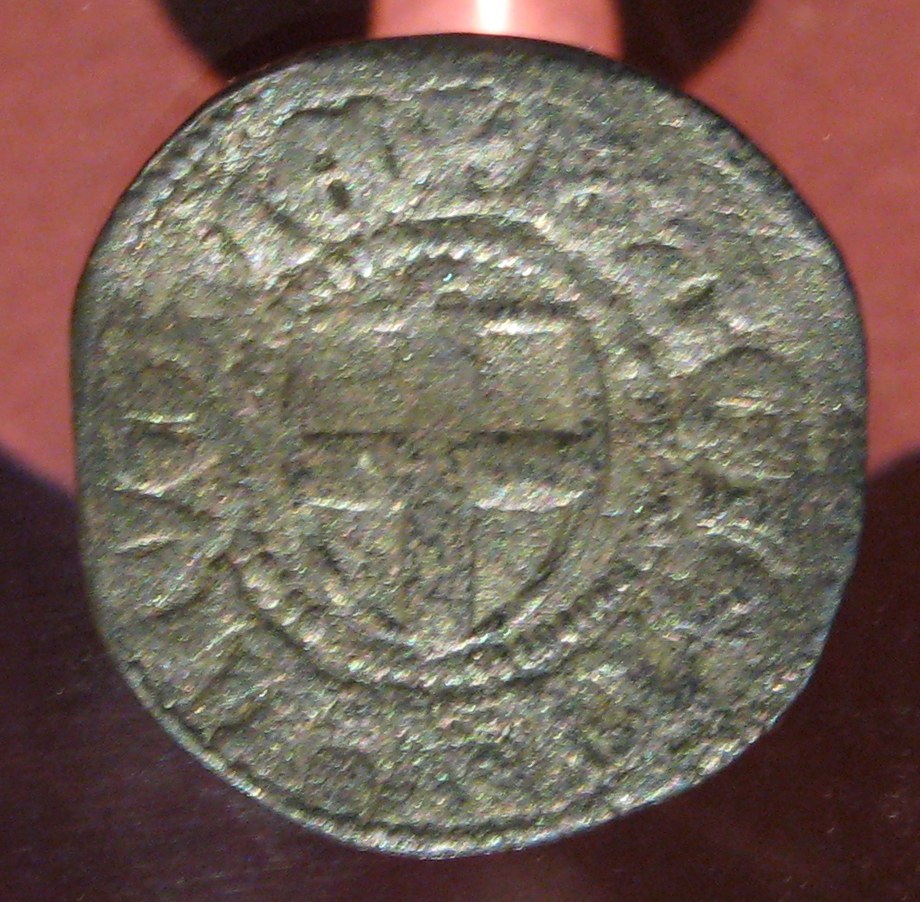
Livonian Order Schilling
A small hammered silver schilling of the medieval Livonian Order, showing heraldic shields and a cross, struck in the Baltic around 1410–1415.
- Country
- Livonia
- Denomination
- Schilling
- Metal
- Silver
Got a coin like this?
Identify any coin from a photo, free.
Overview
The Livonian Order schilling is a small hammered silver coin issued in medieval Livonia, the Baltic territory (covering much of present-day Estonia and Latvia) governed by the Livonian Order, an autonomous branch of the Teutonic Knights. The example shown here dates to roughly 1410–1415 and displays a heraldic shield on one face and a cross-and-shield arrangement on the other.
Struck by hand from thin silver, these coins are irregular in shape and modest in size, typical of late-medieval European small change. The paired shields express the dual authority behind the coinage: the arms of the Order and those of its ruling master or an associated ecclesiastical or civic power. Coins of this type circulated as everyday money across the Order's Baltic lands and among the Hanseatic trading towns of the region.
History & Background
The Livonian Order rose to power in the Baltic in the thirteenth century and, as a branch of the Teutonic Order, controlled a confederation of territories in what is now Estonia and Latvia. From the fourteenth century onward the Order and the region's bishops and towns produced their own coinage, of which the silver schilling became a standard denomination.
A coin from around 1410–1415 belongs to the early fifteenth-century phase of this coinage, an era of ongoing rivalry and cooperation among the Order, the Archbishopric of Riga, and Hanseatic towns such as Riga, Reval (Tallinn), and Dorpat (Tartu). Because medieval issues are usually attributed by their heraldry and legends to the reigning master rather than by a printed date, the roughly 1410–1415 dating reflects the style and heraldic devices of the period rather than a year stamped on the coin.
Schillings of the Livonian Order continued to be struck in various forms until the Order's collapse in the mid-sixteenth century. Surviving early-fifteenth-century pieces are prized today as tangible remnants of the Baltic crusader states and their monetary economy.
How to Identify
Expect a small, thin, hand-struck silver coin with an irregular round flan and slightly uneven strike, not a machine-made disc. One face carries a heraldic shield; the other shows a cross paired with a shield, the standard visual language of the Order's coinage. Surrounding each side is a Latin legend in Gothic (blackletter) lettering, often abbreviated and partly off the flan.
The shields typically render the arms associated with the Order and its master or a related authority; a long or short cross frequently forms the central motif of the reverse. Because the coin was struck by hand, lettering and design elements are commonly weak, doubled, or truncated at the edge. The absence of a numerical date is normal for this period.
The roughly 1410–1415 attribution rests on the heraldic devices and inscriptions rather than a stamped year, so precise dating usually requires matching the arms and legend to published references on Livonian and Baltic medieval coinage.
Value & Collectibility
As a genuine medieval silver coin more than six centuries old, the Livonian Order schilling carries real collector interest, but it is not among the great rarities. Values are best expressed as ranges: ordinary examples with clear heraldry but typical wear often fall in the low tens to low hundreds of dollars, while sharply struck, well-centered, or scarcer variants can command more.
Condition drives price heavily. Because these coins were struck by hand on thin flans, many survive with weak areas, clipping, edge cracks, or off-center strikes, all of which lower value; a full, legible legend and complete shields raise it. Correct attribution to a specific master or mint town can also add a premium.
Given the age and the market for medieval Baltic coinage, buyers should treat any exact figure with caution and rely on recent comparable sales and specialist references rather than a single quoted price.
Frequently asked questions
What is a Livonian Order schilling?
It is a small hammered silver coin issued in medieval Livonia, the Baltic region ruled by the Livonian Order, a branch of the Teutonic Knights. The example here dates to around 1410–1415 and shows heraldic shields and a cross.
Why doesn't the coin have a date on it?
Medieval coins of this type were not struck with printed years. Their period is inferred from the heraldry, legends, and the reigning master, which is why this piece is dated only approximately to about 1410–1415.
Where was it made?
It was produced in the Baltic lands of the Livonian Order, covering much of present-day Estonia and Latvia, where the Order and regional towns and bishops struck their own coinage.
Is it made of real silver?
Yes. Schillings of this era were struck from silver, though the small thin flans mean the actual silver content of each coin is modest.
Is a coin like this valuable?
It has genuine collector value as a medieval silver coin, but it is not a great rarity. Prices vary widely with condition and attribution, so it is best judged against recent comparable sales rather than a single figure.
Livonian Order Schilling guides
In-depth guides for identifying, valuing, and collecting Livonian Order Schilling.
Other coins you may enjoy
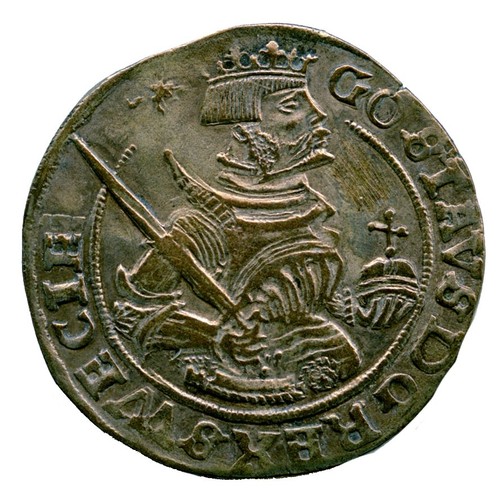
Gustav I Silver Coin
c. 1521–1560
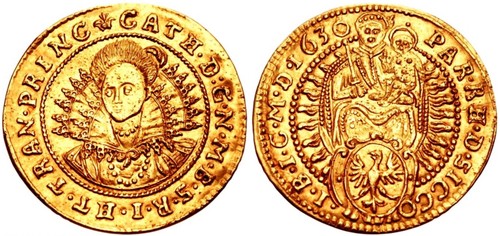
Transylvanian Ducat of Catherine of Brandenburg
1630
Venetian Grosso (Matapan)
c. 1193–1350s (13th–14th century)
Eric XIV Silver Coin
c. 1560–1568 (this example c. 1565)
Matapan (Serbian imitation)
1243-1276
Real (Medieval)
13th–14th century
Hryvnia
Medieval (c. 11th-13th century)
Byzantine Follis
641 AD
Akçe
Late 14th-Early 15th century
Venetian Ducat
Medieval (c. 1284 onward)
Denier of Charles the Bald
c. 840–877
Denier of Charlemagne
c. 790–814 AD