
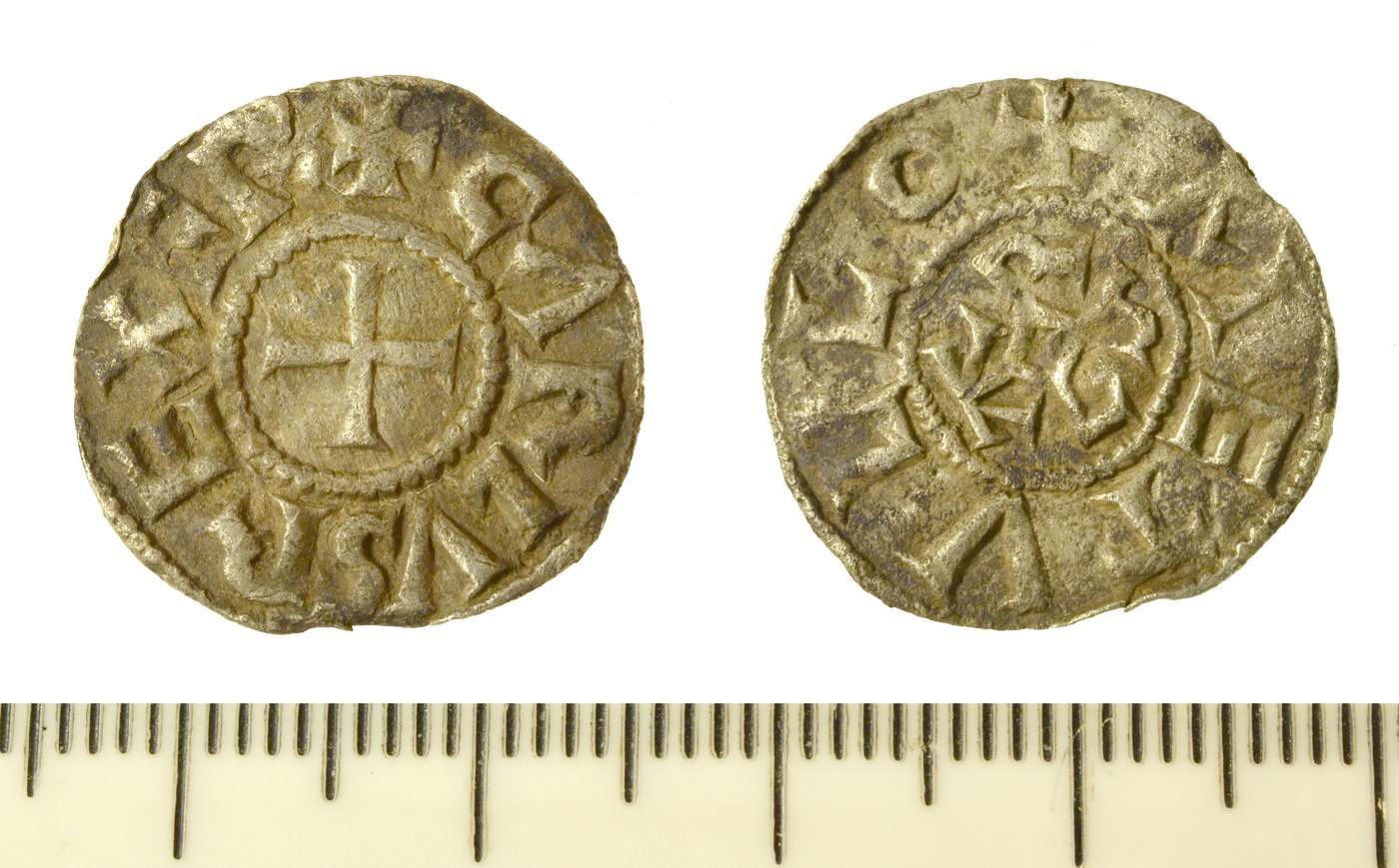
Denier of Charles the Bald
A small hammered silver denier of the Carolingian king Charles the Bald (r. 840–877), pairing a cross or monogram design with a ruler's profile.
- Country
- France
- Denomination
- Denier
- Metal
- Silver
Got a coin like this?
Identify any coin from a photo, free.
Overview
The Denier of Charles the Bald is a small hammered silver coin of the Carolingian period, struck for the West Frankish king (and later emperor) Charles II, known as Charles the Bald, who ruled from 840 to 877. The denier — the medieval descendant of the Roman denarius — was the standard silver coin of the Frankish realm and the everyday money of Charles's kingdom.
This example shows the two elements typical of Carolingian coinage: a cross or monogram on one face and a ruler's profile on the other. Carolingian deniers were struck by hand from silver blanks between two engraved dies, so each piece is slightly irregular in shape, thickness and centring. The designs are stylised rather than realistic, in keeping with the coin art of the ninth century.
As a class, deniers of Charles the Bald are among the more frequently encountered Carolingian coins, because he reigned for nearly four decades and reformed the coinage during his reign. They are prized today as tangible relics of the Carolingian world that followed the empire of Charlemagne, Charles's grandfather.
History & Background
Charles the Bald was a grandson of Charlemagne and a son of Louis the Pious. After the division of the Carolingian empire, formalised at the Treaty of Verdun in 843, he received the western portion — roughly the territory that would become France — and reigned there until his death in 877, being crowned emperor near the end of his life. His long rule made his coinage widespread.
During the ninth century the silver denier was effectively the only denomination in circulation; larger sums were reckoned in money-of-account (the pound and the shilling/sou) rather than struck as coins. Charles undertook a monetary reform, associated with the Edict of Pîtres of 864, which sought to standardise the coinage, restrict the number of mints and combat counterfeiting. Coins after the reform commonly carry a standardised legend and mint name.
Carolingian deniers were struck at many mints across the realm, and the name of the issuing town frequently appears in the legend. Because production spanned decades and numerous mints, the surviving coins of Charles the Bald vary considerably in legend, style and design detail, even within the single denier denomination.
How to Identify
A denier of Charles the Bald is a small, thin silver coin, typically around 20 mm or less in diameter and roughly 1.5–2 g in weight, struck by hand so that the flan is often slightly irregular or off-centre. The silver is generally good but not refined to modern standards, and surfaces are usually toned grey from age.
One face of this coin carries a cross or a monogram design — Carolingian deniers famously use the KAROLVS monogram, a cross, or a small temple or church motif — surrounded by a beaded border and a Latin legend. The other face shows a ruler's profile together with a legend naming the king, commonly rendered with forms such as CARLVS or KAROLVS REX and, on reform coins, GRATIA D-I REX ("by the grace of God, king"). Mint names appear in the surrounding legend on many issues.
Because the lettering is often blundered, worn or only partly struck, attribution relies on reading whatever legend survives together with the design elements — cross or monogram on one side, profile and royal title on the other. The small module, thin hammered flan, stylised ninth-century engraving and Latin legends together mark the coin as a Carolingian denier rather than a later medieval or modern piece.
Value & Collectibility
Deniers of Charles the Bald are collectable medieval silver coins, and their value depends heavily on legibility, mint, style and condition rather than on any single catalogue price. Worn, off-centre or partly struck examples with unclear legends sit at the lower end, while sharply struck coins with a fully readable legend and identifiable mint command higher premiums.
As genuine Carolingian silver more than a thousand years old, even modest examples carry real collector interest, so prices are set by the numismatic market well above any bullion value — the silver content of a single small denier is negligible as metal. Scarcer mints, unusual designs or historically notable legends can raise value substantially.
Because attribution and authenticity strongly affect price, it is best to compare recent auction results for coins of the same king, mint and design, and to be cautious of pieces sold without provenance. A specialist in medieval or Carolingian coinage can help place a particular denier accurately.
Frequently asked questions
Who was Charles the Bald?
Charles the Bald (Charles II) was a grandson of Charlemagne who ruled the West Frankish kingdom — the forerunner of France — from 840 to 877 and was crowned emperor late in life. His long reign is why his silver deniers are relatively widely encountered today.
What is a denier?
The denier was the standard silver coin of the Carolingian and later medieval French world, descended from the Roman denarius. In the ninth century it was effectively the only coin struck; larger amounts were counted in money-of-account rather than minted.
Is this coin real silver?
Yes. Carolingian deniers were struck in silver, though of ninth-century refinement rather than modern purity. Each coin was hammered by hand from a small silver blank, which is why the flans are thin and often slightly irregular.
Why do the letters look crude or incomplete?
The coins were struck by hand with engraved dies, and the small flan often did not capture the full legend. Worn dies, off-centre strikes and centuries of circulation mean the Latin lettering is frequently blundered or only partly visible.
How can I tell which mint struck it?
Many deniers of Charles the Bald name the issuing town in the surrounding legend, especially after his coinage reform. Reading whatever survives of that legend, alongside the design, is the usual way to attribute the coin to a particular mint.
Denier of Charles the Bald guides
In-depth guides for identifying, valuing, and collecting Denier of Charles the Bald.
Other coins you may enjoy
Gustav I Silver Coin
c. 1521–1560
Livonian Order Schilling
c. 1410–1415
Transylvanian Ducat of Catherine of Brandenburg
1630
Venetian Grosso (Matapan)
c. 1193–1350s (13th–14th century)
Eric XIV Silver Coin
c. 1560–1568 (this example c. 1565)
Matapan (Serbian imitation)
1243-1276
Real (Medieval)
13th–14th century
Hryvnia
Medieval (c. 11th-13th century)
Byzantine Follis
641 AD
Akçe
Late 14th-Early 15th century
Venetian Ducat
Medieval (c. 1284 onward)
Denier of Charlemagne
c. 790–814 AD