
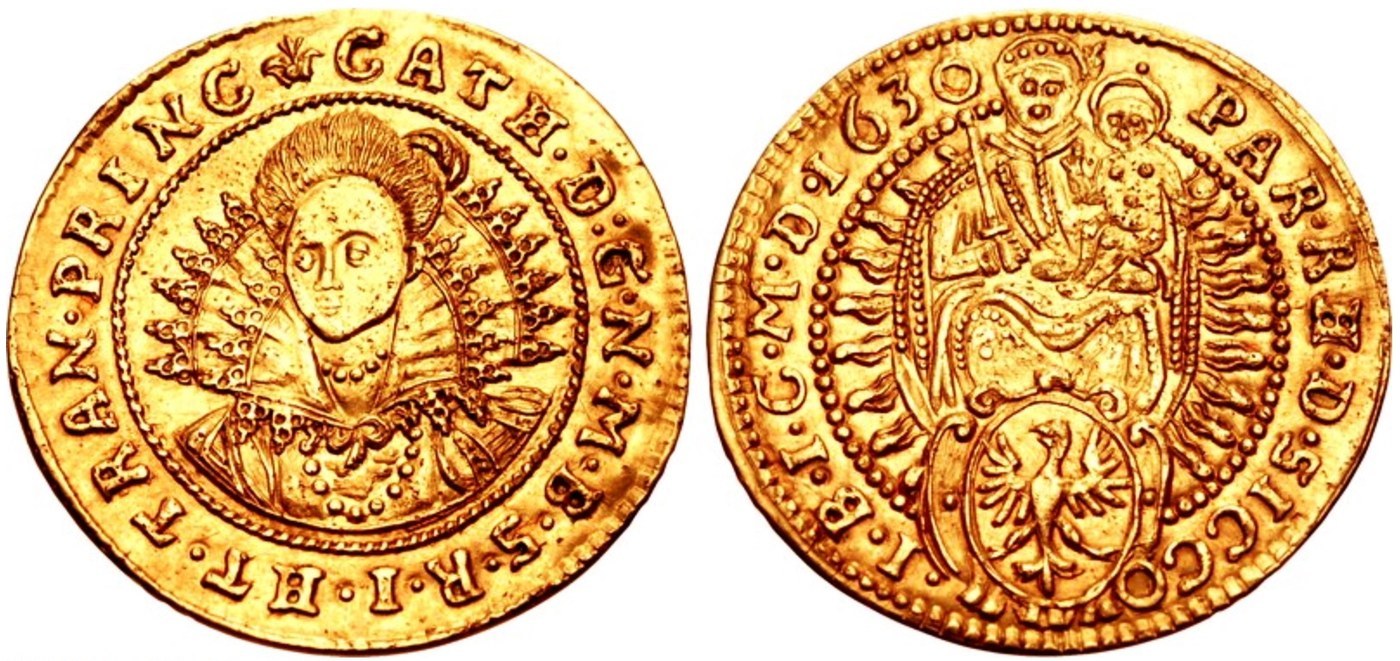
Transylvanian Ducat of Catherine of Brandenburg
Gold ducat dated 1630 of Catherine of Brandenburg, ruling Princess of Transylvania, with her portrait and a double-headed eagle and shield reverse.
- Country
- Transylvania
- Denomination
- Ducat
- Metal
- Gold
Got a coin like this?
Identify any coin from a photo, free.
Overview
This is a gold ducat dated 1630 struck in the name of Catherine of Brandenburg (Katharina von Brandenburg; Hungarian: Brandenburgi Katalin), who reigned as Princess of Transylvania after the death of her husband Gábor Bethlen. The example pictured shows her portrait with a surrounding Latin inscription on the obverse and a coat of arms bearing a double-headed eagle and a shield on the reverse.
As a ducat, the coin is a small, thin gold piece struck to the international ducat standard used across early-modern Central Europe — roughly 3.4–3.5 g of near-pure gold on a flan of about 20–22 mm. Its design follows the pattern of Transylvanian princely gold, pairing a ruler portrait with heraldry that asserts the authority of the Principality.
Coins issued in Catherine's own name are among the rarest in the Transylvanian series because her personal rule lasted barely a year. A gold ducat dated 1630 therefore documents a very short-lived reign and is prized both as a numismatic rarity and as a portrait of the only woman to rule the Principality of Transylvania in her own right.
History & Background
Catherine of Brandenburg (1602–1644) was a Hohenzollern princess, sister of the Elector George William of Brandenburg, and the second wife of Gábor Bethlen, the powerful Calvinist Prince of Transylvania. Before his death in November 1629, Bethlen arranged for the Transylvanian estates to recognize Catherine as his successor, an unusual step that made her the principality's ruling princess.
Her authority was contested almost from the start. Real power was shared with a governor, and opposition among the Transylvanian nobility — together with religious tension surrounding her leanings toward the Habsburg and Catholic camp — quickly undermined her position. Within about a year she was pushed aside, and by 1630 the estates turned to other candidates, leading ultimately to the election of George I Rákóczi as prince.
The 1630 date on this ducat places it squarely at the end of her short reign, during the turbulent transition that followed Bethlen's death. Transylvania in this period was an autonomous principality under Ottoman suzerainty, balancing between the Ottoman and Habsburg spheres, and its gold coinage — struck to the ducat standard — served both as prestige money and as a means of paying troops and subsidies.
How to Identify
The obverse carries a portrait of Catherine of Brandenburg surrounded by a Latin legend that names her and her title as Princess of Transylvania; the exact wording and abbreviations vary between dies and are often crowded against the rim. The reverse shows a coat of arms centered on a double-headed eagle with a shield, reflecting the heraldry of the Principality, with the date 1630 incorporated into the legend or fields.
Expect the fabric of a hand-struck gold ducat: a thin, bright-yellow flan of high fineness, roughly 3.4–3.5 g in weight and about 20–22 mm across, with slightly irregular edges and legends that can run off the flan. Because the metal is near-pure gold it is soft, non-magnetic, and shows warm color without the reddish or grayish tones of lower-karat alloys.
Key diagnostics are the ruler's name in the obverse legend, the 1630 date, and the double-headed eagle-and-shield reverse. Small letters, rosettes or privy marks in the fields can indicate the mint or die and help separate genuine princely strikings from later restrikes and copies.
Value & Collectibility
Gold ducats issued in the name of Catherine of Brandenburg are major rarities of the Transylvanian series, and they do not trade at a single fixed price. Because her sole reign was so brief, surviving coins in her name are few, and genuine examples are firmly in the high-value, specialist-auction bracket rather than the everyday market.
Value is driven by authenticity, strike quality, centering and preservation, and by the intrinsic gold content that underpins every ducat. Well-documented pieces with clear provenance command strong premiums, while damaged, mounted (ex-jewelry) or cleaned coins are worth considerably less. Any figure should be treated as an estimate pending in-hand examination.
Given the rarity and the long history of gold-ducat forgeries and modern restrikes, third-party authentication and a documented provenance are essential before buying or selling. Treat any inexpensive 'Catherine of Brandenburg ducat' with strong suspicion until it has been independently verified.
Frequently asked questions
Who was Catherine of Brandenburg?
Catherine of Brandenburg (1602–1644) was a Hohenzollern princess and the second wife of Gábor Bethlen, Prince of Transylvania. After his death she briefly reigned as ruling Princess of Transylvania around 1629–1630, the only woman to rule the principality in her own right.
Why is a 1630 ducat in her name significant?
Her personal rule lasted only about a year, so coins struck in her own name are scarce. A gold ducat dated 1630 documents the very end of her reign and the unstable succession that followed Bethlen's death.
What does the reverse design show?
The reverse bears a coat of arms centered on a double-headed eagle with a shield, heraldry associated with the Principality of Transylvania, together with the 1630 date. The obverse shows Catherine's portrait and her titles.
How big is the coin and what is it made of?
It is a gold ducat struck to the international standard: near-pure gold, roughly 3.4–3.5 g in weight and about 20–22 mm across, thin and soft, with the bright yellow color of high-fineness gold.
Are these coins valuable?
Yes. Genuine Transylvanian gold ducats of Catherine of Brandenburg are rare and can be highly valuable at specialist auctions, but value depends on authenticity, condition and provenance. Because forgeries exist, any example should be professionally authenticated.
Transylvanian Ducat of Catherine of Brandenburg guides
In-depth guides for identifying, valuing, and collecting Transylvanian Ducat of Catherine of Brandenburg.
Other coins you may enjoy
Gustav I Silver Coin
c. 1521–1560
Livonian Order Schilling
c. 1410–1415
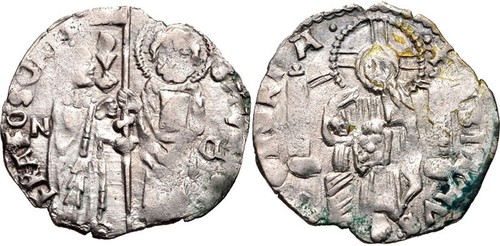
Venetian Grosso (Matapan)
c. 1193–1350s (13th–14th century)
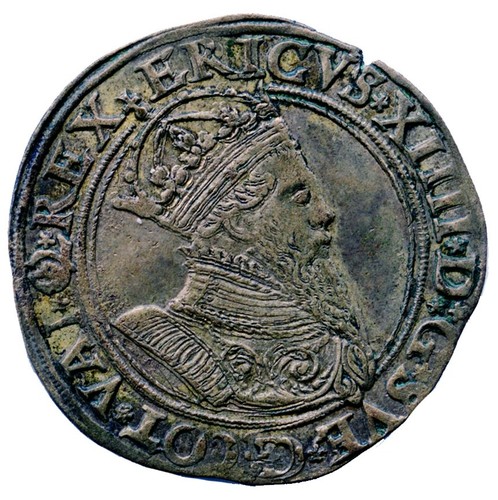
Eric XIV Silver Coin
c. 1560–1568 (this example c. 1565)
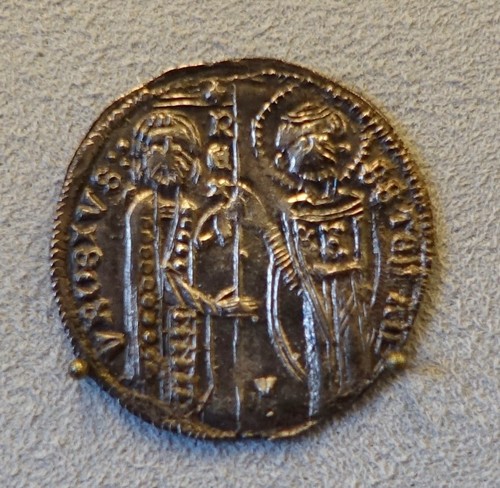
Matapan (Serbian imitation)
1243-1276
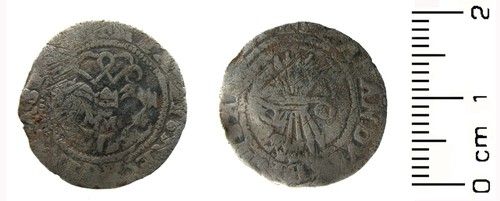
Real (Medieval)
13th–14th century
Hryvnia
Medieval (c. 11th-13th century)
Byzantine Follis
641 AD
Akçe
Late 14th-Early 15th century
Venetian Ducat
Medieval (c. 1284 onward)
Denier of Charles the Bald
c. 840–877
Denier of Charlemagne
c. 790–814 AD