
How to Identify the Venetian Grosso (Matapan)
Diagnostics for the medieval Venetian silver Grosso: the Doge-and-St.-Mark scene, enthroned Christ, size, legends, and common look-alikes.
Read the full Venetian Grosso (Matapan) encyclopedia entry →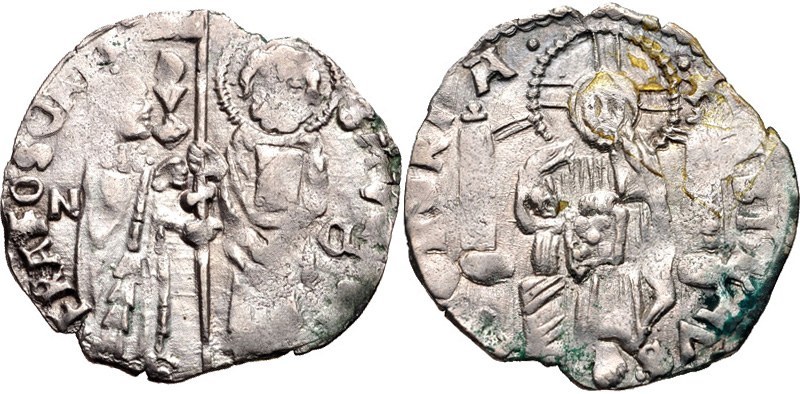
Start with size and metal. A genuine Grosso is a small, thin silver coin about 20–22 mm across and near 2 grams, usually in high-fineness silver with a bright or gently toned look. The flan is often slightly cup-shaped (scyphate tendency), a hallmark of its Byzantine-influenced manufacture. A thick, heavy, or brassy piece is not a classic Grosso.
Read the two-figure side first. You should see two standing figures facing each other: the Doge on the viewer's left holding a long staff or banner, and Saint Mark on the right handing it over. A vertical line of lettering runs between them, and the outer legend names the Doge on his side and S · M · VENETI on the saint's side. This scene is the single most diagnostic feature.
Check the other side for an enthroned Christ — seated, facing forward, holding a book, with abbreviated sacred lettering such as IC XC in the fields. Together, the Doge/Saint-Mark scene and the seated Christ confirm the type; either one alone with the wrong companion image suggests a different coin.
Attribute the Doge by the legend, not the picture. Because the design barely changes across reigns, the ruler's name in the Latin inscription is what dates the coin. Poor centering or wear that erases the legend makes precise attribution difficult and lowers value.
Be cautious about look-alikes and fakes. Adriatic and Aegean imitations copied the type in baser silver or lighter weight, and cast or tooled forgeries exist. Warning signs include soft, mushy detail, seams on the edge, incorrect weight, non-silver color, and lettering that doesn't resolve into real Latin. For a costly attribution or a scarce Doge, seek confirmation from a specialist in medieval coinage.
Frequently asked questions
What size and weight should a genuine Grosso be?
Expect roughly 20–22 mm in diameter and about 2 grams in high-fineness silver, often on a slightly dished flan. Pieces far outside this range, or non-silver in color, warrant suspicion.
Which side is the obverse?
Conventionally the Doge-and-Saint-Mark scene is treated as the obverse and the enthroned Christ as the reverse, but collectors describe both by their imagery since the design is standardized.
How can I spot a fake or imitation?
Watch for wrong weight, base-metal or brassy color, casting seams, mushy or tooled detail, and garbled legends. Contemporary Balkan and Aegean imitations exist and are usually lighter or less pure than Venetian originals.
Do I need to read the legend to identify it?
To confirm the type, no — the two standing figures plus enthroned Christ are enough. To attribute it to a specific Doge and date it, yes, you must read the Latin legend beside the Doge.