
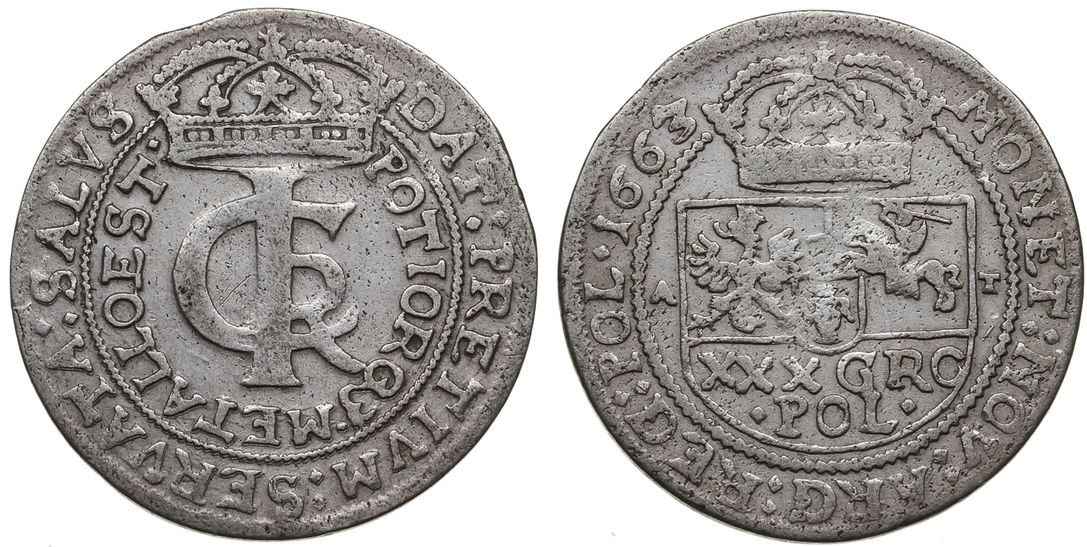
Tymf
A debased Polish silver coin of 1663 tariffed at 30 groszy, famous for a Latin motto declaring the state's safety worth more than the metal.
- Country
- Poland
- Denomination
- Tymf
- Metal
- Silver
Got a coin like this?
Identify any coin from a photo, free.
Overview
The Tymf is a Polish silver coin issued in 1663 under King John II Casimir, tariffed to circulate as 30 groszy (one zloty) even though its actual silver content was worth considerably less. Because of this deliberate gap between face value and intrinsic value, it is one of the most historically notorious coins of the old Polish-Lithuanian Commonwealth.
The piece takes its name from Andreas Tymf (Andrzej Tymf), the mint lessee associated with its production. In everyday use it was also called a zlotowka, since it was meant to pass for one zloty of thirty groszy. Its most striking feature is the Latin inscription on the reverse, which openly frames the coin's worth in terms of saving the state rather than the value of its metal.
For collectors, the Tymf is prized as a large, historically loaded piece of seventeenth-century Polish coinage. It sits at the crossroads of numismatics and economic history, remembered as an early example of a state issuing overvalued fiduciary money to fund itself during crisis.
History & Background
The Tymf was struck in 1663, in the difficult period following the Swedish invasion known as the Deluge, when the Commonwealth's treasury was exhausted and the crown owed heavy back-pay to its soldiers. To raise funds, the government authorized coins whose declared value ran well ahead of their silver content, effectively borrowing against the difference.
Ordered to pass for thirty groszy, the Tymf actually contained silver worth only around a third to a half of that nominal value, so each coin represented a forced loan from whoever held it. The reverse motto, often rendered as the idea that the saved welfare of the fatherland is worth more than the metal, was an attempt to justify this overvaluation as a patriotic sacrifice.
Contemporaries were not fooled for long, and the name Tymf became a byword for debased or deceptive money. The episode is a classic case study in early modern monetary manipulation, and it is a large part of why the coin remains famous with historians and collectors today.
How to Identify
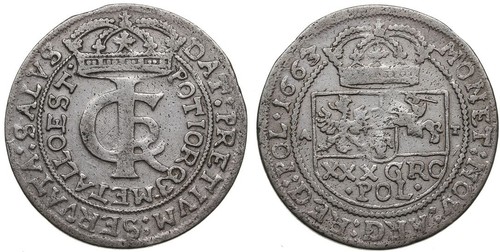
The observed 1663 coin shows a crown with decorative heraldic elements on the obverse, associated with the crowned royal monogram of John II Casimir. The reverse displays the eagle (Orzel) and coat of arms together with a Latin inscription, the coin's signature feature, arranged around the central heraldic device.
The reverse legend is the key diagnostic: it is a Latin motto expressing that the preserved safety of the state is worth more than the metal, a wording unique to this issue. The date 1663 and the crowned arms of the Commonwealth, combined with the stated tariff tied to thirty groszy, confirm the type.
The Tymf is a broad, thin silver coin rather than a heavy crown, reflecting its deliberately reduced silver content. Genuine strikes show period-correct lettering, the crowned monogram on the obverse, and the eagle with heraldic shield on the reverse; the distinctive motto and the 1663 date distinguish it from ordinary groszy and higher-grade Polish silver of the era.
Value & Collectibility
As a famous and historically significant type, the Tymf enjoys steady collector demand. Genuine examples in circulated condition typically trade in the tens to low hundreds of dollars, with well-struck, sharply detailed, and problem-free pieces bringing higher premiums because of the coin's fame and its relatively low original silver content.
Condition and originality drive most of the price. These coins were struck on broad, thin flans and saw hard use, so many survivors are weakly struck, worn, or damaged; a coin with clear legends, a legible motto, and undisturbed surfaces is worth clearly more than a tired or cleaned example.
Exact prices vary with grade, market conditions, and the specific variety, so treat these as general ranges rather than fixed quotes. Because the type is well known, it is also imitated, and cleaned, tooled, or counterfeit pieces trade far below genuine problem-free coins.
Frequently asked questions
What is a Tymf coin?
It is a Polish silver coin of 1663 tariffed to pass for 30 groszy (one zloty), even though its silver content was worth much less. It is named after the mint lessee Andreas Tymf.
Why is the Tymf famous?
Because its face value was deliberately set far above its metal value to fund the state, making it an early example of overvalued fiduciary money. Its name became a byword for debased coinage.
What does the inscription mean?
The Latin reverse motto expresses the idea that the preserved safety of the fatherland is worth more than the metal, framing the coin's overvaluation as a patriotic sacrifice.
Is the Tymf real silver?
Yes, but of reduced fineness. It is a genuine silver coin struck on a broad, thin flan with less silver than its 30-groszy tariff implied, which is the whole point of its history.
Who was king when it was issued?
The 1663 Tymf was issued under John II Casimir Vasa, the last Vasa king of the Polish-Lithuanian Commonwealth, whose crowned monogram appears on the obverse.
Tymf guides
In-depth guides for identifying, valuing, and collecting Tymf.
Other coins you may enjoy
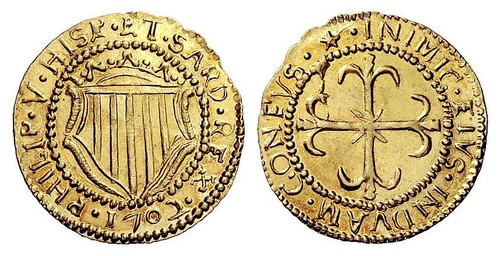
Scudo (Philip V)
c. 1701–1708
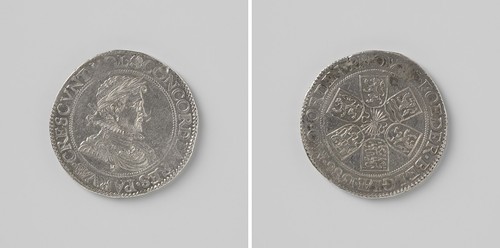
Rijksdaalder van Leicester
1580s-1590s
Kopek (Peter I)
c. 1704–1718 (observed 1711)
Imperial Chervonets
1762
Prinsendaalder (Rijksdaalder)
1592
10 Para
AH 1280 (1863-1864 CE)
Halve Rijksdaalder van Leicester
1580s-1590s
Gouden Dukaat
1724
Escudo (Joanna and Charles V, contemporary copy)
1516-1558
Duit (VOC)
1790
4 Escudos
1780s
Speciedaler
1628