
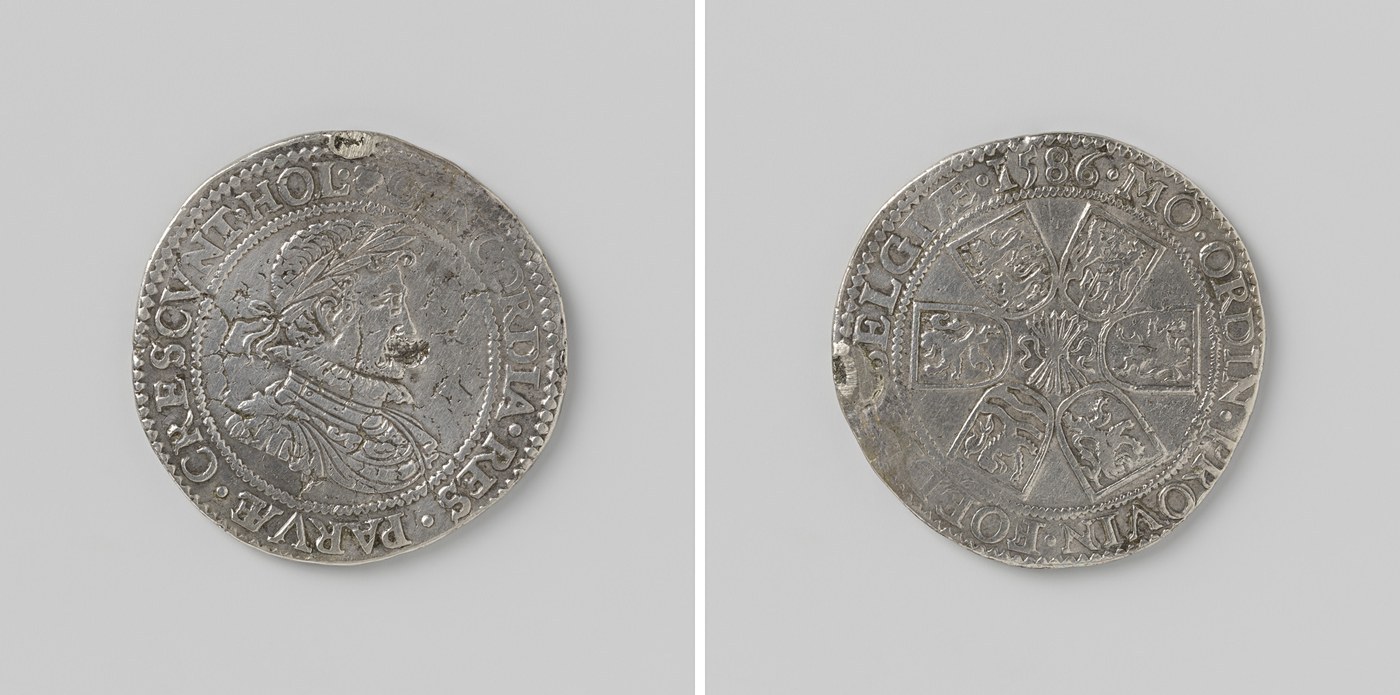
Halve Rijksdaalder van Leicester
Silver half rijksdaalder of the Leicester type, struck in the rebelling Dutch provinces, showing an armored bust and a split provincial shield.
- Country
- Netherlands
- Denomination
- Half Rijksdaalder
- Metal
- Silver
Got a coin like this?
Identify any coin from a photo, free.
Overview
The Halve Rijksdaalder van Leicester is a silver coin of the northern Netherlands struck to the standard associated with Robert Dudley, Earl of Leicester, who served as Governor-General of the United Provinces during the revolt against Spain. It is the half denomination of the rijksdaalder, the large trade coin introduced under the coinage reform of that period.
The design pairs a helmeted, armored bust facing right on the obverse with a split heraldic shield surrounded by decorative elements on the reverse. This military portrait, rather than a royal or religious image, reflects the coin's origin in a province at war and asserting its own authority to strike money.
As a half rijksdaalder it is a mid-to-large silver piece, smaller and lighter than the full rijksdaalder but struck in the same style. It is collected today as a tangible artifact of the Dutch struggle for independence and of the birth of one of the most important trade-coin systems in early modern Europe.
History & Background
In the mid-1580s the rebelling provinces of the northern Netherlands were fighting the Spanish crown and looked to England for support. Queen Elizabeth I sent Robert Dudley, Earl of Leicester, who was accepted as Governor-General of the United Provinces in 1586. During his governorship a coinage ordinance sought to bring order to the many provincial issues by standardizing a large silver coin, the rijksdaalder, and its fractions.
The rijksdaalder and its halves and quarters became widely accepted money of account and trade. Even after Leicester's short and troubled tenure ended in 1587, coins of this type and standard continued to be struck through the following years across several provincial mints, which is why examples carry dates spanning the 1580s and 1590s.
The broader rijksdaalder tradition it launched proved long-lived: the Dutch rijksdaalder and its descendants circulated for centuries and influenced trade coinage far beyond Europe. The Leicester-type half is remembered as an early link in that chain and as a coin tied directly to the formative years of the Dutch Republic.
How to Identify
The obverse shows a helmeted, armored bust facing right, a martial figure rather than a crowned monarch, typically surrounded by a Latin legend naming the authority of the provincial estates and the province of issue. The armored, half-length or bust portrait is the hallmark of the Leicester-standard rijksdaalder family.
The reverse carries a heraldic shield, often shown split or quartered, decorated with surrounding ornament and framed by a legend. On the full and half rijksdaalders the arms and legends identify the issuing province and the coin's role as money of the united estates. Because these were struck at several provincial mints, small mint marks or symbols and the exact heraldry vary from coin to coin.
This is a struck silver coin of substantial size; as a half rijksdaalder it is smaller and lighter than the crown-sized full rijksdaalder while sharing its designs and legends. Key identifiers are the armored right-facing bust, the split decorated shield, the Latin provincial legends, and the true silver fabric. Dates in the 1580s to 1590s and provincial arms rather than a national emblem confirm the early United Provinces origin.
Value & Collectibility
As a genuine sixteenth-century Dutch silver coin, the Leicester-type half rijksdaalder carries both historical and precious-metal value. Well-worn but honest examples typically trade in the low-to-mid hundreds of dollars, while sharply struck, well-centered, and problem-free pieces command higher premiums as scarce early United Provinces silver.
Condition, centering, and completeness of the legends drive most of the price spread. Hammered coins of this era are often weakly struck or slightly off-center, so examples with a clear armored portrait, full shield detail, and readable inscriptions are worth clearly more than crude, corroded, or clipped pieces. Original, uncleaned surfaces with even toning are especially valued.
Prices vary widely with grade, province, date, and the market, so treat these as broad ranges rather than fixed quotes. Cleaned, holed, or damaged coins and modern fakes trade well below sound genuine examples, and rare province-and-date combinations can bring substantially more.
Frequently asked questions
Who was Leicester and why is the coin named after him?
Robert Dudley, Earl of Leicester, was Elizabeth I's appointee as Governor-General of the United Provinces in 1586. A coinage reform during his governorship set the standard for the rijksdaalder, so coins of that type carry his name.
Is the Halve Rijksdaalder van Leicester real silver?
Yes. It is a genuine struck silver coin of the late sixteenth century, the half denomination of the large silver rijksdaalder, so it has real precious-metal content in addition to collector value.
What is shown on the coin?
The obverse shows a helmeted, armored bust facing right, and the reverse shows a split, decorated heraldic shield with Latin legends naming the issuing province and the authority of the estates.
Why do examples have different dates and details?
Coins of this type and standard were struck at several provincial mints over a span of years in the 1580s and 1590s, so dates, mint marks, and exact heraldry differ from coin to coin.
Is it valuable?
It is a scarce and historic early Dutch silver type. Worn examples are modestly priced for such an old coin, while sharp, original pieces bring notable premiums. Value depends on grade, province, date, and eye appeal.
Halve Rijksdaalder van Leicester guides
In-depth guides for identifying, valuing, and collecting Halve Rijksdaalder van Leicester.
Other coins you may enjoy
Scudo (Philip V)
c. 1701–1708
Rijksdaalder van Leicester
1580s-1590s
Kopek (Peter I)
c. 1704–1718 (observed 1711)
Imperial Chervonets
1762
Prinsendaalder (Rijksdaalder)
1592
10 Para
AH 1280 (1863-1864 CE)
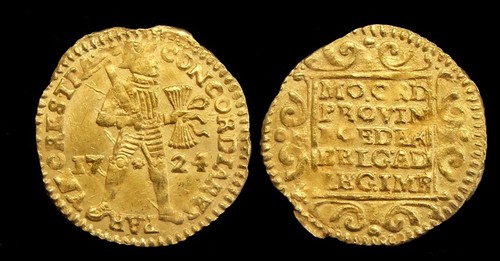
Gouden Dukaat
1724
Escudo (Joanna and Charles V, contemporary copy)
1516-1558
Duit (VOC)
1790
4 Escudos
1780s
Tymf
1663
Speciedaler
1628