
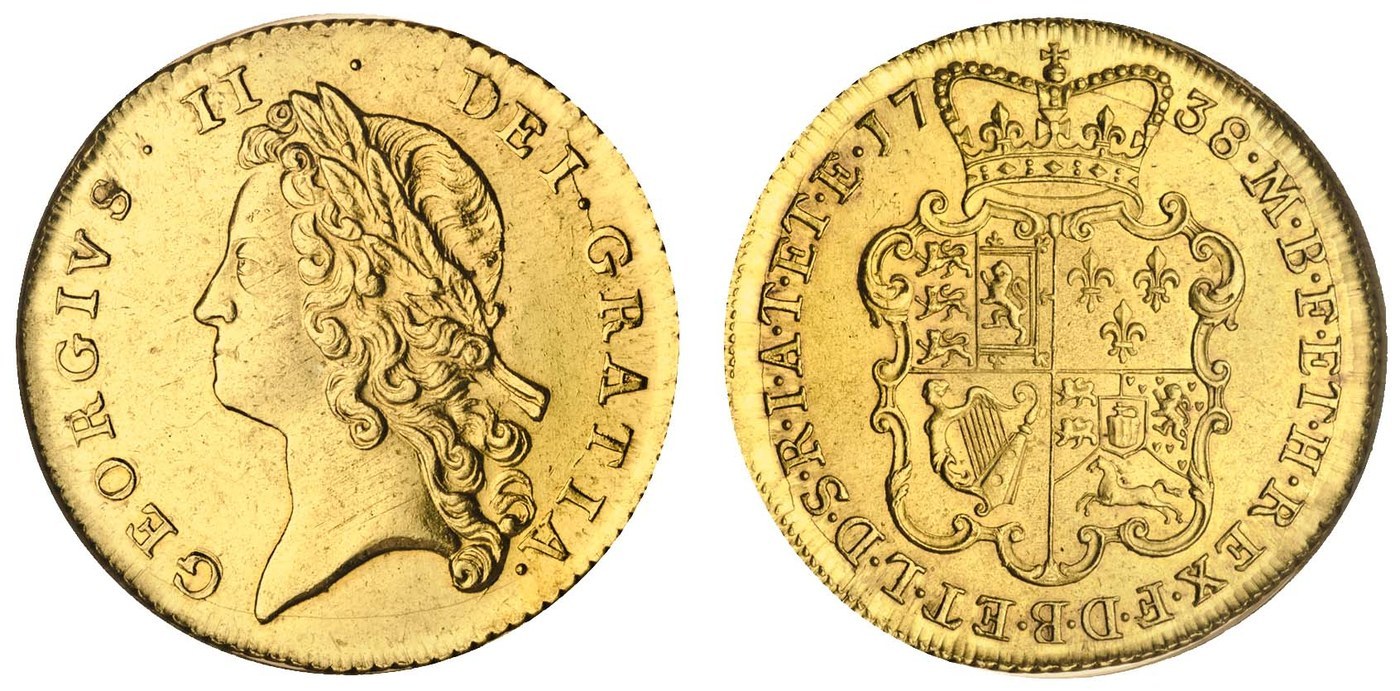
Two Guineas of George II
A large milled gold two-guinea piece of George II, with his left-facing laureate head and a crowned garnished shield of the royal arms; the pictured coin is dated 1738.
- Country
- England
- Denomination
- Two Guineas
- Metal
- Gold
Got a coin like this?
Identify any coin from a photo, free.
Overview
The Two Guineas of George II is a large milled gold coin of Great Britain, worth two guineas or nominally forty-two shillings. The photographed example shows the king's laureate head facing left on the obverse and a single crowned, ornately garnished shield bearing the royal arms on the reverse, and is dated 1738. It is one of the higher gold denominations of the reign, sitting between the guinea and the five guineas.
Struck at the Royal Mint in the Tower of London, the two-guinea piece was a substantial gold coin intended for large payments rather than everyday use. Its heavy gold content and bold portrait make it one of the more imposing circulating coins of the mid-eighteenth century, and surviving pieces are prized by collectors of milled British gold.
Because it was a high-value coin issued only in certain years, the two guineas of George II was never a common coin in circulation and is scarcer today than the smaller guinea. The 1738 date seen on this piece belongs to the earlier "young head" portrait period of the denomination.
History & Background
George II reigned from 1727 to 1760, and his gold coinage was produced under the pre-decimal system in which the guinea and its multiples were the principal gold denominations. The two-guinea piece was struck only in a limited number of years during his reign, making it one of the less frequently issued gold coins of the period. The gold used for some issues came from particular sources, and certain guineas and multiples of the reign carry marks such as EIC or LIMA reflecting their origin, though these do not appear on every date.
The denomination continued the earlier tradition of large gold coins that had been established under William III and the later Stuart and early Hanoverian kings. As with the guinea and five guineas, the two guineas was valued in shillings and its worth in relation to silver fluctuated with the price of gold before the values were later fixed. A guinea was long reckoned at twenty-one shillings, so two guineas represented forty-two shillings, a very large sum in the mid-1700s.
High-value gold coins like this circulated mainly among merchants, banks, and the wealthy, and many were later melted when gold prices or coinage reforms made them worth more as bullion. This attrition, combined with the limited years of issue, is why the two guineas of George II survives in relatively small numbers compared with contemporary silver.
How to Identify
The obverse shows the laureate head of George II facing left, encircled by a Latin legend giving his name and titles. On the pictured 1738 coin this is the earlier "young head" portrait; later two-guinea issues of the reign used revised, older portraits, so the style of the bust together with the date helps place the coin within the series.
The reverse displays a single large crowned shield of the royal arms with elaborate ornamental garniture around it. The shield is quartered with the arms of England and Scotland, France, Ireland, and Hanover, reflecting the Hanoverian monarchy, and is surrounded by a Latin reverse legend and the date. This single-shield reverse distinguishes George II gold from the cruciform four-shield reverses used on some earlier and later reigns' coinage.
The coin is struck in gold and is physically large and heavy, roughly in the region of a five-shilling silver crown in diameter but noticeably denser because of the gold. The edge is milled. Because the two guineas, guinea, and five guineas of George II share the same basic obverse portrait and shield reverse, the denomination must be confirmed by measuring the diameter and weight rather than by design alone.
Value & Collectibility
As a scarce high-denomination milled gold coin, the two guineas of George II is a valuable collector item worth well beyond its bullion gold content in any collectable grade. Even worn examples command significant sums, and prices rise sharply with condition, sharpness of the portrait and shield, and the desirability of the particular date and portrait type.
Value is driven by year, portrait variety, and preservation. Some dates and varieties in the George II two-guinea series are considerably scarcer than others, and an original, problem-free coin with good surfaces will far outperform a bent, mounted, or heavily worn piece. Coins that have been used as jewellery or cleaned are worth less.
Because these are high-value gold coins, they are targets for forgery and for altered dates, so any example should be authenticated and, ideally, independently graded. Treat any single figure as broad context only and rely on recent auction results for comparable dates and grades to gauge a realistic value.
Frequently asked questions
What is a two guineas of George II?
It is a large milled gold coin of Great Britain worth two guineas, or nominally forty-two shillings, struck during the reign of George II. It shows his laureate head facing left and a crowned garnished shield of the royal arms, as on the pictured 1738 example.
How much was two guineas worth?
A guinea was long reckoned at twenty-one shillings, so two guineas equalled forty-two shillings. This was a very large sum in the mid-eighteenth century, so the coin was used for major payments rather than everyday spending.
Is the 1738 two guineas rare?
The two guineas was struck in only a limited number of years and was never common, so it is scarcer than the guinea. Exact survival varies by date, but all George II two-guinea pieces are considered collectable and comparatively scarce today.
What is on the reverse?
A single large crowned shield of the royal arms with ornamental garniture, quartered with the arms of England and Scotland, France, Ireland, and Hanover, surrounded by a Latin legend and the date.
How is it different from a guinea or five guineas?
The two guineas, guinea, and five guineas of George II share the same portrait and shield reverse but differ in size and weight. The denomination is confirmed by measuring diameter and weight, since the two guineas sits between the smaller guinea and the larger five guineas.
Two Guineas of George II guides
In-depth guides for identifying, valuing, and collecting Two Guineas of George II.
Other coins you may enjoy
Spade Guinea
1760-1820
Shilling of Victoria
1838-1901
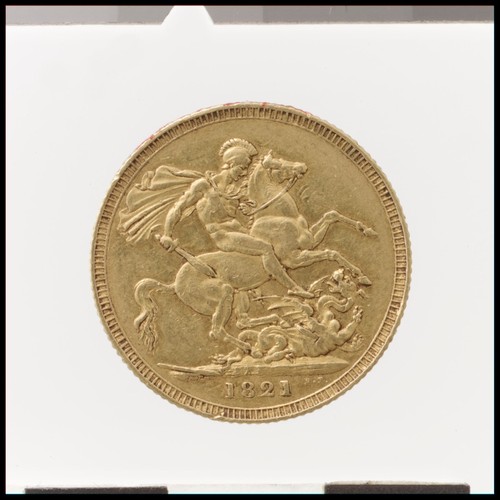
Sovereign of George IV
1821-1830
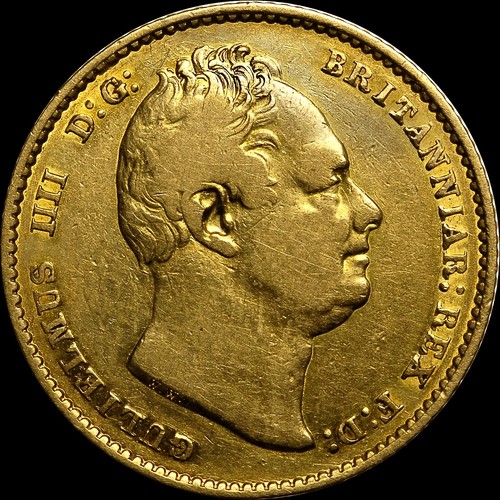
Sovereign of William IV
1831–1837
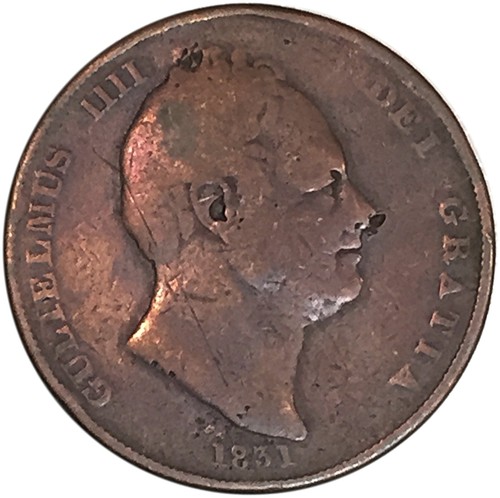
Penny of William IV
1831-1837
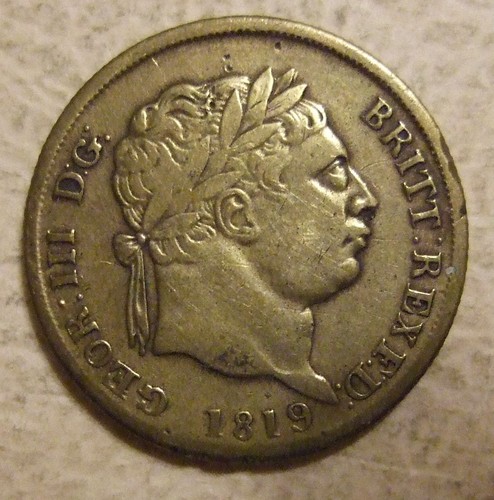
Shilling of George III
1816-1820
Milled Sixpence of Elizabeth I
1561-1571
Shilling of George II
1727-1758
Shilling of Anne
1702-1714
Charles II Twopence
1660-1685
Charles II Half Crown
1660–1685
Irish Halfpenny of Charles II
1680–1684