
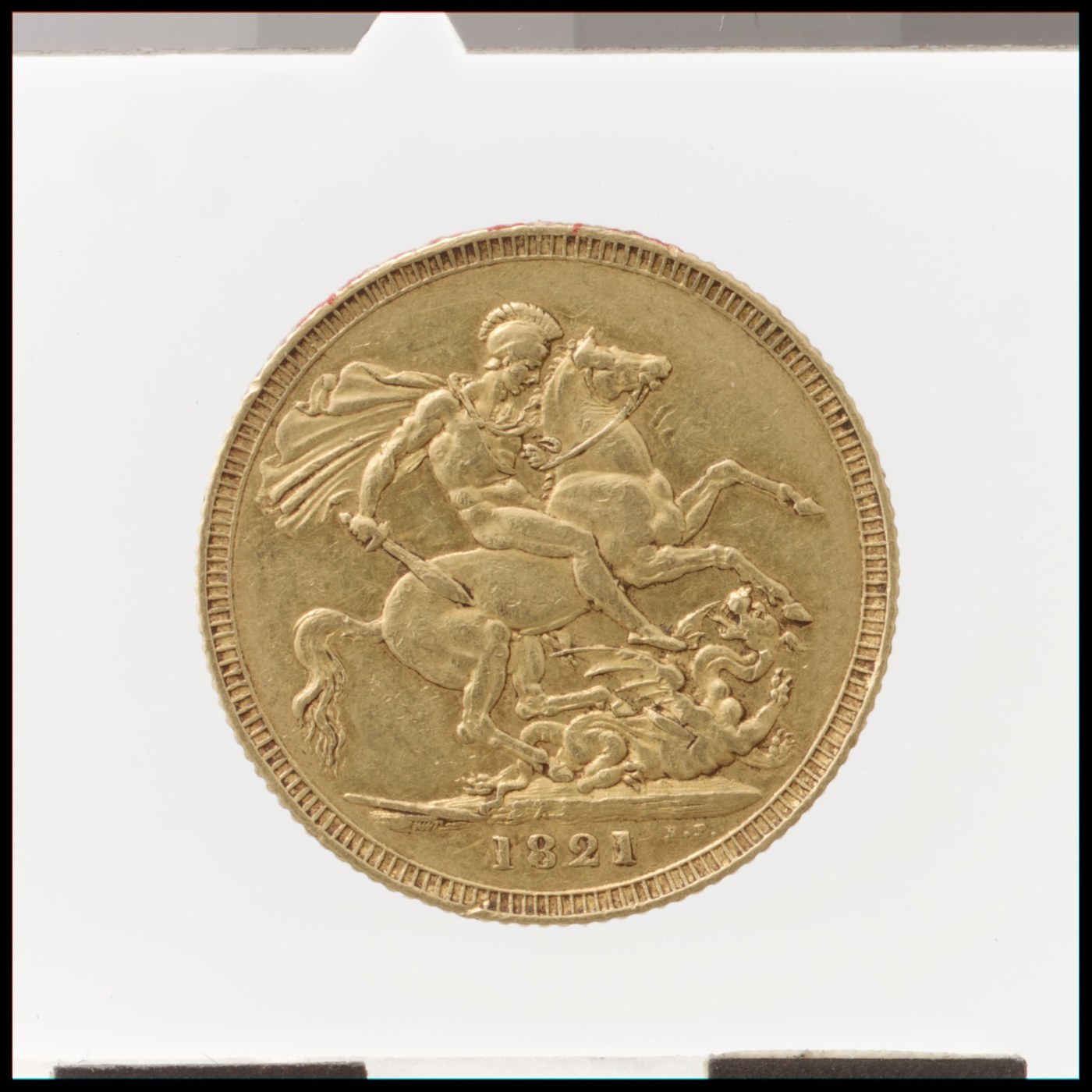
Sovereign of George IV
A milled gold sovereign of Great Britain struck under George IV, with the king's laureate head and Pistrucci's St George slaying the dragon reverse, dated 1821.
- Country
- Great Britain
- Denomination
- Sovereign
- Metal
- Gold
Got a coin like this?
Identify any coin from a photo, free.
Overview
This is a gold sovereign struck during the reign of George IV, whose sovereign coinage runs from 1821 to 1830. The photographed coin shows the king's bare, laureate head in profile facing left on the obverse, with the Latin legend giving his name and titles. The reverse carries Benedetto Pistrucci's celebrated design of St George on horseback slaying a dragon, and is dated 1821.
The sovereign was the standard gold coin of the reformed British currency introduced after the great recoinage of 1816-17, valued at one pound or twenty shillings. Struck by machine at the Royal Mint, it shows the regular, well-centred flan and even lettering of the milled series.
The 1821 date places this coin at the very start of George IV's sovereign issues, the first year the denomination was struck in his name. Early George IV sovereigns of this type pair the laureate head with the St George reverse; a later portrait and a shield reverse were introduced toward the end of the reign, so the exact type should be read from the individual coin.
History & Background
The gold sovereign was reintroduced under George III in 1817 as the centrepiece of Britain's reformed coinage, replacing the older guinea and fixing the principal gold coin at a value of one pound. When George III died in 1820 the design passed to his successor, and the first sovereigns bearing the head of George IV were struck in 1821.
The reverse of these early George IV sovereigns is the work of the Italian engraver Benedetto Pistrucci, whose depiction of St George on horseback slaying the dragon had first appeared on the sovereign in 1817. The image, drawn from classical models, became one of the most enduring designs in British coinage and has returned to the sovereign many times since. The obverse of the 1821 issue shows the king's laureate head, a portrait also modelled by Pistrucci.
George IV reigned from 1820 to 1830, and his sovereigns span 1821 to 1830. Partway through the reign the coinage was revised: a new bare head portrait replaced the laureate head, and a crowned heraldic shield replaced the St George reverse on the sovereign. The 1821 coin therefore belongs to the earlier laureate-head, St George type that opened the reign.
How to Identify
The obverse shows the laureate head of George IV in profile facing left, with a Latin legend giving his name and titles beginning GEORGIUS IIII. Reading the legend and confirming the regnal name is the surest way to place the coin in this reign rather than that of George III or the Williams and Victorias that followed.
The reverse carries Pistrucci's St George on horseback, spear or sword in hand, slaying a dragon beneath the horse, with the date in the exergue below. On this coin that date reads 1821. The presence of the St George reverse, rather than a crowned shield, marks it as the earlier type of the reign; the shield reverse belongs to the later bare-head sovereigns of the same king.
As a gold coin the sovereign has the warm yellow tone and heft of high-purity gold, and as a milled piece it shows regular machine-struck lettering and a well-formed edge. The sovereign is a small coin, close in size to the guinea it replaced; measuring the diameter and weight and comparing them to published specifications is more reliable than judging by eye, and helps separate the full sovereign from the smaller half sovereign.
Value & Collectibility
As a gold coin of the early nineteenth century, a George IV sovereign carries both bullion value from its gold content and a collector premium tied to its age, design, and condition. Even a worn example is a substantial gold piece worth well above contemporary silver and copper coins.
The first-year 1821 date and the popular Pistrucci St George reverse make this type attractive to collectors, so it typically trades at a numismatic premium over its gold value. Condition is the main driver of price: circulated examples carry a modest markup over bullion, while sharp, well-preserved coins and scarcer dates within the reign can command considerably more. Mounting, damage, or cleaning reduce value.
Because gold sovereigns are valuable and have long been imitated, and because grade strongly affects price, any example of significance should be weighed, measured, and ideally examined by a specialist or submitted for professional grading. Treat any single figure as broad context and rely on recent auction results for comparable dates and grades for a realistic estimate.
Frequently asked questions
What is a sovereign of George IV?
It is a British gold coin valued at one pound, struck during the reign of George IV (sovereigns 1821-1830). The 1821 example shows the king's laureate head on the obverse and Pistrucci's St George slaying the dragon on the reverse.
Is it made of real gold?
Yes. The sovereign was struck in high-purity gold as the standard one-pound gold coin of Britain, so it carries both bullion and collector value.
Who designed the St George and dragon reverse?
The St George on horseback slaying the dragon was designed by the Italian engraver Benedetto Pistrucci. It first appeared on the sovereign in 1817 and remains one of the most famous designs in British coinage.
Why is the 1821 date significant?
1821 was the first year sovereigns were struck in the name of George IV, following his accession in 1820. It opens the laureate-head, St George reverse type of his reign.
Are George IV sovereigns valuable?
They are, both as gold and as historic coins. Value depends on the date and condition; circulated examples carry a modest premium over gold, while well-preserved coins and scarcer dates are worth considerably more.
Sovereign of George IV guides
In-depth guides for identifying, valuing, and collecting Sovereign of George IV.
Other coins you may enjoy
Spade Guinea
1760-1820
Two Guineas of George II
1738–1753
Shilling of Victoria
1838-1901
Sovereign of William IV
1831–1837
Penny of William IV
1831-1837
Shilling of George III
1816-1820
Milled Sixpence of Elizabeth I
1561-1571
Shilling of George II
1727-1758
Shilling of Anne
1702-1714
Charles II Twopence
1660-1685
Charles II Half Crown
1660–1685
Irish Halfpenny of Charles II
1680–1684