
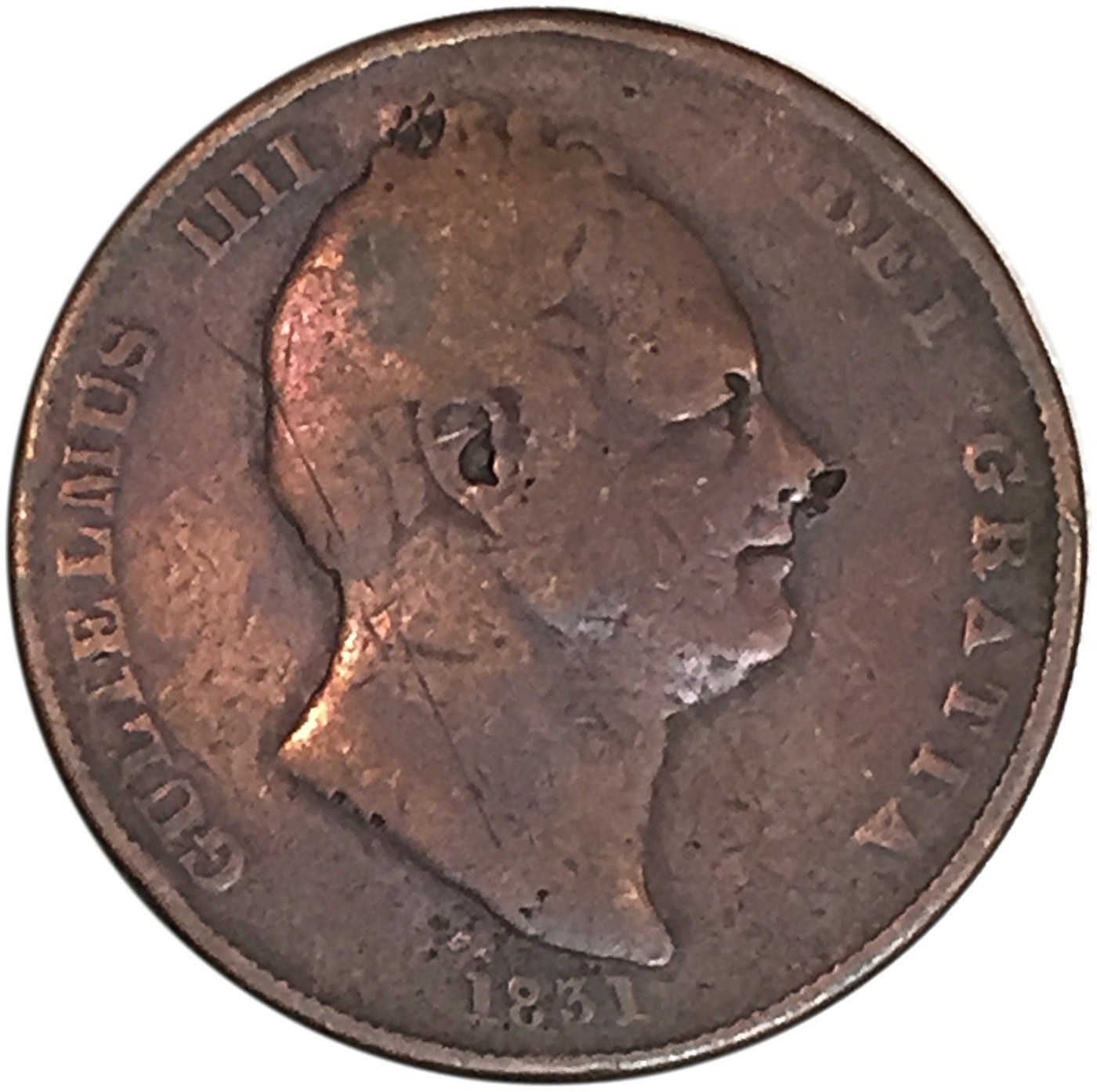
Penny of William IV
A large copper penny of King William IV, struck in the 1830s, with the king's right-facing head and the Latin legend GULIELMUS IIII D:G.
- Country
- Great Britain
- Denomination
- 1 Penny
- Metal
- Copper
Got a coin like this?
Identify any coin from a photo, free.
Overview
The Penny of William IV is a large copper penny of the British milled series, struck during the short reign of King William IV in the 1830s. The photographed coin shows the standard obverse: the bare head of the king facing right, with the Latin legend GULIELMUS IIII D:G ('William the Fourth, by the Grace of God') running around the rim, and the date 1831 below the truncation of the neck. The reverse, not visible in this photograph, carries the seated figure of Britannia that was standard on British copper pennies of the period.
This is a substantial coin. Like the George IV and early Victorian copper pennies around it, it is a broad, heavy piece struck in pure copper, considerably larger than the bronze pennies that replaced the copper coinage in 1860. In the hand it feels weighty and warm-toned, and circulated examples typically show the mellow brown surfaces characteristic of old copper.
Because William IV reigned only from 1830 to 1837, the copper penny in his name was struck in just a few years, making it a compact and clearly defined type. The 1831 date seen on the photographed coin is one of the principal issue years.
History & Background
William IV came to the throne in 1830 on the death of his brother George IV and reigned until his own death in 1837, when he was succeeded by his niece Victoria. His copper coinage continued the format established under George IV, with the same denominations and the familiar seated Britannia reverse, but carried a new royal portrait and the legend GULIELMUS IIII D:G naming the new king.
The portrait of William IV was engraved by William Wyon of the Royal Mint, which by this period was operating from its purpose-built premises on Tower Hill in London with steam-powered machinery descended from the earlier Soho experiments. Copper pennies in the king's name were produced in only a handful of years during the short reign, so the series is far smaller than the long Victorian copper and bronze runs that followed.
The copper penny of William IV belongs to the last generation of large British copper pennies. Within a few decades of his reign the heavy copper coinage was withdrawn and replaced from 1860 by the smaller, more durable bronze penny, so coins of this type represent an older tradition of hefty pure-copper small change.
How to Identify
The clearest identifier is the obverse legend. A William IV penny reads GULIELMUS IIII D:G around a bare head of the king facing right, with the date below the neck — on the photographed coin, 1831. 'Gulielmus' is the Latin for William, and the four strokes 'IIII' (rather than the modern 'IV') confirm the fourth king of that name. If the legend instead names GEORGIUS or VICTORIA, the coin is a different reign.
The reverse, though not shown here, should carry a seated Britannia facing right with a shield and trident and the word BRITANNIA, the standard copper-penny reverse of the era. Size and metal help confirm the denomination: this is a large copper penny roughly 34 mm across, distinctly bigger and heavier than a modern penny and struck in solid copper rather than bronze, so genuine circulated pieces show brown to dark-brown surfaces.
Because the head faces right and the coin is pure copper with a broad, worn rim, it is easily distinguished from later Victorian bronze pennies, which are smaller, lighter and darker. Confirm the reign from the GULIELMUS legend rather than from the portrait alone, since worn heads of successive monarchs can look similar at a glance.
Value & Collectibility
Copper pennies of William IV were struck in only a few years, so the type is scarcer than the abundant Victorian coppers, but it is a recognised collector coin rather than a great rarity, and worn examples are obtainable. Condition is the main driver of value: heavily circulated coins with flat rims and soft detail sit at the modest end, while pieces that retain sharp legends, a clear Britannia and original surfaces command a strong premium.
As with all copper, colour and surface quality matter as much as sharpness. Coins keeping smooth, glossy brown surfaces or traces of original mint colour are far scarcer than typical dull-brown circulated pieces, while cleaning, verdigris, edge knocks and corrosion all reduce desirability.
Because values vary widely by date and grade, compare recent sales of a William IV penny in similar condition rather than relying on a single figure. An accurate grade and confirmation of the exact date will give the most reliable guide to what a particular coin is worth.
Frequently asked questions
What does GULIELMUS IIII D:G mean?
It is Latin: 'Gulielmus' means William, 'IIII' is the numeral four, and 'D:G' abbreviates Dei Gratia, 'by the Grace of God.' Together the legend names King William the Fourth.
What years was the William IV penny struck?
William IV reigned from 1830 to 1837, and the copper penny in his name was struck in only a few of those years. The photographed coin is dated 1831, one of the main issue years.
What is the coin made of?
It is solid copper, part of the last generation of large British copper pennies. From 1860 the copper penny was replaced by a smaller, lighter bronze penny.
How big is a William IV penny?
It is a large penny about 34 mm across, noticeably broader and heavier than a modern penny and than the later Victorian bronze pennies.
Is the William IV penny rare?
It was struck in only a few years, so it is scarcer than the common Victorian coppers, but it is a collectable type rather than a great rarity. High-grade or original-colour examples are much harder to find.
Penny of William IV guides
In-depth guides for identifying, valuing, and collecting Penny of William IV.
Other coins you may enjoy
Spade Guinea
1760-1820
Two Guineas of George II
1738–1753
Shilling of Victoria
1838-1901
Sovereign of George IV
1821-1830
Sovereign of William IV
1831–1837
Shilling of George III
1816-1820
Milled Sixpence of Elizabeth I
1561-1571
Shilling of George II
1727-1758
Shilling of Anne
1702-1714
Charles II Twopence
1660-1685
Charles II Half Crown
1660–1685
Irish Halfpenny of Charles II
1680–1684