
How to Identify the Penny of William IV
A collector's guide to spotting a William IV copper penny by its GULIELMUS IIII legend, right-facing head, copper metal and large size, and avoiding look-alikes.
Read the full Penny of William IV encyclopedia entry →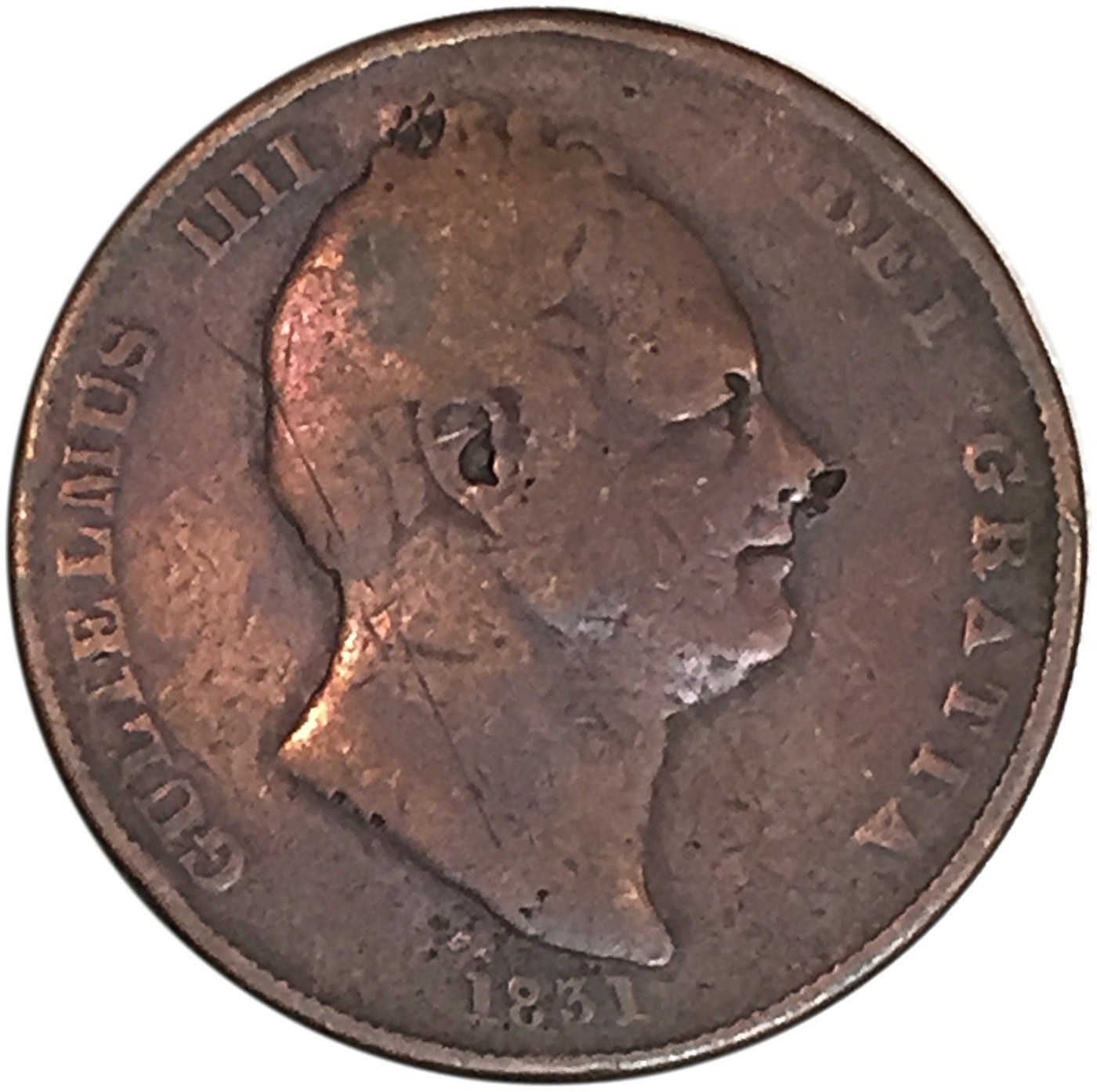
Begin with the obverse legend, which is the single most reliable identifier. A William IV penny reads GULIELMUS IIII D:G around a bare head of the king facing right, with the date beneath the neck — 1831 on the photographed coin. 'Gulielmus' is Latin for William and the four strokes 'IIII' fix the reign. If the head faces left or the legend reads GEORGIUS or VICTORIA, you are looking at a different monarch's penny.
Confirm the reverse and the denomination. The reverse, not shown in this photograph, should carry a seated Britannia facing right with shield and trident and the word BRITANNIA, the standard copper-penny reverse of the 1820s-1850s. Measure the coin: a genuine copper penny of this era is large, roughly 34 mm across, and clearly heavier than a modern coin. If the piece is small and dark, it is more likely a later Victorian bronze penny.
Check the metal and surfaces. This is solid copper, so honest circulated examples show brown to dark-brown tones, sometimes with mellow or spotted surfaces. A pinkish, unnaturally bright surface usually signals cleaning, while green crusts indicate verdigris; both hurt value and can mask problems. The rim and the high points of the head and Britannia are the first areas to wear flat.
Beware of look-alikes and altered pieces. Worn portraits of successive kings can resemble one another, so always read the legend rather than trusting the face. Contemporary and later copies exist; cast fakes betray themselves with soft, grainy detail, a seam around the edge or bubbles in the field, and a coin struck in the wrong metal or the wrong size is not genuine. Because certain dates and varieties within the short reign are much scarcer than others, confirm the exact date before valuing.
When in doubt, weigh and measure the coin and compare it against reference figures for a William IV copper penny, and have unusually sharp or high-value examples authenticated, since original-colour copper of this period is both desirable and widely imitated.
Frequently asked questions
What is the quickest way to confirm a William IV penny?
Read the obverse legend. GULIELMUS IIII D:G around a right-facing head confirms William the Fourth. Any other name, such as GEORGIUS or VICTORIA, means a different reign.
How do I tell it apart from a Victorian bronze penny?
By size, metal and legend. The William IV penny is a large pure-copper coin about 34 mm across with a brown tone, while Victorian bronze pennies are smaller, lighter, darker and read VICTORIA.
Does the date matter for identification?
Yes. William IV pennies were struck in only a few years, so confirming the exact date, such as the 1831 on this coin, both verifies the type and matters for value, since some dates are scarcer than others.
Should I clean a corroded copper penny?
No. Cleaning copper leaves an unnatural bright or pink surface that collectors avoid and that lowers value. Original brown surfaces are preferred, so leave the coin as found.