
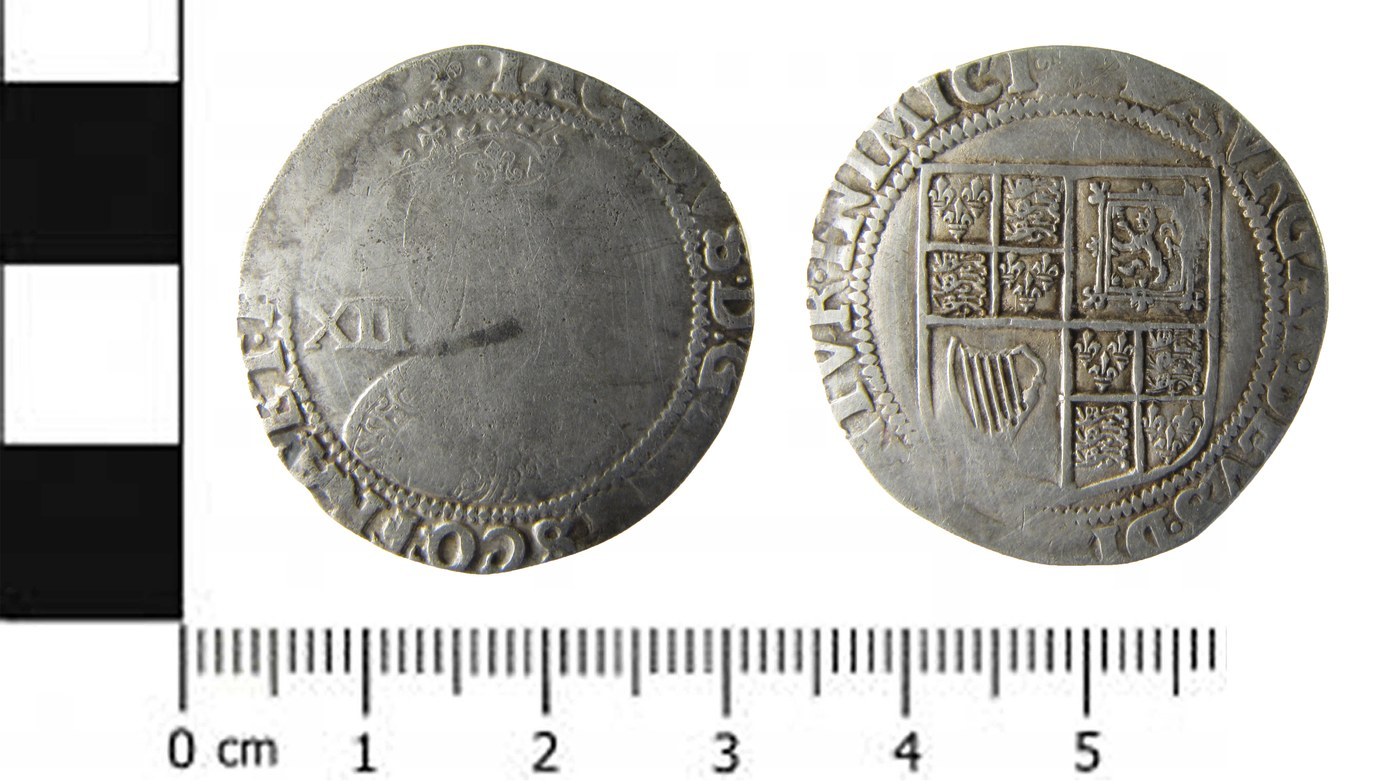
Shilling of Charles I
A hammered silver English shilling of King Charles I, showing his crowned left-facing profile with the value mark XII and a quartered royal shield.
- Country
- United Kingdom
- Denomination
- 1 Shilling
- Metal
- Silver
Got a coin like this?
Identify any coin from a photo, free.
Overview
The Shilling of Charles I is a hammered silver coin of the Kingdom of England struck during the reign of King Charles I (1625-1649). The example shown carries the king's crowned, left-facing profile bust on the obverse with the roman numeral XII marking its value of twelve pence, and a heraldic shield divided into four quarters on the reverse.
As a shilling, it was worth twelve pence, or one-twentieth of a pound, and it sat among the larger everyday silver denominations of the period. Struck by hand rather than by machine, these coins were the standard silver money of Stuart England and circulated widely in the decades leading up to and through the English Civil War.
The type spans a turbulent chapter of English history and survives today in many varieties, making it a popular and historically evocative coin for collectors of hammered British silver.
History & Background
Charles I ruled England, Scotland and Ireland from 1625 until his execution in 1649, a reign that culminated in the English Civil War between Crown and Parliament. His shillings were produced throughout this period, chiefly at the Tower of London mint under royal control, and later also at provincial and emergency mints established during the conflict.
Like all English coinage of the era, the shilling was made by hand striking: a blank silver disc was placed between two engraved dies and struck with a hammer, which accounts for the often irregular flans and slightly off-centre designs seen on surviving pieces. The obverse presents the king crowned and in profile with the XII value mark, while the reverse displays the quartered royal arms combining the emblems of England, Scotland, France and Ireland.
A distinctive feature of the series is the use of small symbols called mint marks (or initial marks) placed in the legends, which changed periodically and help date individual coins within the reign. The coinage of this period reflects the political upheaval of the age, including scarcer issues from Royalist mints operating away from London during the war.
How to Identify
Look for a round-ish hammered silver coin bearing a crowned bust of the king facing left, with the roman numeral XII placed in the field beside or behind the head to indicate the value of twelve pence. A Latin legend naming Charles as king runs around the rim, and the striking is typically a little uneven, as expected for a hand-struck coin.
The reverse shows a heraldic shield divided into four quarters bearing the royal arms, usually surrounded by another Latin legend. Small mint marks (initial marks) appear at the start of the legends on both sides; identifying these symbols is central to attributing the coin to a particular mint and period within the reign.
The coin is struck in silver and is broadly comparable in size to later machine-made shillings, though hammered flans vary. Wear tends to show first on the high points of the king's face, crown and hair, and on the raised lines of the shield. Because the coins were hand-made, no two are identical in centring or flan shape.
Value & Collectibility
Charles I shillings were produced over a long reign and survive in considerable numbers, so most examples are affordable relative to their age, with value driven chiefly by condition, mint, mint mark and eye appeal rather than by rarity alone. Well-worn but genuine pieces are among the more accessible hammered English silver coins, while sharply struck examples on full, well-centred flans command clear premiums.
Scarcer issues, particularly those from Royalist and provincial Civil War mints or rarer mint-mark combinations, can be worth substantially more than common Tower mint strikes. Problems such as clipping, bending, holing, or heavy corrosion reduce value considerably.
Because attribution and grade have such a large effect, and because hammered coins have been copied and faked, any single figure should be treated as approximate. Verify identification and check recent sales of comparable coins before buying or selling.
Frequently asked questions
What does the XII on the coin mean?
The roman numeral XII marks the coin's value of twelve pence. A shilling was worth twelve pence, or one-twentieth of a pound, so the XII identifies it as a shilling.
Who is shown on the coin?
The crowned profile is King Charles I of England, who reigned from 1625 to 1649. His name and titles appear in the Latin legend around the portrait.
Is it made of real silver?
Yes. The Shilling of Charles I is a silver coin. It was the standard larger silver denomination of the period, struck by hand rather than by machine.
Why does the coin look uneven or off-centre?
It was hammered by hand, struck between two dies with a hammer blow. This process produced irregular flans and slightly off-centre designs, which is normal and expected for the type.
How can I tell when in the reign it was made?
Small symbols called mint marks (initial marks) at the start of the legends changed over time and help place a coin within the reign and to a particular mint. Attributing these marks is key to dating it.
Shilling of Charles I guides
In-depth guides for identifying, valuing, and collecting Shilling of Charles I.
Other coins you may enjoy
8 Reales (Portrait/Bust Type)
1759-1788
Napoleon III 20 Francs
1852-1870
British Penny
1937-1952
Shilling of James I
1603-1625
British Shilling
1837-1901 (Victoria); example dated 1887
Australian Florin
1910-1963
British Double Florin
1887-1890
Gold Guinea
1663-1813
Half Sovereign
1817-1937
Mexican 1 Peso
1910-1914
Japanese 5 Yen
Meiji era (example dated Meiji 30 / 1897)
Japanese 20 Yen
1870 (Meiji 3)