
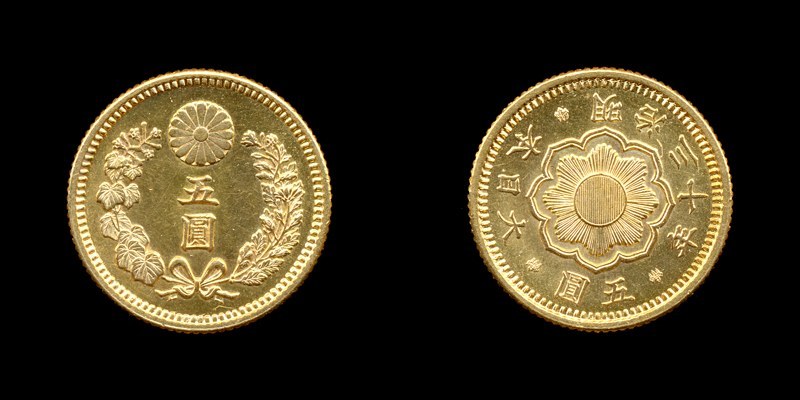
Japanese 5 Yen
Small Meiji-era Japanese gold coin with an imperial chrysanthemum and characters on the obverse and a floral wreath framing the 5 Yen value.
- Country
- Japan
- Denomination
- 5 Yen
- Metal
- Gold
Got a coin like this?
Identify any coin from a photo, free.
Overview
The Japanese 5 Yen shown here is a small gold coin of the Meiji era, and the pictured example is dated Meiji 30 (1897). The obverse centers on the imperial chrysanthemum crest surrounded by Japanese characters giving the country name and denomination, while the reverse displays the "5 Yen" value framed by a floral wreath and ornament.
Gold 5 Yen coins were part of Japan's modernizing coinage introduced after the country moved to a Western-style yen system in the late 19th century. As a gold denomination struck for a relatively short period, it is a compact, collectible piece of Meiji numismatic history rather than an everyday circulating coin seen today.
History & Background
The yen was established as Japan's modern decimal currency in 1871 during the Meiji period, replacing the older feudal money system as part of sweeping reforms that opened Japan to international trade. Gold denominations, including the 5 Yen, were issued to give the new currency a hard-money backing recognizable to foreign markets.
The gold 5 Yen went through more than one design and size during the Meiji era. Japan formally adopted a gold standard in 1897 (Meiji 30), the year of the pictured coin, which coincided with a reduction in the gold content and physical size of the smaller gold pieces. Coins are dated by regnal year, so the characters read as a year of the Meiji Emperor's reign rather than a Western calendar date.
How to Identify
Look for a small gold coin with the imperial chrysanthemum crest at the top or center of the obverse, ringed by Japanese characters that spell out "Great Japan" and the 5 Yen denomination, typically with a paulownia or floral ornament. The reverse carries the numeral and character value "5 Yen" inside a wreath of stylized flowers and ribbon.
The regnal date is written in Japanese characters, so Meiji 30 corresponds to 1897; other Meiji dates read as different reign years. Confirm the yellow color and heft of gold and note the small diameter of the post-1897 gold 5 Yen. Genuine strikes show crisp chrysanthemum petals and sharp characters; the metal is a high-fineness gold alloy rather than pure gold.
Value & Collectibility
Value rests mainly on gold content, date, and condition. Because the coin is small gold, even a well-worn genuine example carries a bullion floor, and collector demand for Meiji gold generally pushes prices above melt for problem-free pieces. Scarcer dates and higher grades can command significant premiums over common ones.
Meiji gold 5 Yen coins have been widely copied and counterfeited, so authentication strongly affects value; a certified genuine coin is worth far more than an unverified one. Treat any single figure as approximate, check the specific regnal-year date against reference listings, and compare against recent auction results before buying or selling.
Frequently asked questions
What does "Meiji 30" mean?
Japanese coins are dated by the emperor's reign year. Meiji 30 is the 30th year of the Meiji Emperor, which equals 1897 in the Western calendar.
Is the coin really gold?
Yes. The 5 Yen of this era was struck in a high-fineness gold alloy. It is small but noticeably dense, with the warm yellow color of gold.
What is the flower on the front?
It is the imperial chrysanthemum crest, the symbol of the Japanese imperial house, which appears on official Meiji-era coinage.
Why is it so small?
Japan reduced the size and gold content of the smaller gold coins when it adopted the gold standard in 1897, so later Meiji 5 Yen pieces are quite compact.
Are these coins commonly faked?
Yes. Meiji gold has been widely counterfeited. Because value depends heavily on authenticity, professional grading or a trusted dealer is recommended before any significant purchase or sale.
Japanese 5 Yen guides
In-depth guides for identifying, valuing, and collecting Japanese 5 Yen.
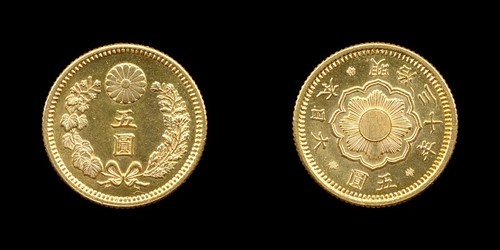
Japanese 5 Yen identified by the community
Real coins identified with Coin Identifier.
Other coins you may enjoy
8 Reales (Portrait/Bust Type)
1759-1788
Napoleon III 20 Francs
1852-1870
British Penny
1937-1952
Shilling of James I
1603-1625
British Shilling
1837-1901 (Victoria); example dated 1887
Australian Florin
1910-1963
British Double Florin
1887-1890
Gold Guinea
1663-1813
Half Sovereign
1817-1937
Mexican 1 Peso
1910-1914
Japanese 20 Yen
1870 (Meiji 3)
Australian Penny
1911-1964