
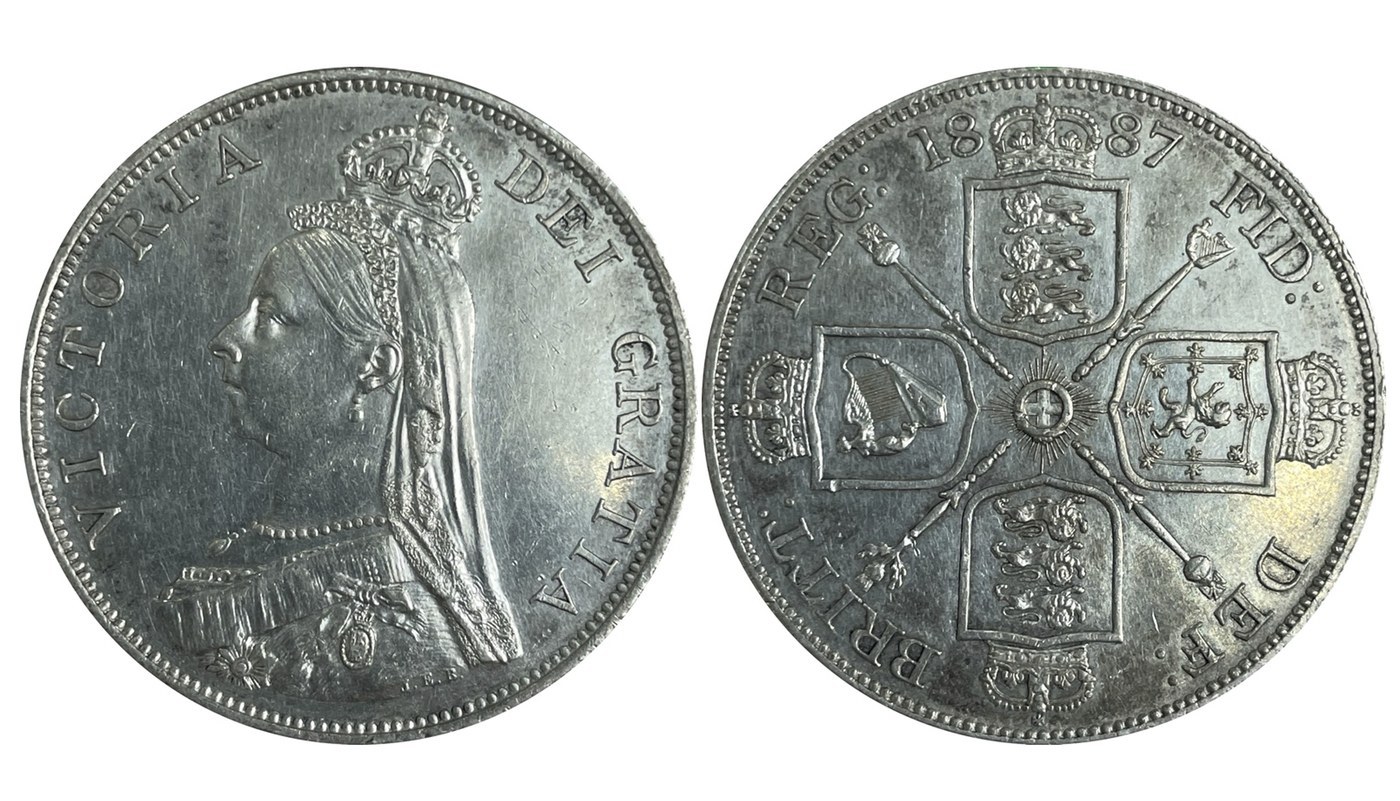
British Double Florin
Large Victorian silver four-shilling piece with the Jubilee Head of Queen Victoria and a cross of four crowned shields on the reverse.
- Country
- United Kingdom
- Denomination
- Double Florin (4 Shillings)
- Metal
- Silver
Got a coin like this?
Identify any coin from a photo, free.
Overview
The British Double Florin is a large silver coin of the United Kingdom valued at four shillings, or two florins. The example shown carries the "Jubilee Head" portrait of Queen Victoria on the obverse, a left-facing profile wearing an ornate crowned headdress, dated 1887, with a reverse built around a cross of four crowned shields bearing the arms of England, Scotland, and Ireland.
Struck only during a brief window in Victoria's reign, the Double Florin was one of the largest silver denominations placed into general circulation at the time. It is a short-lived, somewhat unusual denomination that never gained lasting popularity, which makes it a distinctive and readily identifiable coin for collectors of British silver.
History & Background
The Double Florin was introduced in 1887, the year of Queen Victoria's Golden Jubilee, and was issued alongside the new "Jubilee Head" coinage designed by Joseph Edgar Boehm. It was struck for general circulation for only four years, from 1887 through 1890, before being discontinued, making it one of the shortest-lived denominations in modern British coinage.
The coin was unpopular for practical reasons: at four shillings it was easily confused with the very similar-sized crown of five shillings, a difference of a full shilling. A widely repeated tradition also links the coin to barmaids being short-changed, earning it the nickname the "Barmaid's Ruin," though such stories are anecdotal. No Double Florins were struck for circulation after 1890, and the denomination was never revived.
How to Identify
Look for a large silver coin roughly 36 mm across, a little smaller than a British crown. The obverse shows Queen Victoria's crowned Jubilee Head facing left with a small crown perched high on her veiled head, surrounded by a Latin legend giving her name and titles. The example shown is dated 1887.
The reverse is the diagnostic feature: four crowned shields arranged in a cross, separated by scepters, showing the quartered arms of the United Kingdom, with Star of the Garter emblems in the angles. The 1887 issues come in two varieties distinguished by the form of the numeral in the date, an Arabic "1" versus a Roman-style figure. Genuine coins are struck in sterling (.925) silver and have a reeded edge.
Value & Collectibility
The Double Florin is more available than its short four-year issue period might suggest, because many were saved rather than heavily circulated, so common dates in worn to moderately circulated grades remain among the more affordable large Victorian silver coins. Value is driven chiefly by grade, eye appeal, and variety rather than outright rarity.
Well-preserved examples with original surfaces, sharp detail, and attractive toning command clear premiums, and certain die varieties and proof strikings are worth substantially more than ordinary circulated pieces. As with any older silver coin, cleaning, damage, and wear reduce value. Treat any single figure as approximate and check recent auction results for the specific date and grade.
Frequently asked questions
What is a Double Florin worth in shillings?
The Double Florin was valued at four shillings, equal to two florins. This placed it just one shilling below the crown, which caused confusion in everyday use.
How long was the Double Florin made?
Only from 1887 to 1890. It was introduced in Queen Victoria's Golden Jubilee year and discontinued after just four years, making it one of Britain's shortest-lived denominations.
Is it made of real silver?
Yes. The Double Florin was struck in sterling silver of .925 fineness, and it is a large, heavy coin about 36 mm in diameter.
Why was the Double Florin discontinued?
It was too close in size to the five-shilling crown, causing confusion, and it never became popular. No circulation examples were struck after 1890 and the denomination was never revived.
Who is on the coin?
Queen Victoria, shown in the crowned "Jubilee Head" profile introduced in 1887 and designed by Joseph Edgar Boehm.
British Double Florin guides
In-depth guides for identifying, valuing, and collecting British Double Florin.
Other coins you may enjoy
8 Reales (Portrait/Bust Type)
1759-1788
Napoleon III 20 Francs
1852-1870
British Penny
1937-1952
Shilling of James I
1603-1625
British Shilling
1837-1901 (Victoria); example dated 1887
Australian Florin
1910-1963
Gold Guinea
1663-1813
Half Sovereign
1817-1937
Mexican 1 Peso
1910-1914
Japanese 5 Yen
Meiji era (example dated Meiji 30 / 1897)
Japanese 20 Yen
1870 (Meiji 3)
Australian Penny
1911-1964