
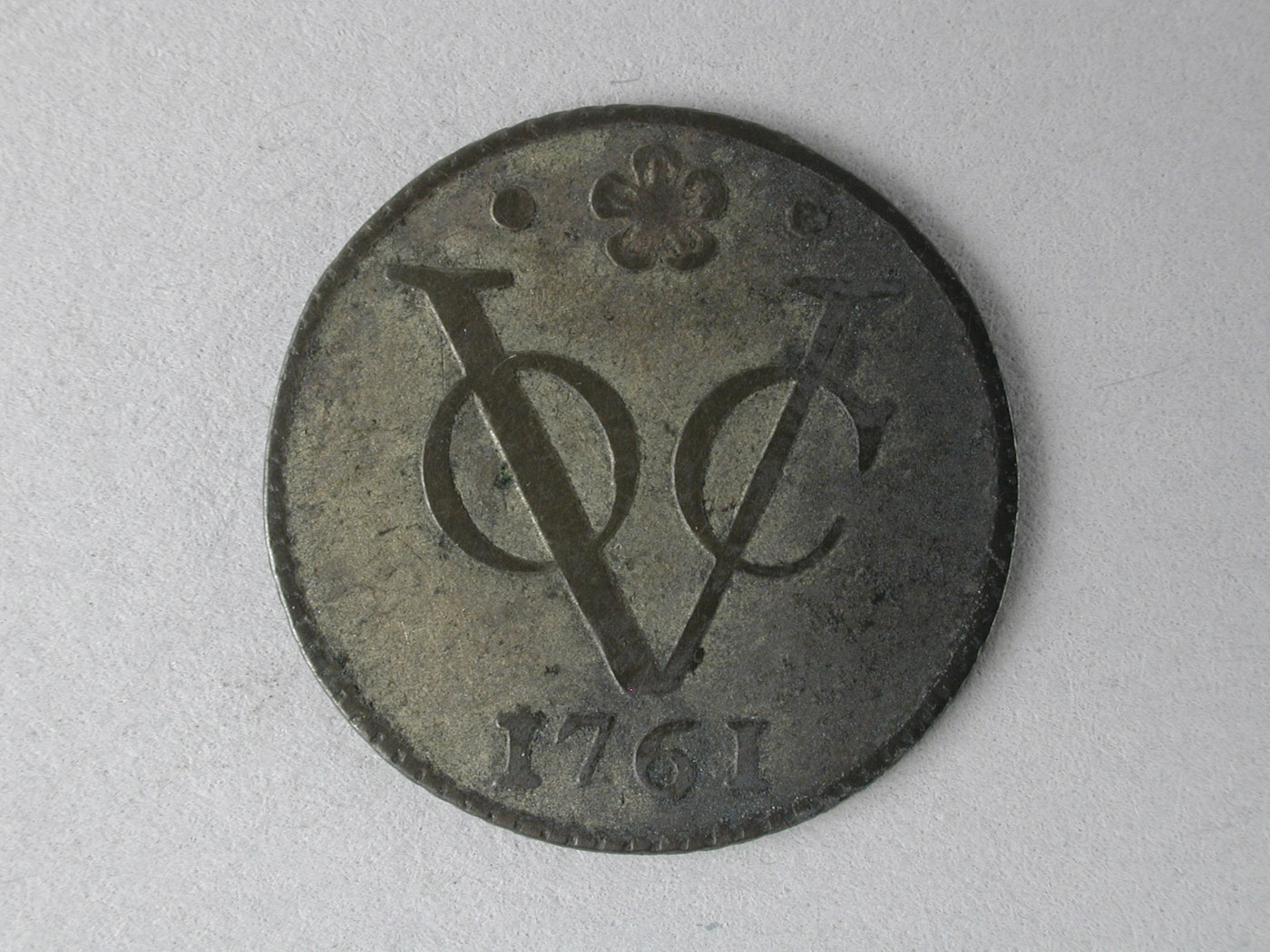
Halve Duit (VOC)
Small copper half-duit of the Dutch East India Company (VOC), bearing the crowned VOC monogram, struck in the 1700s for use in the Dutch trading world.
- Country
- Netherlands
- Denomination
- Half Duit
- Metal
- Copper
Got a coin like this?
Identify any coin from a photo, free.
Overview
The Halve Duit is a small copper coin issued under the authority of the Vereenigde Oostindische Compagnie (VOC), the Dutch East India Company. Worth half a duit, itself one of the smallest units of the old Dutch money of account, it was petty change of the lowest order, meant for everyday small transactions across the company's commercial network.
The most recognizable feature of the piece is the crowned VOC monogram on the obverse, the interlaced company cipher that served as the corporate emblem of one of history's first great chartered trading companies. This monogram, sometimes combined with a provincial mark and decorative elements, is the defining device of VOC copper coinage.
As a base-metal minor issue, the half duit is modest in size and intrinsic worth, yet it carries considerable historical interest. It is a tangible artifact of the eighteenth-century Dutch mercantile empire and the era of long-distance trade in spices, textiles, and other goods.
History & Background
The VOC was chartered in 1602 and granted broad powers to conduct trade, wage war, and administer territory in Asia on behalf of the Dutch Republic. Over the seventeenth and eighteenth centuries it grew into a vast commercial and colonial enterprise, and it required coinage to support its operations both in the Netherlands and overseas.
Duit and half-duit copper coins were struck in the various provinces and mints of the Dutch Republic, and pieces carrying the VOC cipher were associated with the company's monetary needs. The duit system provided the smallest denominations of Dutch currency, and the half duit sat at the very bottom of that scale as minor circulating change.
The VOC declined toward the end of the eighteenth century amid war, debt, and mismanagement, and it was formally dissolved around 1799, its possessions passing to the Dutch state. Copper pieces bearing the company monogram survive as small witnesses to that long era of Dutch overseas commerce.
How to Identify
The observed obverse shows the crowned VOC monogram, the interlocked letters V, O, and C forming the company's cipher, topped by a crown and accompanied by decorative elements. This monogram is the single most important identifier of the type. The reverse of this specimen is not visible in the photographs, but VOC copper commonly carries a provincial arms or mark, a value indication, or a date on the opposite face.
This is a small, thin copper coin. Genuine pieces show the warm brown or reddish-brown patina of aged copper and are light in the hand, in keeping with a half-duit minor denomination. The flans are often somewhat irregular and the strikes uneven, which is typical of low-value copper produced in quantity during the eighteenth century.
Key identifiers are the crowned VOC cipher, the copper composition, the small module, and the eighteenth-century date range. Because the reverse is not shown here, exact province and year should be confirmed from that side when available, since VOC copper was produced by several provincial mints and dates vary across the series.
Value & Collectibility
As a common base-metal minor coin, the VOC half duit is generally modest in value, and most circulated examples trade in the low tens of dollars or less. Its appeal rests on history and the evocative company monogram rather than on precious-metal content, of which there is none.
Condition and legibility drive the price spread. Coins with a clear, sharp VOC monogram, an identifiable province and date, smooth surfaces, and even patina bring more than worn, corroded, or heavily pitted pieces. Because these small coppers circulated hard and were often buried or exposed to the elements, well-preserved examples with strong detail are the exception.
Exact prices vary with grade, specific province, date, and demand, so treat these as general ranges rather than fixed quotes. Corroded, holed, or damaged coins sit at the bottom of the market, while attractive, fully identifiable specimens command a premium among collectors of colonial and company coinage.
Frequently asked questions
What does VOC stand for on the coin?
VOC stands for Vereenigde Oostindische Compagnie, the Dutch East India Company. The interlaced V, O, and C letters form the company's monogram, which is the defining device on this copper coin.
Is the Halve Duit made of silver?
No. It is a copper coin with no precious-metal content. Its value to collectors comes from its history and the VOC monogram, not from any silver or gold.
How much was a half duit worth?
A half duit was one of the smallest units of old Dutch money, worth half of a duit. It served as petty change for the lowest everyday transactions.
When was it made?
This type dates to the eighteenth century, during the later era of the VOC. The company was chartered in 1602 and dissolved around 1799, and its copper coinage circulated within that world.
Why can't I see a design on the reverse?
The reverse is simply not shown in these photographs. VOC copper typically carries a provincial arms or mark, a value, or a date on the other side, which is where the specific mint and year can be confirmed.
Halve Duit (VOC) guides
In-depth guides for identifying, valuing, and collecting Halve Duit (VOC).
Other coins you may enjoy
Scudo (Philip V)
c. 1701–1708
Rijksdaalder van Leicester
1580s-1590s
Kopek (Peter I)
c. 1704–1718 (observed 1711)
Imperial Chervonets
1762
Prinsendaalder (Rijksdaalder)
1592
10 Para
AH 1280 (1863-1864 CE)
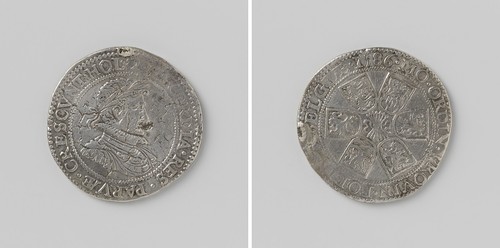
Halve Rijksdaalder van Leicester
1580s-1590s
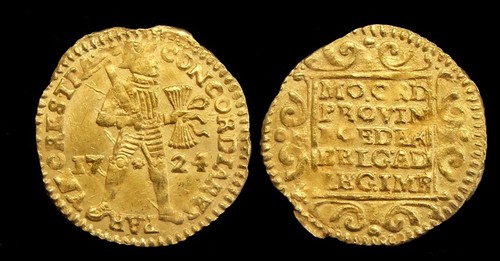
Gouden Dukaat
1724
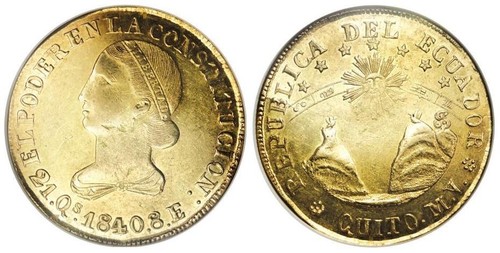
Escudo (Joanna and Charles V, contemporary copy)
1516-1558
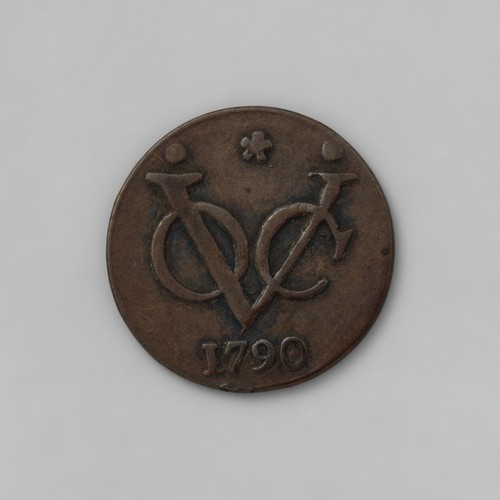
Duit (VOC)
1790
4 Escudos
1780s
Tymf
1663