
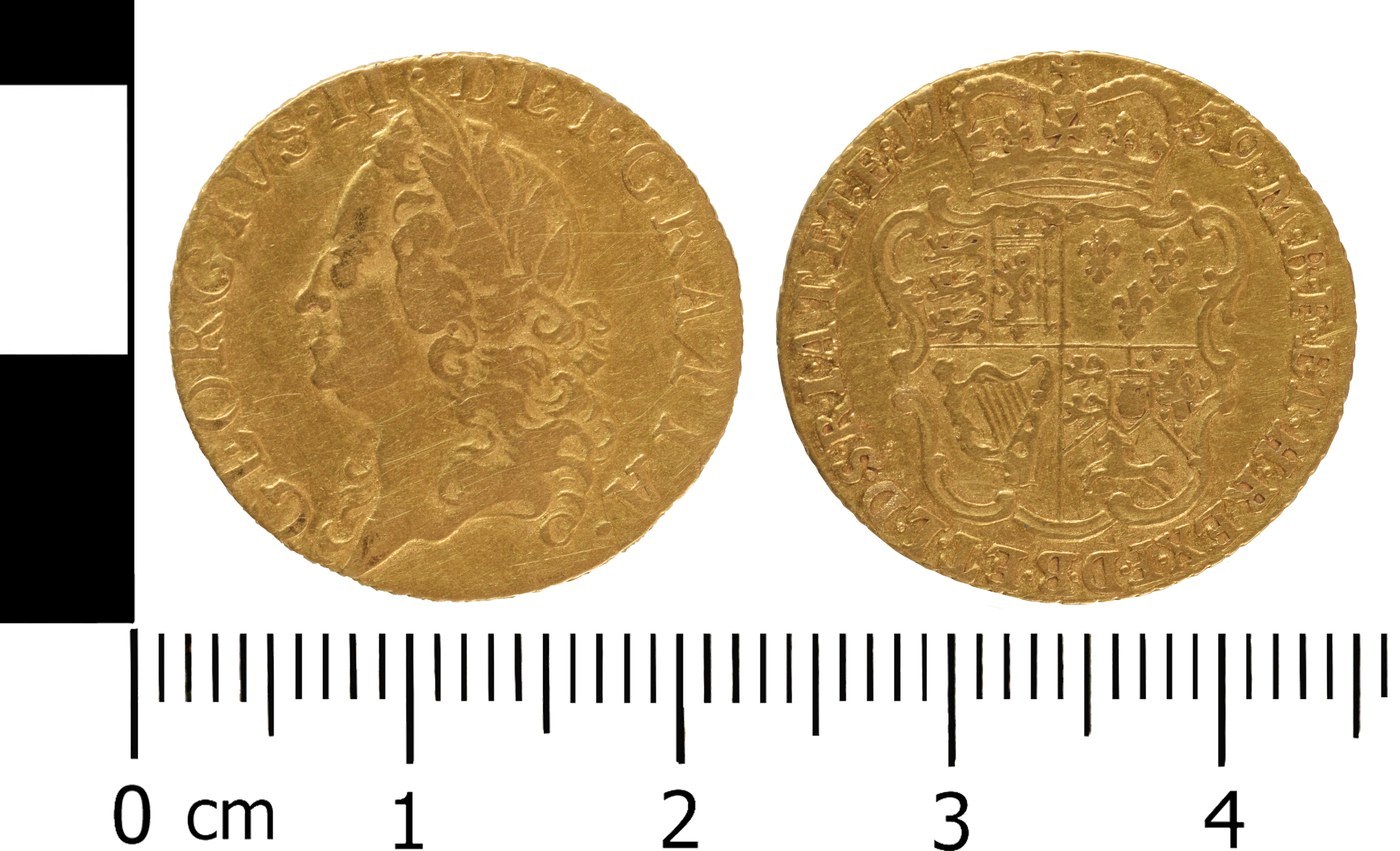
Half Guinea of George II
A small British gold coin of the reign of George II, worth half a guinea, with the king's left-facing bust and a crowned heraldic shield reverse.
- Country
- England
- Denomination
- Half Guinea
- Metal
- Gold
Got a coin like this?
Identify any coin from a photo, free.
Overview
The Half Guinea of George II is a small milled gold coin struck in Great Britain during the reign of King George II (1727-1760). It was valued at half a guinea, the guinea being the principal British gold coin of the eighteenth century. The photographed example is dated 1759, near the end of the reign, and shows the king's laureate bust facing left on the obverse and a crowned heraldic shield of the royal arms on the reverse.
As the name suggests, the half guinea was a fraction of the larger guinea and served as a convenient higher-value gold piece for commerce among those who dealt in significant sums. It is noticeably smaller and lighter than the full guinea while sharing the same general design layout of monarch's portrait and armorial reverse.
Struck in gold and carrying the portrait of a Hanoverian king, this is a collectable eighteenth-century coin rather than everyday small change. Genuine examples in good condition are prized by collectors of British milled gold.
History & Background
George II reigned from 1727 to 1760, and his coinage was produced at the Royal Mint, then located in the Tower of London. The guinea and its fractions, including the half guinea, were the workhorse gold denominations of Georgian Britain. The guinea took its name from the West African region that supplied much of the gold used in early strikings, and the half guinea followed as a smaller companion piece.
Half guineas of George II were issued in several years across the reign, with the portrait and details of the design evolving over time. A coin dated 1759, like the example shown, belongs to the later years of the reign, shortly before George II died in 1760 and was succeeded by his grandson George III. Coinage of this later period was struck during the Seven Years' War, a time of considerable demand for gold.
The guinea system of gold coinage continued after George II and was not replaced until the introduction of the sovereign in 1817, well into the reign of George III. Surviving George II half guineas are therefore relics of the mid-eighteenth-century British monetary system that predated the modern decimal and sovereign coinages.
How to Identify
The obverse shows the laureate bust of George II facing left, surrounded by a Latin legend giving his name and titles. The reverse shows a crowned heraldic shield bearing the quartered royal arms of the period, with a surrounding legend and the date; on the photographed coin the date is 1759. This portrait-and-shield arrangement is the standard format for the denomination.
The coin is small and struck in gold, considerably smaller than a full guinea and much smaller than the larger gold denominations. Its size, golden colour, milled (machine-struck) fabric, and reeded edge together mark it out from silver coins of similar diameter. Confirming the denomination requires checking the diameter and weight against published specifications for the half guinea.
Key diagnostics are the left-facing laureate bust of George II, the crowned arms on the reverse, the Latin legends, and a clear date such as 1759. Because portrait styles changed through the reign, the specific bust variety and date should be read carefully and matched to a reference catalogue to confirm the exact issue.
Value & Collectibility
As an eighteenth-century British gold coin, the Half Guinea of George II carries value both as a collectable and for its gold content. Prices vary widely with condition, the specific date and bust variety, and eye appeal. Well-worn but genuine examples command a solid premium over their bullion gold value, while sharp, high-grade coins with clear detail can be worth substantially more.
Value depends heavily on grade and originality. Coins that have been mounted, bent, polished, or damaged are worth considerably less than problem-free examples, and certain dates or varieties are scarcer and more sought after than others. A common date in average circulated condition sits toward the lower end, while rare dates or choice preservation reach the upper end of the range.
Because gold coins of this era are frequently faked and sometimes mounted or repaired, and because grading strongly affects price, any example of real value should be examined by a specialist in British milled coins. Treat any single figure as broad context and rely on recent auction results for comparable dates and grades for a realistic estimate.
Frequently asked questions
What is a Half Guinea of George II?
It is a small British gold coin struck during the reign of George II (1727-1760), valued at half a guinea. It shows the king's laureate bust facing left and a crowned heraldic shield of the royal arms, and the example here is dated 1759.
Is it made of real gold?
Yes. The half guinea was struck in gold, like the full guinea. Its small size, golden colour, milled fabric, and reeded edge distinguish it from silver coins, though weight and diameter should be checked to confirm the denomination.
How much is it worth?
Value depends on the date, variety, and condition. Genuine examples are worth a premium over their gold content, with well-preserved or scarce dates worth considerably more than worn common ones. Damaged or mounted coins are worth less.
What does the 1759 date mean?
1759 is the year the coin was struck, near the end of George II's reign. He died in 1760 and was succeeded by George III, so a 1759 half guinea is a later-reign issue of the Seven Years' War period.
How is it different from a full guinea?
The half guinea was worth half of a guinea and is smaller and lighter, while sharing the same general design of the king's bust and a crowned armorial reverse. Diameter and weight are the surest way to tell the two apart.
Half Guinea of George II guides
In-depth guides for identifying, valuing, and collecting Half Guinea of George II.
Other coins you may enjoy
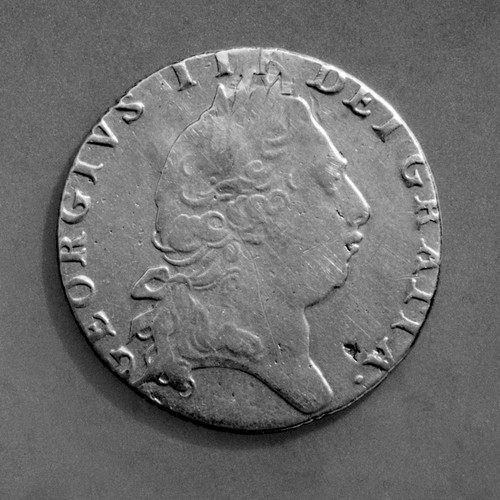
Spade Guinea
1760-1820
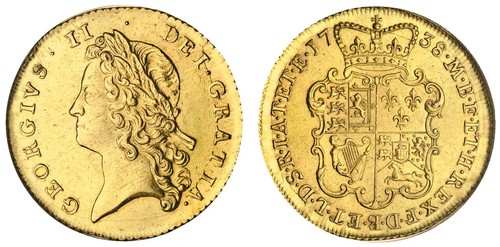
Two Guineas of George II
1738–1753
Shilling of Victoria
1838-1901
Sovereign of George IV
1821-1830
Sovereign of William IV
1831–1837
Penny of William IV
1831-1837
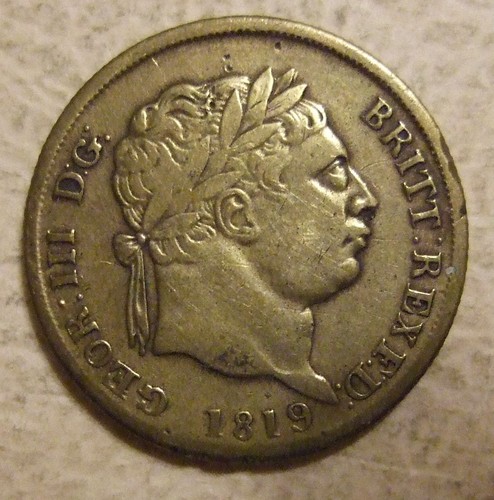
Shilling of George III
1816-1820
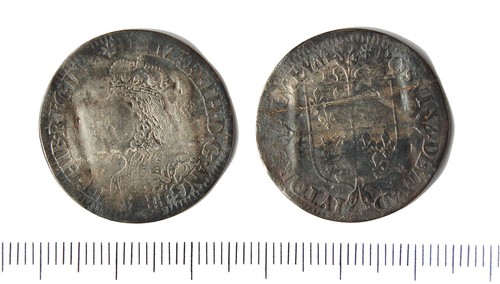
Milled Sixpence of Elizabeth I
1561-1571
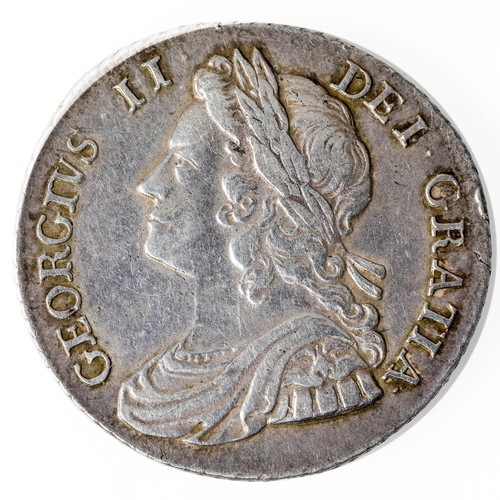
Shilling of George II
1727-1758
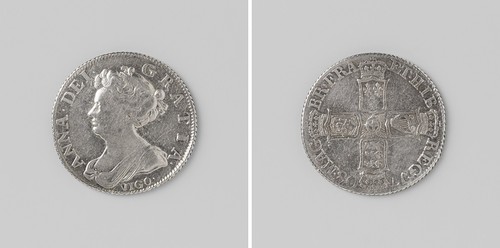
Shilling of Anne
1702-1714
Charles II Twopence
1660-1685
Charles II Half Crown
1660–1685