
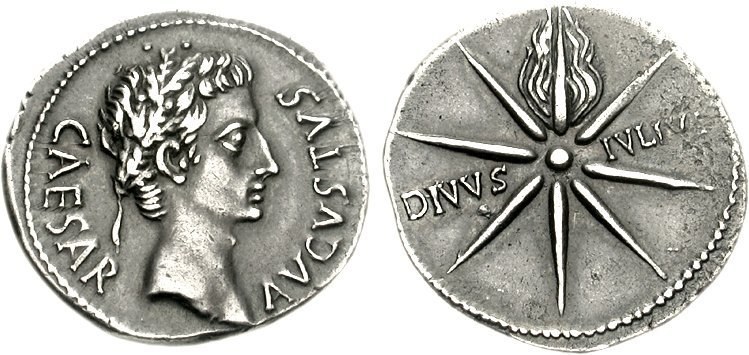
Denarius of Augustus
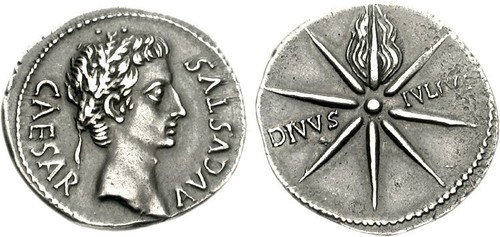
Silver denarius of Augustus (c. 19-18 BC) with his bare head and a comet-star of the deified Julius Caesar, inscribed DIVVS IVLIVS.
- Country
- Roman Empire
- Denomination
- Denarius
- Metal
- Silver
Got a coin like this?
Identify any coin from a photo, free.
Overview
This is a silver denarius struck under Rome's first emperor, Augustus, around 19-18 BC. The obverse shows his bare head facing left with the legend CAESAR AVGVSTVS. The reverse displays a prominent eight-rayed star, or comet, with the inscription DIVVS IVLIVS, honoring his adoptive father Julius Caesar as a deified figure.
The denarius was the workhorse silver coin of the Roman world, roughly 18-20 mm across and typically around 3.5-4 grams of high-purity silver. This particular type belongs to a group of denarii produced at a mint in Roman Spain during the reign of Augustus, and it ties Augustus's political authority directly to the divine status of Julius Caesar.
History & Background
Augustus, born Gaius Octavius and known earlier as Octavian, became Rome's first emperor after decades of civil war that followed the assassination of Julius Caesar in 44 BC. Because Caesar had adopted him as heir, Augustus styled himself the son of a god after the Roman state formally deified Caesar in 42 BC, adopting the title Divi Filius.
The star on this reverse refers to a bright comet that appeared during funeral games Octavian held for Caesar in 44 BC. Romans interpreted the comet, later called the sidus Iulium or 'Julian Star,' as a sign that Caesar's soul had ascended to the heavens as a god. By placing DIVVS IVLIVS and the comet on his coinage, Augustus advertised his descent from a deified ancestor and reinforced the legitimacy of his rule.
This type was struck several years into Augustus's principate, after he had consolidated sole power. Many denarii of this era, including issues carrying the Divus Julius theme, are attributed to mints in the Iberian Peninsula, such as those operating around Colonia Patricia or Caesaraugusta, though exact mint attributions in this period are debated by scholars.
How to Identify
The defining features are the paired inscriptions. The obverse reads CAESAR AVGVSTVS around a bare (uncrowned) head of Augustus facing left, with youthful, idealized features. The reverse shows a large star or comet, often rendered with eight rays and sometimes a trailing tail, accompanied by the words DIVVS IVLIVS.
Expect a small silver coin, generally 18-20 mm in diameter and roughly 3.5-4 grams, hand-struck so that the flan is slightly irregular and the strike may be off-center. Ancient denarii have no milled edge, no date, and no mint mark in the modern sense; attribution comes from the legends, portrait style, and reverse design rather than a stamped year.
Because Augustus reigned for decades and used many reverse types, the comet-and-DIVVS IVLIVS combination is the key diagnostic that separates this issue from his numerous other denarii, which carry motifs such as Gaius and Lucius Caesar, a bull, a capricorn, or military standards.
Value & Collectibility
Denarii of Augustus are among the most collected of all Roman silver coins, and the Divus Julius comet type is a popular design because of its direct link to Julius Caesar's deification. As with all ancient coins, value depends heavily on condition, centering, strike quality, surface preservation, and how clearly the portrait and legends survive.
Worn but genuine and clearly identifiable examples are often affordable relative to their fame, while sharply struck, well-centered, high-grade pieces command substantial premiums. Toning, metal quality, and the presence of the full comet detail all affect desirability. Because pricing in the ancient market varies widely from coin to coin, treat any single figure as a rough guide rather than a fixed catalog value.
Ancient silver denarii are widely counterfeited and also copied as museum reproductions and tourist souvenirs, so provenance and expert opinion strongly influence value. Coins with clear collection history or third-party authentication generally sell more easily and for more.
Frequently asked questions
What does the star on the reverse mean?
It represents a comet, the sidus Iulium, that appeared in 44 BC during funeral games for Julius Caesar. Romans read it as a sign of his deification, and the DIVVS IVLIVS inscription names him as the deified Julius.
Is this coin made of real silver?
Yes. Denarii of Augustus were struck in high-purity silver, typically weighing about 3.5-4 grams and measuring roughly 18-20 mm across.
Who is shown on the front?
The obverse shows Augustus, Rome's first emperor, bare-headed and facing left, with the legend CAESAR AVGVSTVS. Julius Caesar himself is referenced only by name and the comet on the reverse.
Does it have a date or mint mark?
No. Ancient Roman coins do not carry calendar dates or modern mint marks. Approximate dating, here about 19-18 BC, comes from the legends, portrait style, and reverse type studied by numismatists.
Where was it struck?
Many Augustan denarii of this period, including Divus Julius issues, are attributed to mints in Roman Spain. Exact mint attributions for these coins remain debated among scholars.
Denarius of Augustus guides
In-depth guides for identifying, valuing, and collecting Denarius of Augustus.
Other coins you may enjoy
Antoninianus
250-270 AD
Sestertius of Antoninus Pius
138-161 AD
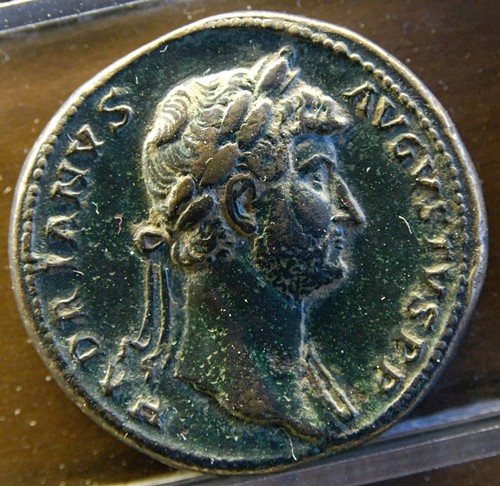
Sestertius of Hadrian
117-138 AD
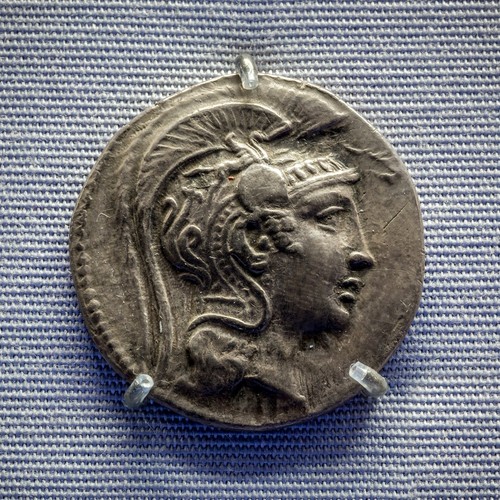
Athenian Owl Tetradrachm
165-42 BC
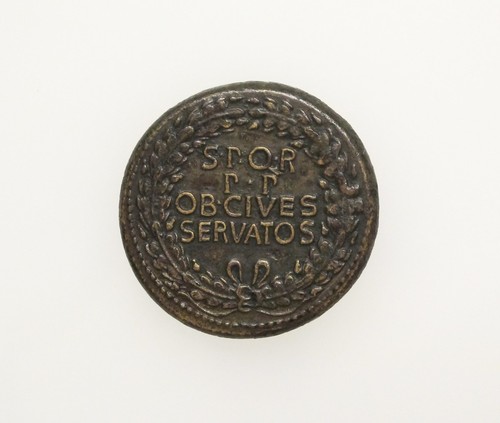
Sestertius of Caligula
37-41 AD
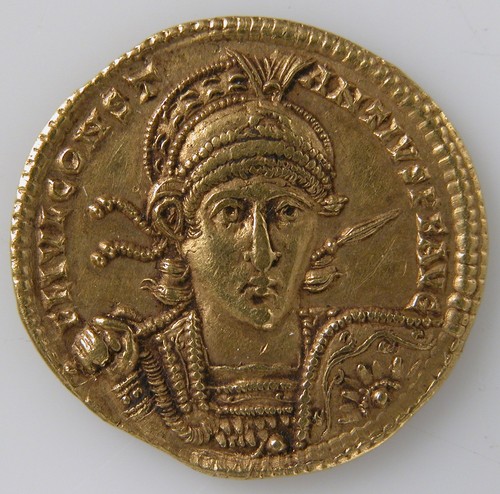
Solidus of Constantius II
337-361 AD
Sestertius of Alexander Severus
222-235 AD
Antoninianus of Gallienus
253-268 AD
Aureus of Nero
54-68 AD
Antoninianus of Laelianus
AD 269
Aureus of Augustus
27 BC-14 AD
Aureus of Faustina II
147-150 AD