
How to Identify the Denarius of Augustus
A collector's guide to identifying the Augustus 'Divus Julius' comet denarius by its legends, portrait, comet reverse, size, and authenticity checks.
Read the full Denarius of Augustus encyclopedia entry →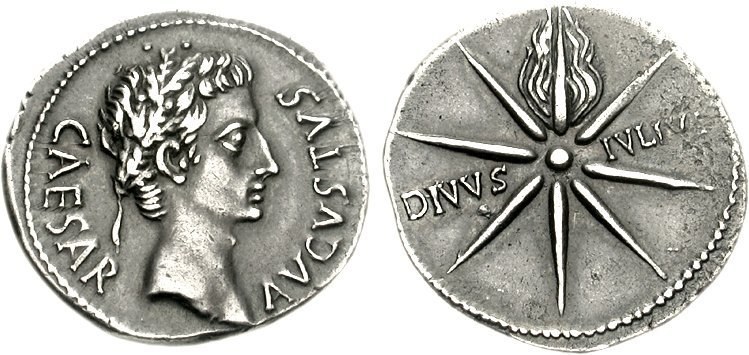
Read the legends first. This type pairs CAESAR AVGVSTVS on the obverse with DIVVS IVLIVS on the reverse. If you can make out those two inscriptions, you have narrowed the coin to Augustus's deified-Julius issues rather than the hundreds of other Roman denarii. The lettering is Latin capitals struck by hand, so spacing is uneven and some letters may run off the flan.
Study the two designs. The obverse carries a bare head of Augustus facing left, without a wreath or crown, in an idealized youthful style. The reverse shows a single large star or comet, commonly with eight rays and sometimes a tail, standing alone in the field. This solitary comet is the key diagnostic; do not confuse it with reverses that show multiple small stars, standards, or standing figures.
Check size, weight, and fabric. A genuine denarius of this era is about 18-20 mm across and roughly 3.5-4 grams of good silver. The flan is a small, slightly irregular disc with no reeded or lettered edge, and true silver is non-magnetic. A coin that is oversized, heavy, perfectly round with a machined edge, or attracted to a magnet is not an authentic ancient denarius.
Beware of look-alikes and reproductions. Museum replicas, gift-shop souvenirs, and modern fantasy pieces frequently copy famous Augustan types, and cast or pressed fakes are common in the ancient market. Warning signs include soft or blurry detail, visible casting seams or bubbles, a greasy or too-uniform surface, incorrect weight, and lettering that looks etched rather than struck. Genuine strikes show crisp raised devices and metal flow consistent with hammer striking.
When in doubt, seek expert opinion. Attribution of Augustan denarii relies on comparison with reference catalogs and known die styles rather than any date or mint mark on the coin. For anything you intend to buy or sell at a meaningful price, favor coins with documented provenance or a reputable third-party authentication.
Frequently asked questions
What is the single best clue this is the right type?
The DIVVS IVLIVS legend beside a solitary comet-star on the reverse, combined with CAESAR AVGVSTVS and a bare head on the obverse. That specific pairing identifies the Augustus deified-Julius denarius.
How do I tell a genuine denarius from a replica?
Check for correct size and weight (about 18-20 mm and 3.5-4 g), non-magnetic silver, hand-struck irregular flan, and crisp raised detail. Casting seams, bubbles, soft detail, or a machined edge point to a copy.
Why is there no date or mint mark to read?
Ancient Rome did not date coins or use modern mint marks. Numismatists assign the approximate 19-18 BC date and mint from the legends, portrait style, and reverse design compared with reference works.
Could this be a coin of Julius Caesar himself?
No. The portrait and CAESAR AVGVSTVS legend are Augustus's. Julius Caesar appears only by reference through the comet and the DIVVS IVLIVS inscription that names him as the deified Julius.