
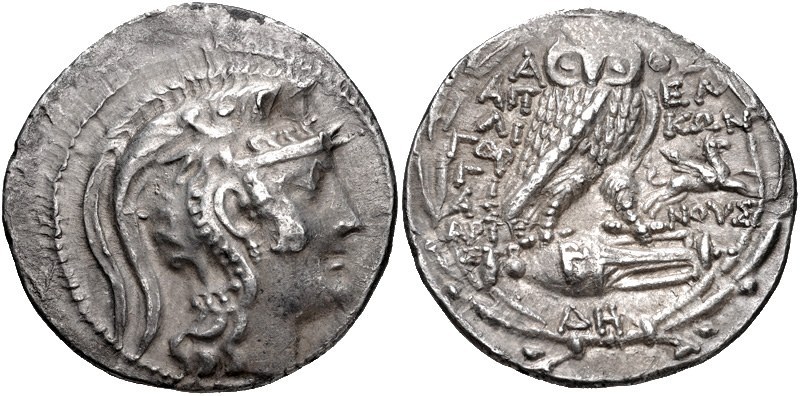
Athenian Owl Tetradrachm
Broad silver 'New Style' tetradrachm of Athens (c. 165-42 BC): helmeted Athena on the front, owl on an amphora within an olive wreath on the back.
- Country
- Ancient Greece
- Denomination
- Tetradrachm
- Metal
- Silver
Got a coin like this?
Identify any coin from a photo, free.
Overview
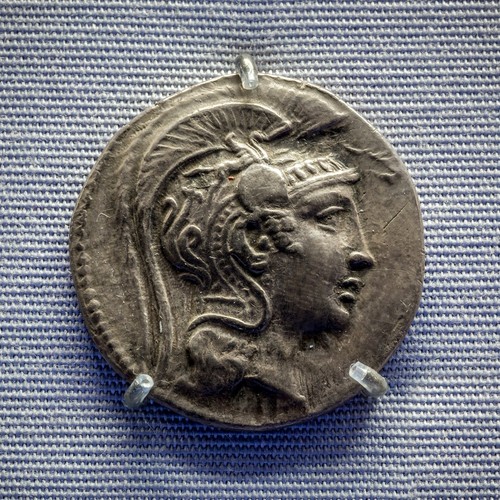
This is a large silver tetradrachm struck by the ancient city of Athens in the second and first centuries BC, a series numismatists call the 'New Style' owls. The obverse shows the head of Athena facing right in an ornate triple-crested Attic helmet. The reverse shows Athens's owl standing on a fallen amphora, with the abbreviated city name AthE beside it, the whole design enclosed in a wreath of olive leaves.
The tetradrachm was worth four drachms and was the principal high-value silver coin of the Greek world. New Style owls are struck on a broad, thin flan, typically around 28-35 mm across and roughly 16-17 grams of good silver on the Attic weight standard. They descend from Athens's famous classical owls but are readily told apart by the wreath, the amphora, and the crowded fields full of names and symbols.
History & Background
Athens had minted 'owl' tetradrachms since the sixth century BC, and its coinage financed the city's golden age. The compact, thick classical owls of the fifth and fourth centuries were among the most trusted trade coins in the ancient Mediterranean. The New Style series represents a later revival of that tradition after a long gap in large silver production.
The New Style coinage is generally dated from about 165 BC, following Athens's acquisition of the sacred island of Delos, down to the middle of the first century BC. These issues were struck during the Hellenistic and early Roman periods, when Athens was a self-governing but no longer imperial city. The coins circulated widely in the eastern Mediterranean and were used to pay for grain, trade, and, at times, Roman military expenses.
Unlike the anonymous classical owls, New Style tetradrachms carry the names of annually changing magistrates, letters marking the month of issue on the amphora, and small control symbols in the field. This administrative detail lets scholars arrange the series in relative order, even though the coins bear no calendar date. Minting tapered off in the turbulent decades of the Roman civil wars, ending around the 40s BC.
How to Identify
The obverse is the head of Athena facing right in a crested Attic helmet, richly decorated and shown in a Hellenistic style with soft, rounded features. The reverse is the diagnostic side: an owl standing three-quarters facing on a horizontal amphora, flanked by the letters AthE (for Athens) and one or more magistrate names, all surrounded by a closed wreath of olive. This wreath is the quickest way to recognize a New Style owl.
Expect a broad, thin, slightly irregular disc about 28-35 mm in diameter and roughly 16-17 grams of silver. The flan is much wider and flatter than the small, dumpy classical owl. Look on the amphora for a Greek letter marking the month, and in the fields for control symbols such as small figures, objects, or animals that vary from issue to issue.
The coin has no milled edge, no calendar date, and no modern mint mark. Attribution to a particular year within the series relies on the magistrate names, monogram controls, and symbols, compared against reference studies of the series rather than any single stamped feature on the coin.
Value & Collectibility
Athenian owls are among the most recognizable and sought-after of all ancient Greek coins, and the New Style tetradrachm is a popular and comparatively available way to own one. Value depends heavily on condition, centering, strike quality, surface preservation, and how sharply Athena's helmet detail and the owl survive. Broad flans are prone to weak or off-center striking, which affects desirability.
Well-worn but genuine and clearly identifiable examples are often modestly priced relative to the type's fame, while sharply struck, well-centered, high-grade pieces with attractive toning command substantial premiums. Specific magistrate combinations, rare control symbols, and pedigree can also add value. Because prices in the ancient market vary widely coin to coin, treat any single figure as a rough guide rather than a fixed catalog value.
Owls are heavily counterfeited and are also widely reproduced as souvenirs and museum copies, so provenance and expert opinion strongly influence value. Coins with documented collection history or reputable third-party authentication generally sell more readily and for more.
Frequently asked questions
How is this different from the classical Athenian owl?
The classical fifth- and fourth-century owl is small, thick, and shows the owl standing on a ground line with an olive sprig and crescent, and no wreath. This New Style owl is on a broad thin flan, stands on an amphora, and is enclosed in an olive wreath.
Is this coin made of real silver?
Yes. New Style Athenian tetradrachms were struck in good silver on the Attic standard, typically weighing about 16-17 grams and measuring roughly 28-35 mm across.
Who is shown on the front?
The obverse shows Athena, the patron goddess of Athens, facing right in a decorated crested Attic helmet. Her owl, a symbol of Athena and of the city, appears on the reverse.
Does it have a date or mint mark?
No. Ancient Greek coins do not carry calendar dates or modern mint marks. The approximate 165-42 BC range comes from studying the magistrate names, month letters, and control symbols, not a stamped year.
What do the letters and small symbols mean?
The letters AthE abbreviate the name of Athens. Additional names are annual magistrates, a letter on the amphora marks the month of issue, and small field symbols are administrative controls that help scholars order the series.
Athenian Owl Tetradrachm guides
In-depth guides for identifying, valuing, and collecting Athenian Owl Tetradrachm.
Other coins you may enjoy
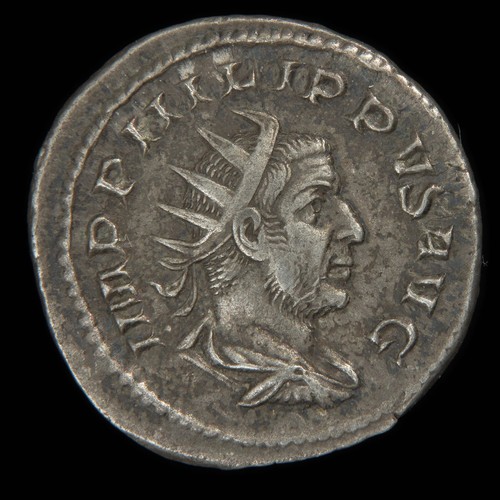
Antoninianus
250-270 AD
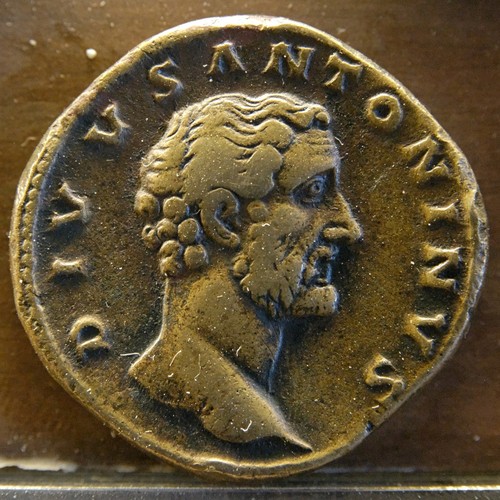
Sestertius of Antoninus Pius
138-161 AD
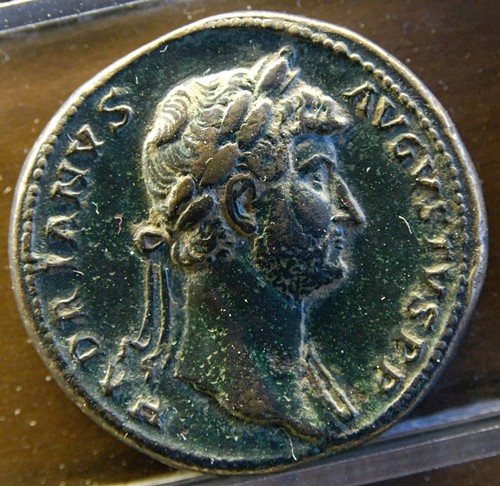
Sestertius of Hadrian
117-138 AD
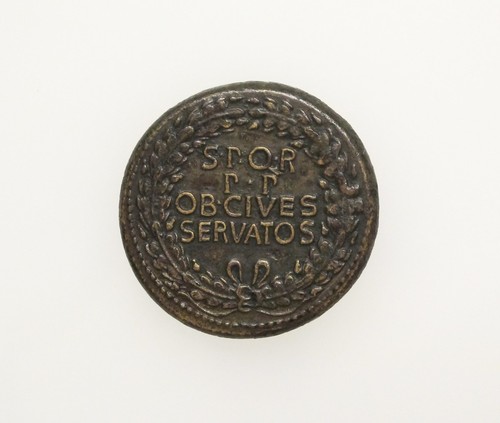
Sestertius of Caligula
37-41 AD
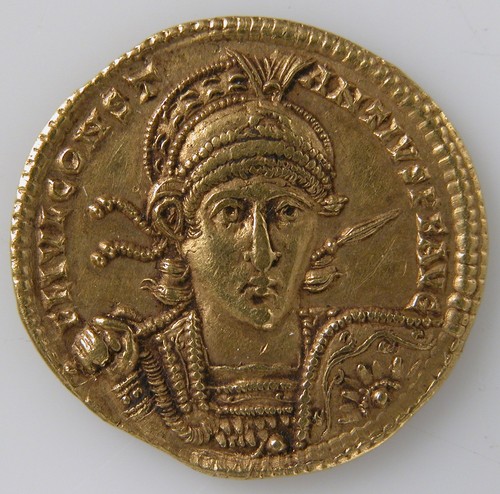
Solidus of Constantius II
337-361 AD
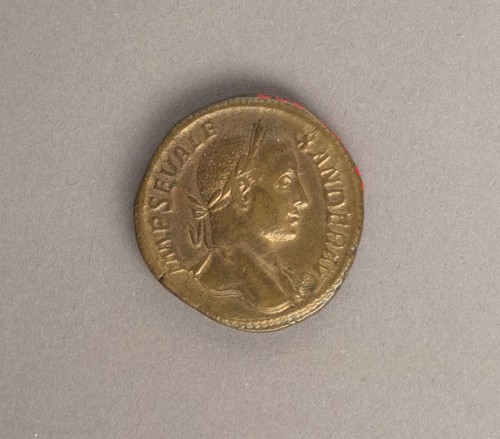
Sestertius of Alexander Severus
222-235 AD
Antoninianus of Gallienus
253-268 AD
Aureus of Nero
54-68 AD
Antoninianus of Laelianus
AD 269
Aureus of Augustus
27 BC-14 AD
Aureus of Faustina II
147-150 AD
Aureus of Marcus Aurelius
c. 161-180 AD