
How to Identify the Athenian Owl Tetradrachm
A collector's guide to spotting the New Style Athenian owl by its wreath, owl-on-amphora reverse, helmeted Athena, broad flan, and authenticity checks.
Read the full Athenian Owl Tetradrachm encyclopedia entry →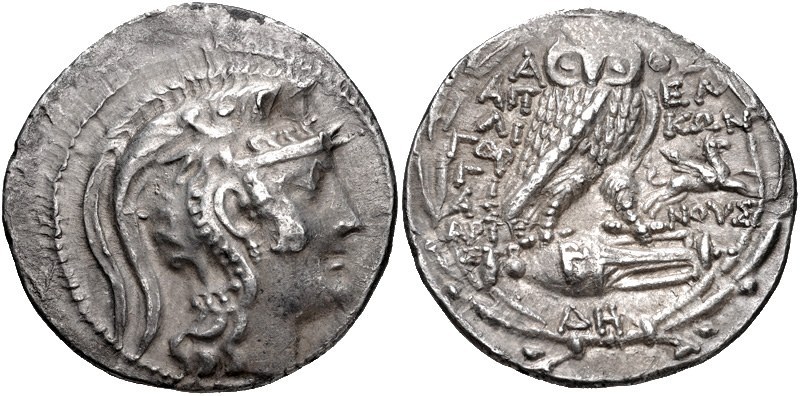
Start with the wreath and the amphora. If the reverse shows an owl standing on a horizontal amphora, framed by the letters AthE and enclosed in a closed olive wreath, you are looking at a New Style Athenian tetradrachm rather than the earlier classical owl. That olive wreath around the whole design is the fastest single confirmation of the type.
Read the obverse next. It carries the head of Athena facing right in an ornate, crested Attic helmet, rendered in a softer Hellenistic style than the stiff archaic owls. The helmet is richly decorated, and the portrait fills a broad field. Combined with the owl-and-wreath reverse, this pairing separates the coin from other Greek tetradrachms that use different deities, rulers, or animal types.
Check size, weight, and fabric. A genuine New Style owl is a broad, thin, slightly irregular disc about 28-35 mm across and roughly 16-17 grams of good silver. The flan is much wider and flatter than the small, thick classical owl, and it has no reeded or lettered edge. True silver is non-magnetic. A coin that is undersized and dumpy like an old-style owl, or oversized, magnetic, or perfectly round with a machined edge, does not fit this type.
Use the names and symbols for finer attribution. New Style owls carry annually changing magistrate names, a Greek letter on the amphora marking the month, and small control symbols in the field, such as figures, objects, or animals. These do not give a calendar year on their own, but numismatists use them together with reference studies to place a coin within the series. Do not expect a date or mint mark in the modern sense.
Be cautious about fakes and copies. Owls are among the most reproduced ancient coins, made as museum replicas, souvenirs, and deceptive cast or pressed forgeries. Warning signs include soft or blurry detail, casting seams or surface bubbles, a greasy or too-uniform look, incorrect weight, and lettering that appears etched rather than struck. Genuine strikes show crisp raised devices and hand-struck irregularity. For any coin bought or sold at a meaningful price, favor documented provenance or reputable third-party authentication.
Frequently asked questions
What is the single best clue this is the right type?
The owl standing on an amphora, flanked by AthE, and enclosed in an olive wreath. That wreathed owl-on-amphora reverse marks the New Style Athenian tetradrachm, paired with a helmeted Athena facing right on the obverse.
How do I tell it from the classical Athenian owl?
The classical owl is small and thick, stands on a ground line with an olive sprig and crescent, and has no wreath. The New Style owl is a broad, thin coin with the owl on an amphora inside a full olive wreath.
How do I spot a replica or forgery?
Check for correct size and weight (about 28-35 mm and 16-17 g), non-magnetic silver, a hand-struck irregular flan, and crisp raised detail. Casting seams, bubbles, soft detail, a machined edge, or a magnetic response point to a copy.
Why is there no date to read on the coin?
Ancient Athens did not date its coins. The approximate 165-42 BC range and finer ordering come from the magistrate names, month letters on the amphora, and control symbols, studied against reference works rather than a stamped year.