
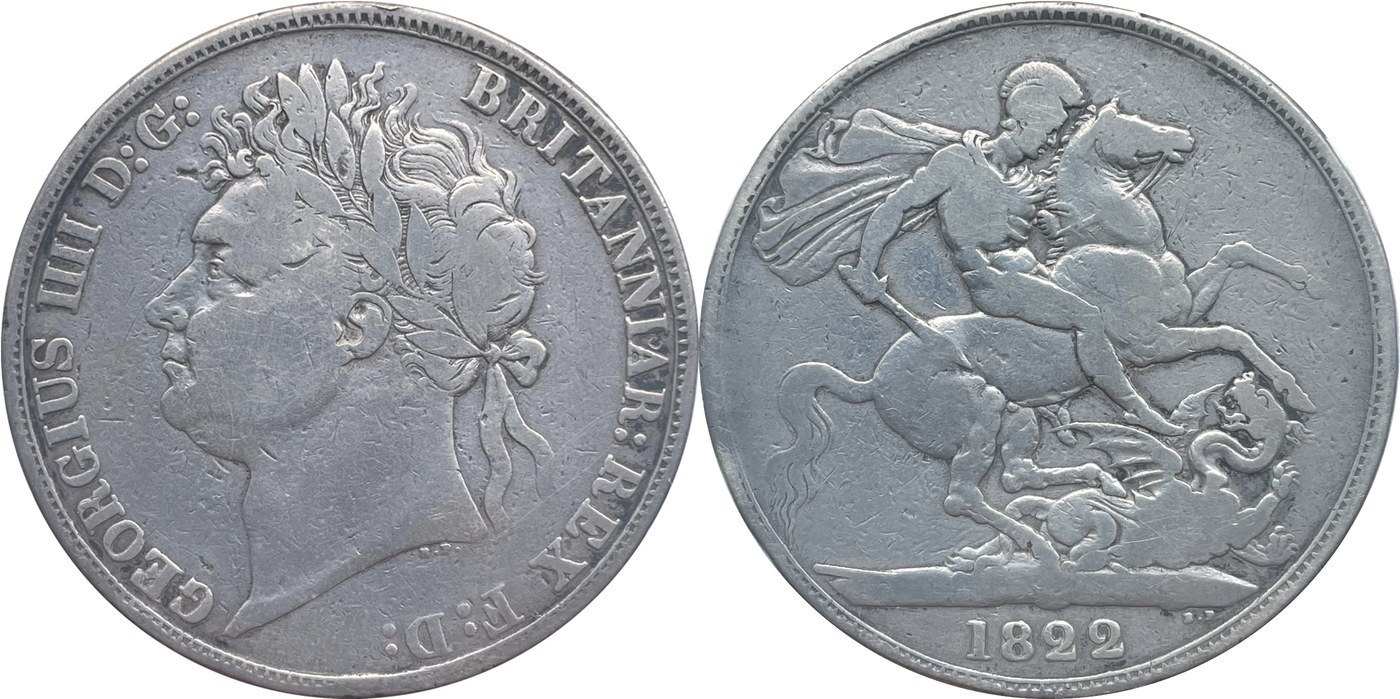
Crown of George IV
A milled silver crown of George IV, with a laureate head facing left and Pistrucci's St George and the dragon on the reverse; the photographed piece is dated 1822.
- Country
- Great Britain
- Denomination
- Crown
- Metal
- Silver
Got a coin like this?
Identify any coin from a photo, free.
Overview
The Crown of George IV is a large milled silver crown struck early in the reign of George IV (1820–1830). The photographed example is dated 1822 and shows the king's laureate head facing left on the obverse, with the Latin legend naming him GEORGIUS IIII, and Benedetto Pistrucci's celebrated design of St George on horseback slaying the dragon on the reverse.
As a crown it is the largest of the standard silver denominations, a machine-struck (milled) coin with the sharp, even relief and regular round flan of early nineteenth-century Royal Mint work. It belongs to the laureate-head crown series of 1821 and 1822, produced in the years after the Great Recoinage of 1816 had reformed and re-standardised the silver coinage.
The pairing of the laureate portrait with the mounted St George is the coin's signature. Pistrucci's St George and dragon, first used on the crown under George III and George IV, became one of the most enduring images in British numismatics and is still associated with the crown and sovereign today.
History & Background
George IV came to the throne in 1820 after serving as Prince Regent, and his crown coinage continued the reformed silver standards introduced by the Great Recoinage of 1816. The laureate-head crown was struck in 1821 and 1822, following the coronation, and carried the reverse that the Italian engraver Benedetto Pistrucci had created for the crown: St George mounted and spearing the dragon within a broken lance and Garter motifs.
The crown was a substantial silver coin worth five shillings, too large a sum for everyday small change, so it circulated less heavily than the smaller silver denominations and was often kept or used for larger payments and presentation. Successive years and later portrait changes during the reign mean the laureate-head type of 1821–1822 is a distinct early group within George IV's coinage.
Like other crowns of the period, these coins carry a lettered edge giving the regnal year in Latin, a security feature that both discouraged clipping and helps date the striking. The 1822 crowns are known with edge inscriptions reading SECUNDO and TERTIO, marking the regnal year of issue.
How to Identify
The obverse shows the laureate head of George IV facing left, wearing a wreath of laurel in the neoclassical manner, surrounded by a Latin legend that begins GEORGIUS IIII D:G and continues with his royal titles as king of the Britains and Defender of the Faith. The left-facing laureate head is the key portrait identifier and distinguishes this early type from the later bare-head coinage of the reign.
The reverse carries Pistrucci's St George on horseback, nude but for a flowing cloak and helmet, thrusting a spear or broken lance down at a dragon beneath the horse, with the date in the exergue below. On the photographed coin this date reads 1822. There is no denomination spelled out on the coin; the design, size and edge identify it as a crown.
As a milled crown it is large — roughly 38–39 mm across and struck in sterling silver — with a lettered edge rather than a plain or reeded one. Reading the edge inscription, which gives the regnal year in Latin (for 1822, SECUNDO or TERTIO), together with the obverse and reverse, confirms both the type and the specific striking. Check diameter, weight and the crisp relief against published crown specifications.
Value & Collectibility
Silver crowns of George IV are collectable coins that trade well above their silver content, with price driven mainly by grade, the exact date and edge variety, and eye appeal. Heavily worn examples are relatively affordable, while sharp, high-grade coins with strong detail on the laurel wreath and on St George command substantial premiums, and proof or specimen strikings sit far higher still.
Because the crown is a large coin that saw limited circulation, many surviving pieces show honest wear, cleaning or edge knocks that affect value. Original surfaces, attractive toning and problem-free edges are prized, and small differences between date and edge-lettering varieties can matter to specialists.
Any specific coin is best valued against recent sales of comparable George IV crowns in matching grade and variety. Treat any single figure as broad context, and for a high-grade or unusually valuable example seek an opinion from a specialist in British milled silver or a reputable grading service.
Frequently asked questions
What is this coin?
It is a milled silver crown of George IV, the largest standard silver denomination, worth five shillings. The photographed piece is dated 1822 and shows the laureate head of George IV and Pistrucci's St George and the dragon.
Why does the legend read GEORGIUS IIII?
That is simply the Latin form of George IV, using IIII rather than IV for the numeral four, together with D:G for Dei Gratia (by the grace of God) and his royal titles. It identifies the king on the obverse.
Who designed the St George and dragon reverse?
The reverse is the work of the Italian engraver Benedetto Pistrucci, whose St George and dragon became one of the most famous images in British coinage and was used on crowns and sovereigns of the period.
What does the lettering on the edge mean?
The crown has a lettered edge giving the regnal year in Latin as a security feature. On 1822 crowns this reads SECUNDO or TERTIO, which helps confirm the year and variety of the striking and discouraged clipping.
Are George IV crowns valuable?
They trade above their silver value as collectable coins. Worn examples are modest, while high-grade, well-toned or proof pieces can be worth considerably more. Grade, date, edge variety and eye appeal drive the price.
Crown of George IV guides
In-depth guides for identifying, valuing, and collecting Crown of George IV.
Other coins you may enjoy
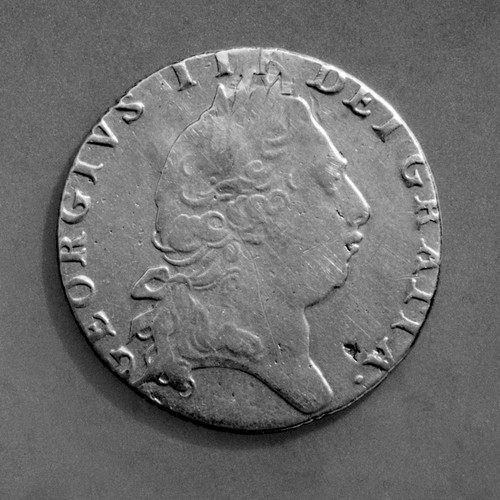
Spade Guinea
1760-1820
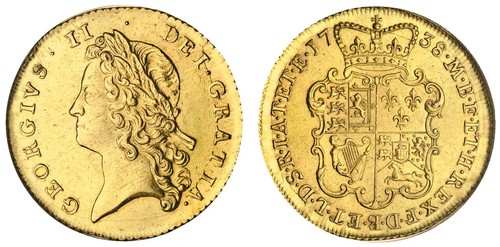
Two Guineas of George II
1738–1753
Shilling of Victoria
1838-1901
Sovereign of George IV
1821-1830
Sovereign of William IV
1831–1837
Penny of William IV
1831-1837
Shilling of George III
1816-1820
Milled Sixpence of Elizabeth I
1561-1571
Shilling of George II
1727-1758
Shilling of Anne
1702-1714
Charles II Twopence
1660-1685
Charles II Half Crown
1660–1685