
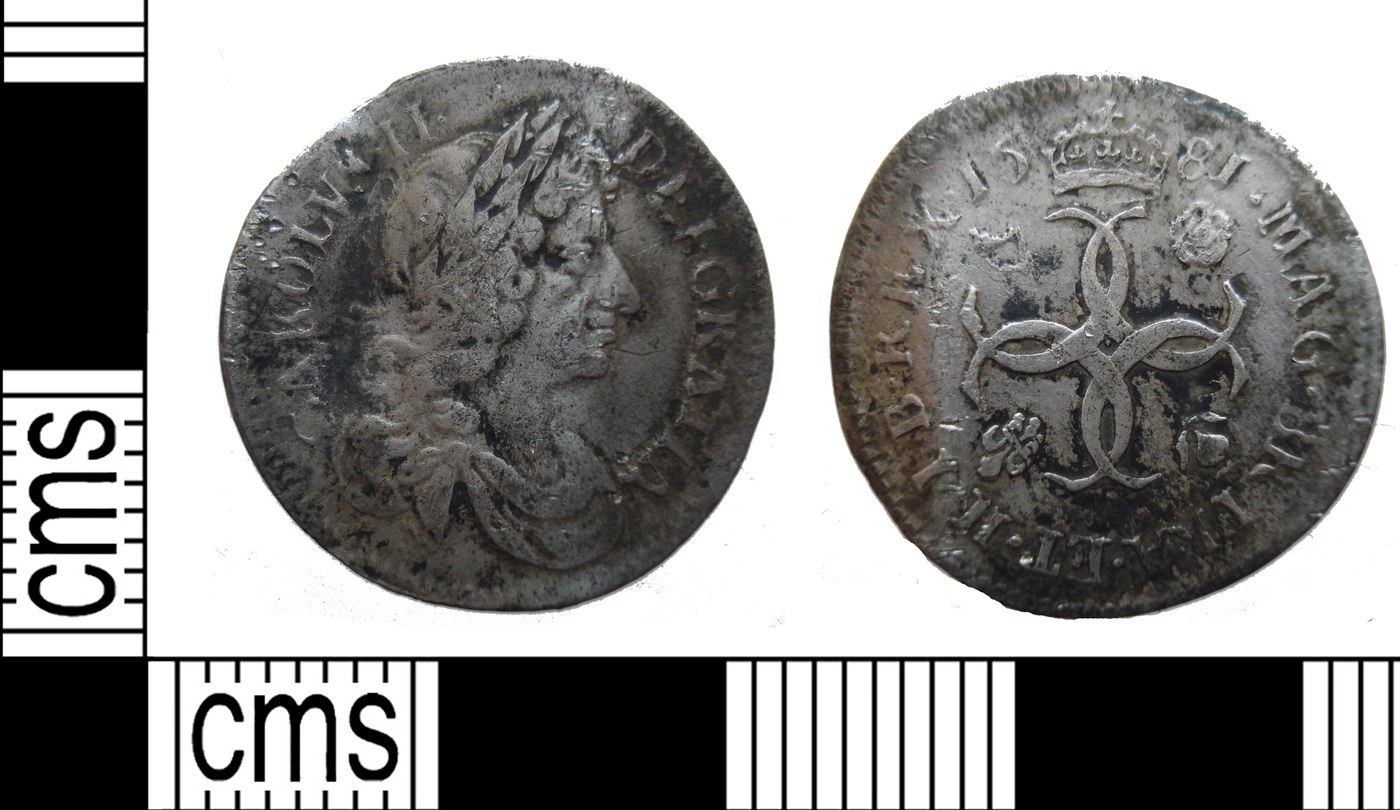
Charles II Fourpence
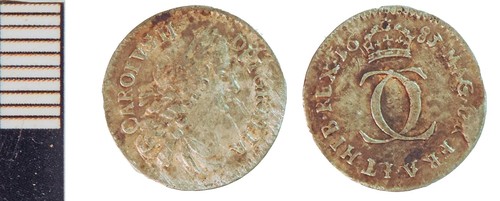
A small milled sterling silver fourpence of Charles II, with his laureate bust and a crowned cipher of interlinked C's flanked by the national emblems.
- Country
- England
- Denomination
- Fourpence
- Metal
- Silver
Got a coin like this?
Identify any coin from a photo, free.
Overview
The Charles II Fourpence, also called a groat, is a small milled silver coin of the English Restoration, struck during the reign of Charles II (1660-1685). The obverse shows a laureate and draped bust of the king facing right, surrounded by the Latin legend CAROLVS II DEI GRATIA ("Charles II, by the grace of God"). The reverse carries a crowned device of four interlinked C ciphers, with the national emblems of the rose, thistle, fleur-de-lis and harp set in the angles and the date divided by the crown above; the surrounding legend continues MAG BR FRA ET HIB REX ("King of Great Britain, France and Ireland").
Unlike the hammered coinage of earlier reigns, this fourpence was produced on mechanized minting equipment, so genuine pieces are neatly round, evenly struck and well centred on a regular flan. It is struck in .925 sterling silver, measures roughly 19 mm across and weighs about 2 grams, placing it among the smallest silver denominations of the period.
The fourpence belonged to a family of small silver coins, alongside the threepence, twopence and penny, that Charles II's mint issued in dated series from 1670. These same little coins later became the basis of the Royal Maundy sets still distributed today, which gives the humble Charles II groat a lasting place in English numismatic tradition.
History & Background
Charles II returned to the throne in 1660 at the Restoration of the monarchy, after the Commonwealth period that followed his father's execution. One of the notable developments of his reign was the permanent adoption of milled, machine-struck coinage at the Tower Mint from 1662, which replaced the centuries-old practice of striking coins by hand between hammered dies. The new method produced coins of more consistent size, weight and appearance, and it made the currency harder to clip and counterfeit.
The small silver denominations, including the fourpence, were issued as a dated series from 1670 onward. The portrait dies for the coinage were engraved by John Roettier (Roettiers), a member of a celebrated family of mint engravers, whose laureate profile of the king appears on this and the larger silver pieces. The fourpence was worth four pence, or one groat, equal to one sixtieth of a pound sterling.
Because these coins were made in modest quantities each year across the 1670-1684 span, individual dates such as the 1681 issue survive in varying numbers. In time the fourpence, threepence, twopence and penny of this pattern evolved into the ceremonial Maundy money that the sovereign gives to selected recipients on Maundy Thursday, so the type links everyday Restoration commerce with a royal custom that endures into the present day.
How to Identify
Start with the obverse, which shows a laureate and draped bust of Charles II facing right, encircled by the Latin legend CAROLVS II DEI GRATIA. The laurel wreath and the rightward-facing profile are characteristic; earlier Stuart and Tudor portraits generally face left, so the direction of the bust is a quick orientation check.
Turn to the reverse to confirm the type. Rather than a single shield, it presents a crowned arrangement of four interlinked C ciphers, with the small national emblems of the rose, thistle, fleur-de-lis and harp placed in the angles between them, a crown above dividing the date, and the legend MAG BR FRA ET HIB REX around the rim. Although this heraldic device is sometimes loosely described as a coat of arms, it is specifically the royal cipher-and-emblems design used on Charles II's smallest silver, and the date, such as 1681, will read across the top.
Genuine pieces are struck in sterling silver on a neat, round, milled flan of about 19 mm and roughly 2 grams. Because the fourpence, threepence, twopence and penny share almost identical designs, the surest way to tell them apart is by diameter and weight, the fourpence being the largest of that small group. Confirming the size, the metal, the rightward laureate bust and the crowned interlinked-C reverse together is the reliable route to attribution.
Value & Collectibility
As a widely issued small silver coin, the Charles II Fourpence is one of the more affordable ways to own genuine milled Stuart silver. Well-worn examples of common dates trade for modest sums, while pieces with sharp detail, original surfaces and clear legends command a premium, and scarcer dates or unusually high grades sit well above the ordinary range.
Condition and eye appeal drive value as much as the date. A coin with a complete, crisp portrait, a clean crowned reverse and an easily readable date is worth considerably more than a smooth, scratched or cleaned example of the same year. Toning, honest wear and problem-free surfaces are viewed favourably by collectors of this series.
Because values range from small amounts for common circulated pieces to significantly more for choice or scarce-date coins, and because the small silver denominations are easily confused with one another, it is wise to confirm the date, denomination, grade and authenticity through a specialist dealer or a reputable auction record before paying a premium.
Frequently asked questions
Is the Charles II Fourpence the same as a groat?
Yes. Fourpence and groat are two names for the same denomination, a coin worth four pence. The Charles II milled fourpence is often catalogued as a groat and belongs to the same small-silver series as the threepence, twopence and penny.
What is the design on the reverse?
The reverse shows a crowned arrangement of four interlinked C ciphers with the national emblems, the rose, thistle, fleur-de-lis and harp, in the angles, a crown above dividing the date, and the legend MAG BR FRA ET HIB REX. It is a royal cipher-and-emblems device rather than a single armorial shield.
How do I tell a fourpence from a threepence of Charles II?
The two share nearly identical designs, so the difference is size and weight. The fourpence is the larger and heavier of the two, about 19 mm across; the threepence is noticeably smaller. Measuring the diameter is the most reliable way to separate them.
Why is this coin linked to Maundy money?
The fourpence, threepence, twopence and penny of this Charles II pattern became the basis of the ceremonial Royal Maundy sets still distributed by the sovereign on Maundy Thursday, which is why the type is often described as an early Maundy fourpence.
Charles II Fourpence guides
In-depth guides for identifying, valuing, and collecting Charles II Fourpence.
Other coins you may enjoy
Spade Guinea
1760-1820
Two Guineas of George II
1738–1753
Shilling of Victoria
1838-1901
Sovereign of George IV
1821-1830
Sovereign of William IV
1831–1837
Penny of William IV
1831-1837
Shilling of George III
1816-1820
Milled Sixpence of Elizabeth I
1561-1571
Shilling of George II
1727-1758
Shilling of Anne
1702-1714
Charles II Twopence
1660-1685
Charles II Half Crown
1660–1685