
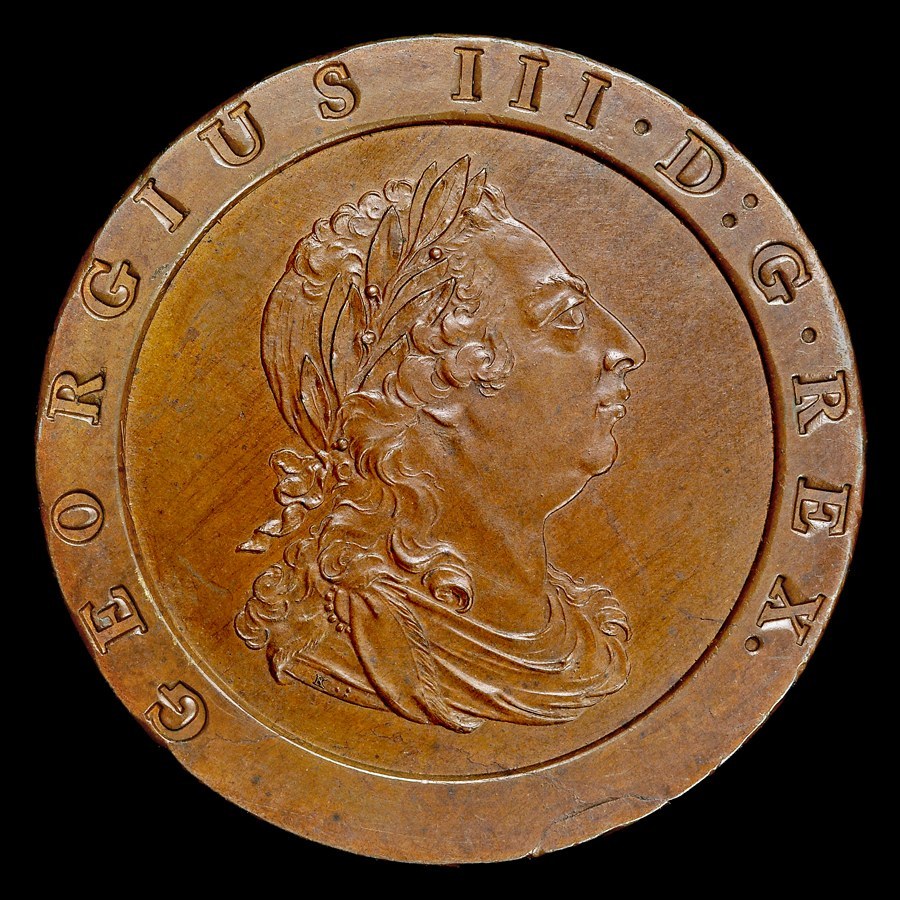
Cartwheel Twopence
The massive 1797 copper twopence of George III, famous for its broad raised rim and full ounce of copper, struck at Boulton's Soho Mint.
- Country
- United Kingdom
- Denomination
- 2 Pence
- Metal
- Copper
Got a coin like this?
Identify any coin from a photo, free.
Overview
The Cartwheel Twopence is a large copper coin of Great Britain issued in 1797 under George III. The photographed example shows the standard type: a right-facing armoured bust of the king on the obverse and Britannia seated with a trident, a shield below her, on the reverse. Its nickname comes from the very broad, deeply raised outer rim into which the lettering is incuse (sunk into the metal), giving the coin the look of a solid wheel.
This piece is one of the heaviest circulating copper coins ever made for British use, containing a full ounce of copper so that its intrinsic metal value matched its face value of two pence. Its sheer size and weight make it unmistakable in hand and one of the most recognisable coins of the George III reign.
All genuine cartwheel twopences carry the single date 1797 and were produced by Matthew Boulton at his Soho Mint near Birmingham using steam-powered presses, a landmark of early industrial coining.
History & Background
By the 1790s Britain suffered a severe shortage of reliable small change, and the official copper coinage in circulation was worn, counterfeited, and distrusted. In 1797 the government contracted Matthew Boulton, partner of James Watt, to strike a new regal copper coinage at his Soho Mint using steam-driven machinery. The result was the cartwheel penny and twopence, produced to a standard where the weight of copper equalled the coin's face value.
The twopence was struck to weigh two ounces of copper for a value of two pence — an ounce per penny — which is why the coin is so massive. The broad raised rim with incuse lettering was both a distinctive design and a practical anti-counterfeiting and anti-wear feature, protecting the central devices as the coins stacked and circulated.
The cartwheel coinage was minted only in 1797. The twopence in particular proved cumbersomely heavy for everyday use and was not repeated; later George III copper of 1799 and 1806–07 returned to lighter, more conventional formats. The cartwheels remain celebrated today as showcase products of Boulton's Soho Mint and of the industrial revolution in coining.
How to Identify
Look first at the size and weight. The genuine cartwheel twopence is very large, roughly 41 mm across and about 2 ounces (around 56–57 grams) of copper, far heavier than any ordinary penny. This bulk, together with the thick flat raised rim, is the single most telling feature.
The obverse shows the laureate, armoured bust of George III facing right, with the legend GEORGIUS III D G REX incuse in the raised rim. The reverse shows Britannia seated left holding a trident, an olive branch in her other hand, with a shield below and a ship in the sea to the side; the incuse rim legend reads BRITANNIA, and the date 1797 appears beneath Britannia. On both sides the lettering is sunk into the broad rim rather than raised, a defining cartwheel trait. The word SOHO appears in tiny letters on the reverse indicating the mint.
All authentic examples are dated 1797 only. Because the coin is copper it will show brown, chocolate, or occasionally green-toned surfaces; heavy circulation often flattens the central portrait and Britannia while the protective rim survives better.
Value & Collectibility
As a large, one-year-only copper coin the cartwheel twopence is popular and readily collected, and prices depend heavily on condition. Well-worn examples with smooth or flattened detail are the most affordable and trade in modest amounts, reflecting how many were struck and how many survive. Coins retaining sharp portrait and Britannia detail, clean rims, and original surfaces command substantially more.
Condition, eye appeal, and surface preservation drive value more than rarity, since the type itself is common in worn grades. Pieces with attractive even toning, no heavy corrosion or edge knocks, and clear incuse lettering sit well above bulk examples, and choice near-uncirculated or proof-related strikings can reach much higher figures.
Because the coin has long been popular, replicas, later restrikes, and cast copies exist. For any example that appears high grade or is being bought at a significant price, confirm authenticity against reference weights and dimensions and, where warranted, seek a professional opinion. Treat all figures as broad context and check recent sales of comparable graded coins.
Frequently asked questions
Why is it called a cartwheel?
The nickname comes from the coin's broad, thick raised rim with the lettering sunk (incuse) into it, which makes the heavy copper piece resemble a solid cartwheel. It applies to both the 1797 penny and twopence.
What year were cartwheel twopences made?
They were struck only in 1797, under George III, at Matthew Boulton's Soho Mint near Birmingham. Every genuine cartwheel twopence carries the date 1797.
Why is the coin so heavy?
The twopence was made so that its copper content equalled its face value, at roughly one ounce of copper per penny. That means about two ounces of copper, some 56–57 grams, making it one of the heaviest British circulating coins.
Who is on the coin?
The obverse shows George III facing right; the reverse shows Britannia seated with a trident and a shield below, with the date 1797. The mint name SOHO appears in tiny letters on the reverse.
Is a cartwheel twopence valuable?
Most worn examples are common and modestly priced, but coins with strong detail, clean original surfaces, and attractive toning are worth considerably more. Condition matters more than rarity for this type.
Cartwheel Twopence guides
In-depth guides for identifying, valuing, and collecting Cartwheel Twopence.
Other coins you may enjoy
Spade Guinea
1760-1820
Two Guineas of George II
1738–1753
Shilling of Victoria
1838-1901
Sovereign of George IV
1821-1830
Sovereign of William IV
1831–1837
Penny of William IV
1831-1837
Shilling of George III
1816-1820
Milled Sixpence of Elizabeth I
1561-1571
Shilling of George II
1727-1758
Shilling of Anne
1702-1714
Charles II Twopence
1660-1685
Charles II Half Crown
1660–1685