
How to Identify the Cartwheel Twopence
A collector's guide to confirming an 1797 cartwheel twopence by its size and weight, incuse rim lettering, George III and Britannia devices, and telltale look-alikes.
Read the full Cartwheel Twopence encyclopedia entry →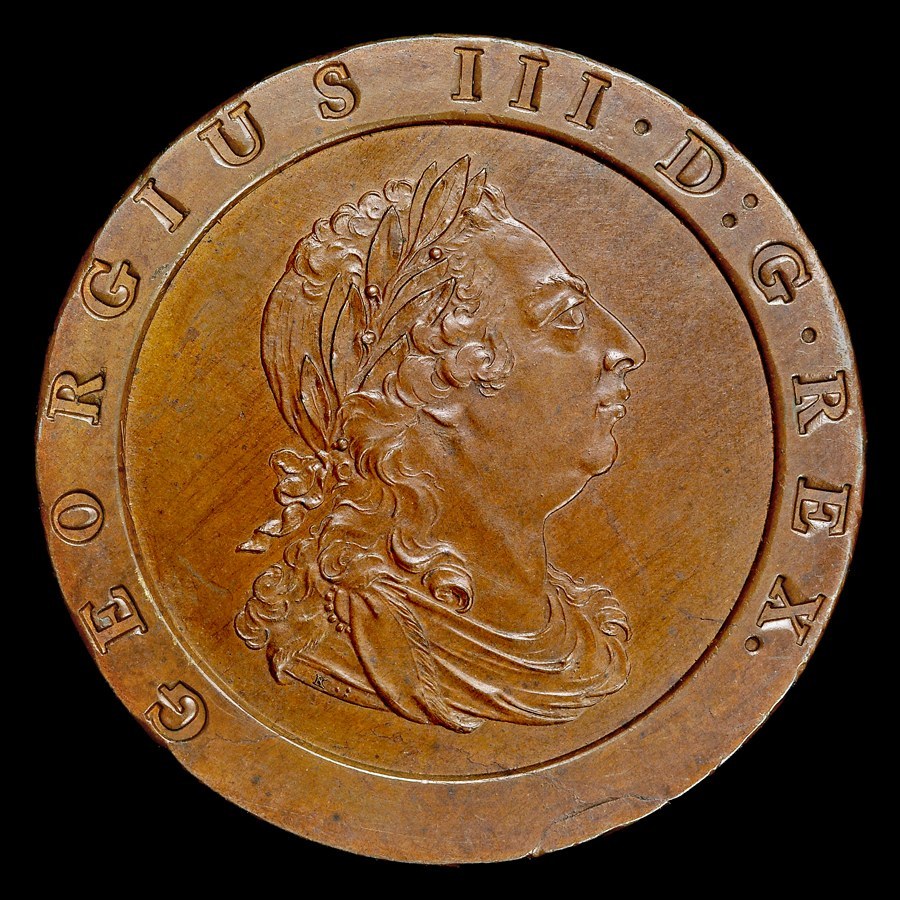
Start with size and heft, because they are decisive. A genuine cartwheel twopence is about 41 mm in diameter and weighs roughly two ounces of copper — around 56–57 grams. Set it beside an ordinary penny and the difference is obvious; nothing in normal British copper approaches this mass. If a coin claiming to be a cartwheel twopence is noticeably light or thin, treat that as a warning sign before going further.
Examine the rim and lettering. The defining cartwheel feature is a broad, flat, raised outer rim with the legends sunk into it (incuse) rather than standing in relief. On the obverse the incuse legend reads GEORGIUS III D G REX around the right-facing armoured bust; on the reverse it reads BRITANNIA. Run a fingertip over the rim: the letters should be recessed. Raised, ordinary relief lettering points to a different coin or a modern copy.
Read the devices and date. The obverse carries the laureate bust of George III facing right. The reverse shows Britannia seated to the left with a trident and olive branch, a shield below her and a ship at sea to the side, with the date 1797 beneath. Every authentic cartwheel twopence is dated 1797 only — there is no other year — and the tiny word SOHO on the reverse records Boulton's Soho Mint. A cartwheel-style twopence bearing any other date is not genuine.
Rule out look-alikes. The 1797 cartwheel penny shares the same design and incuse-rim style but is smaller and about half the weight, so confirm the denomination by measuring and weighing rather than by design alone. Beware also of later restrikes, electrotypes, and cast reproductions sold as souvenirs; casts often show a seam at the edge, soft or bubbly detail, and a weight that does not match. Because the coin is heavily collected, gilt, lacquered, or artificially toned pieces also circulate.
Authenticate high-grade or high-price examples. Compare diameter, weight, and thickness against published specifications, inspect the edge for casting seams, and check that the incuse lettering is crisp and correctly spelled. Copper that looks unnaturally bright, uniform, or coated deserves caution. For any coin offered at a significant price or claimed as choice, seek a professional opinion rather than relying on appearance.
Frequently asked questions
How do I tell a cartwheel twopence from a cartwheel penny?
They share the same design and incuse rim, but the twopence is larger — about 41 mm and two ounces — while the penny is smaller and roughly half the weight. Measure the diameter and weigh the coin to be sure.
What is the quickest authenticity check?
Weight and rim. A genuine piece weighs about 56–57 grams and has broad, flat rims with lettering sunk into them. A light coin, raised rim lettering, or an edge seam suggests a copy or restrike.
Can a cartwheel twopence be dated other than 1797?
No. All genuine cartwheel twopences are dated 1797, the only year of issue. Any other date on a cartwheel-style twopence indicates it is not authentic.
Where is the mint mark?
The coin was struck at Boulton's Soho Mint, indicated by the small word SOHO on the reverse. It is not a rarity mark but confirms the type's origin.