
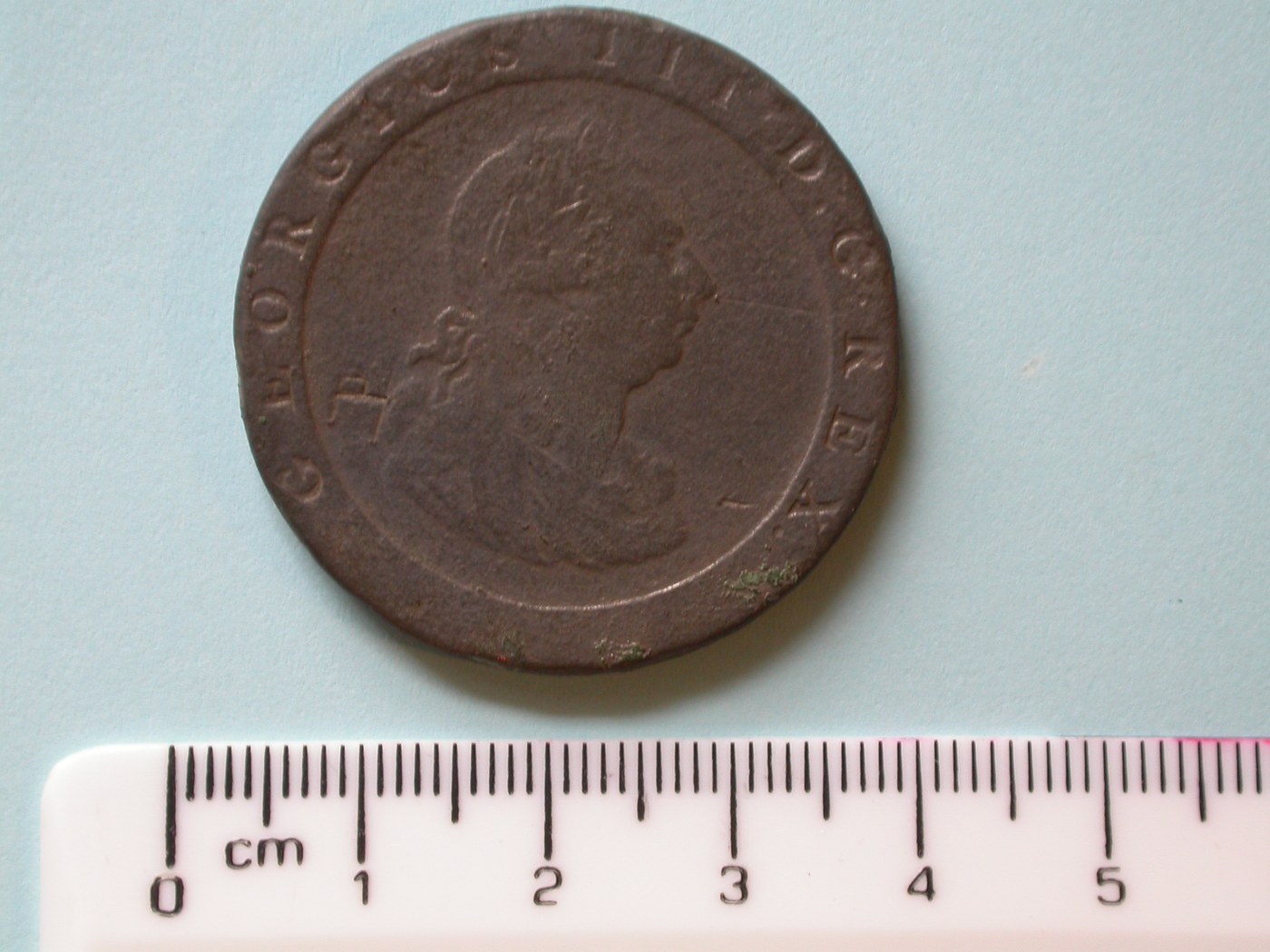
Cartwheel Penny
The heavy 1797 copper penny of George III, with a broad raised rim and sunken lettering, struck by steam power at Matthew Boulton's Soho Mint.
- Country
- United Kingdom
- Denomination
- 1 Penny
- Metal
- Copper
Got a coin like this?
Identify any coin from a photo, free.
Overview
The Cartwheel Penny is a large copper penny of King George III dated 1797, named for its broad, thick raised rim that resembles the rim of a cart wheel. The photographed coin shows the standard type: a right-facing draped bust of George III on the obverse and Britannia seated with a shield, trident and olive branch on the reverse. Both the legends and the date are incuse — pressed into the raised rim rather than standing up in relief — which is the coin's most distinctive feature.
The piece was made from a full ounce of copper, giving it real intrinsic value at a time when small change was scarce and unreliable. Its size and weight make it unmistakable in the hand: it is much larger and heavier than the pennies that came before or after it. A companion twopence of the same design was struck from two ounces of copper and is even larger.
Because the design and date are fixed at 1797, this is a single-year type rather than a series that ran for many years. Surviving examples range from heavily worn pocket pieces to sharp, glossy specimens, and the type is one of the best-known and most collected of all British copper coins.
History & Background
By the 1790s Britain suffered a severe shortage of trustworthy small change, and worn or counterfeit copper circulated widely. The government contracted the industrialist Matthew Boulton, who had developed steam-powered coining machinery at his Soho Mint near Birmingham, to produce a new regal copper coinage. The 1797 pennies and twopences were the result — among the first British coins struck by steam power rather than hand-operated presses.
Boulton's approach was to give the coins an honest metal value, so the penny contained a full ounce of copper and the twopence two ounces. The heavy raised rim was both a design signature and a practical feature: it protected the incuse lettering and central devices from wear and made the large coins harder to counterfeit. The result was a coin of unusual industrial precision for its day.
The cartwheel format proved cumbersome in everyday use because of its bulk, and the design was not repeated. Later George III copper pennies, struck from 1806 onward, returned to conventional raised lettering and a smaller, lighter format, leaving the 1797 cartwheels as a distinctive one-year experiment in the history of British coinage.
How to Identify
Look first for the sunken, or incuse, lettering set into a wide flat raised rim — this is the defining trait and no other British penny shares it. The obverse legend GEORGIVS III D G REX surrounds a right-facing bust of the king; the reverse reads BRITANNIA with the date 1797 below a seated Britannia holding an olive branch and trident, a shield at her side. On the penny you may also see the tiny word SOHO by the shield, marking Boulton's mint.
Size and weight are decisive. The penny is a large coin around 36 mm across and struck from about an ounce of copper, noticeably broad and heavy compared with ordinary pennies. The companion twopence is larger still, roughly 41 mm and about two ounces — if the coin is that big, it is the twopence rather than the penny.
The metal is copper, so genuine circulated examples show a brown to dark brown tone, sometimes with mellow surfaces or spots of verdigris. The raised rim is usually the highest-wear area, so on well-used coins the incuse letters can be soft while Britannia and the bust remain readable.
Value & Collectibility
The 1797 Cartwheel Penny was produced in large numbers and survives in quantity, so worn but complete examples remain among the more affordable early British copper coins. Condition drives value: heavily circulated coins with smooth rims sit at the modest end, while pieces retaining sharp incuse lettering and original surfaces command a clear premium.
Color and surface matter as much as sharpness with copper. Coins that keep glossy, undamaged surfaces or original mint color are far scarcer than typical brown circulated examples and are valued accordingly. Verdigris, cleaning, rim knocks and edge damage all reduce desirability.
The larger cartwheel twopence and higher-grade or proof-quality strikings are more sought after than ordinary circulated pennies. For any specific coin, compare recent sales of the same denomination in similar condition rather than relying on a single figure, as prices vary widely with grade.
Frequently asked questions
Why is it called a Cartwheel Penny?
The nickname comes from the coin's broad, thick raised rim, which looks like the rim of a cart wheel. The wide border also protects the sunken lettering and central designs from wear.
What year is the Cartwheel Penny?
The regal cartwheel copper coinage is dated 1797. It was a single-year type; later George III pennies from 1806 onward used a different, smaller design with raised lettering.
What is the coin made of and how heavy is it?
It is copper. The penny was struck from about one ounce of copper and measures roughly 36 mm across, making it much larger and heavier than a normal penny.
Who made the Cartwheel Penny?
It was struck under government contract at Matthew Boulton's steam-powered Soho Mint near Birmingham, one of the first British coinages produced by steam machinery.
Is the Cartwheel Penny rare?
No, it was made in large numbers and survives widely, so worn examples are common and affordable. Sharp, glossy, or original-color pieces are much scarcer and worth more.
Cartwheel Penny guides
In-depth guides for identifying, valuing, and collecting Cartwheel Penny.
Other coins you may enjoy
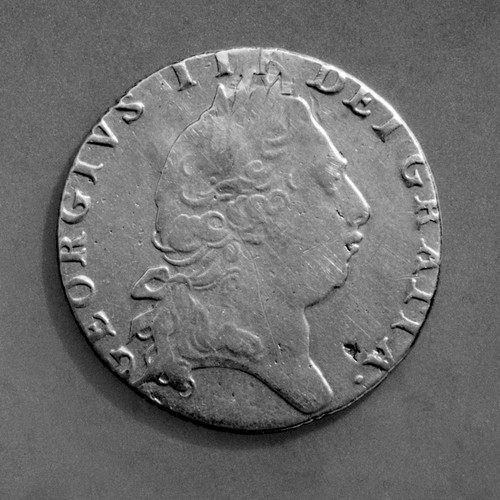
Spade Guinea
1760-1820
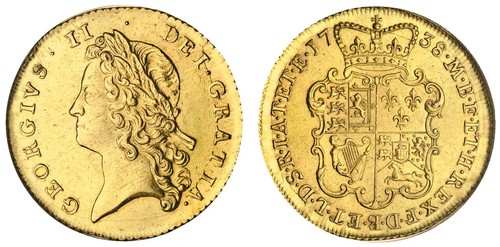
Two Guineas of George II
1738–1753
Shilling of Victoria
1838-1901
Sovereign of George IV
1821-1830
Sovereign of William IV
1831–1837
Penny of William IV
1831-1837
Shilling of George III
1816-1820
Milled Sixpence of Elizabeth I
1561-1571
Shilling of George II
1727-1758
Shilling of Anne
1702-1714
Charles II Twopence
1660-1685
Charles II Half Crown
1660–1685