
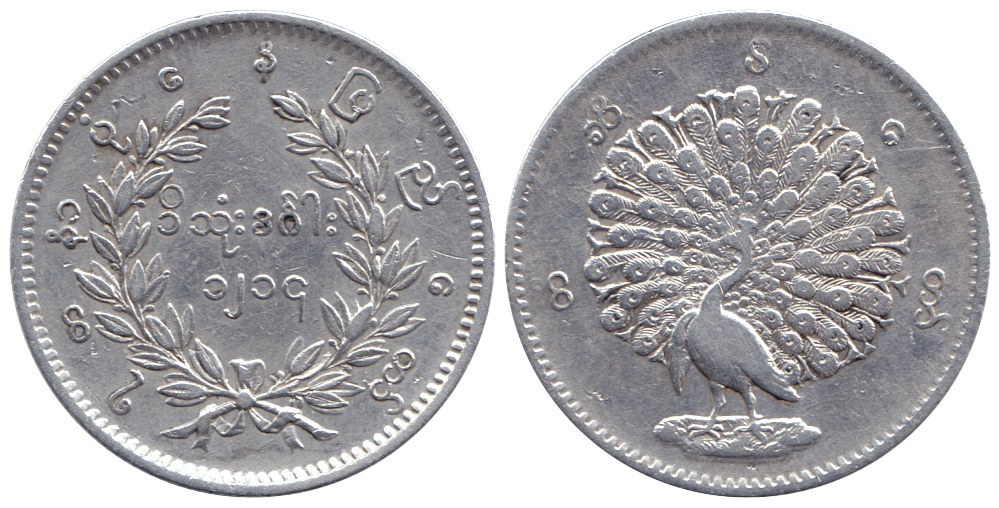
Burma One Kyat (Mindon Min)
Silver kyat of King Mindon Min's Burma, showing the royal peacock with spread tail on the obverse and the denomination within a wreath on the reverse.
- Country
- Myanmar/Burma
- Denomination
- 1 Kyat
- Metal
- Silver
Got a coin like this?
Identify any coin from a photo, free.
Overview
The Burma One Kyat is a silver coin of the Konbaung dynasty struck under King Mindon Min, the ruler who moved the Burmese court to Mandalay in the mid-19th century. It belongs to the celebrated "peacock" coinage: the obverse shows the royal peacock with its tail spread in full display, while the reverse carries the denomination inside a laurel-style wreath, together with the date in the Burmese era. The example shown is dated 1214 of that era, corresponding to about 1852-1853.
The kyat was the principal silver unit of Mindon's new coinage and was struck to a weight and fineness close to the Indian rupee that dominated regional trade, which is why these pieces are sometimes called "peacock rupees." As the standard silver coin of the reign, the one kyat is the flagship denomination of the series and the piece most often meant when collectors speak of Burmese peacock money.
With its spread-tail peacock and Burmese-script legends, the coin is one of the most recognisable of all Southeast Asian issues and marks Burma's move toward a modern, machine-struck national coinage in the years before British annexation of the whole country.
History & Background
King Mindon Min reigned over independent Upper Burma from the 1850s until his death in 1878, in the closing decades of the Konbaung dynasty. He was a reforming ruler who founded the new royal city of Mandalay and sought to modernise the state, and one of his projects was a regular national coinage to replace the lumps of cast and weighed silver that had long served Burmese commerce. To that end he set up a Royal Mint equipped with European-style machinery to strike coins of consistent weight and design.
The peacock series that resulted introduced the kyat as the main silver denomination, supported by smaller fractional pieces. The dancing peacock — the u-to or royal peafowl — was the emblem of the Konbaung house and appears as the central device, making the coinage an assertion of Burmese sovereignty at a time when the British had already taken Lower Burma. The coins carry dates in the Burmese (Chula Sakarat) era rather than the Western calendar; the 1214 date seen on many of these kyats falls around 1852-1853, at the very start of the reign.
The peacock kyat circulated as Burma's national silver until the kingdom's independence ended with the British conquest of Upper Burma in 1885 and the abolition of the monarchy. After annexation the coinage of British India and later British Burma displaced the royal issues, so surviving peacock kyats are relics of the last independent Burmese kingdom.
How to Identify
The Burma One Kyat is a silver coin roughly the size of a rupee or a US quarter, struck to the broadly rupee-weight standard used for regional silver trade. Genuine pieces have the bright grey tone of circulated silver, often with grey or golden toning in the fields and softened high points from handling. It is a struck coin with sharp, even detail, not a cast lump.
The defining feature is the obverse peacock shown facing with its tail fanned out in a full display, surrounded by Burmese-script legend and ornament. The reverse presents the denomination inside a laurel-style wreath, with the date in Burmese numerals of the Chula Sakarat era. There is no royal portrait or Latin lettering — the design relies on the peacock emblem and indigenous script, which sets it apart at once from the English-legend coinage of British India that circulated alongside it.
To confirm an attribution, look for the combination of the spread-tail peacock, a wreath-and-denomination reverse, and Burmese numerals for the date and value on a rupee-sized silver flan. The full-display peacock is the signature of Mindon's coinage; smaller fractional peacock coins share the emblem, so the diameter and the stated value are what mark a piece out as the full one-kyat denomination rather than a fraction.
Value & Collectibility
The Burma One Kyat is a sought-after 19th-century world silver coin with genuine collector demand, so it typically trades well above the value of its silver content. Circulated examples with clear peacock detail are the most commonly offered grade and sit in a moderate collector price range, while sharp, lightly worn or attractively toned pieces command higher premiums.
Condition and eye appeal are the main value drivers within the type. Because these coins saw real circulation in the Burmese economy, many surviving pieces show wear on the peacock's body and tail and softened legends; coins that retain a crisp, fully feathered peacock and clear reverse wreath are markedly more desirable. Die variety, strike quality and originality of surface also matter to specialists, and cleaned or damaged pieces are worth less.
Exact prices depend on grade, variety and market demand, so the figures here are general context rather than fixed values. As with most historic silver, condition and the completeness of the peacock design count for far more than the face denomination, and provenance or certification can add confidence and value for higher-grade examples.
Frequently asked questions
What country and ruler issued the Burma One Kyat?
It was issued in independent Upper Burma under King Mindon Min of the Konbaung dynasty in the mid-19th century. Mindon founded a Royal Mint to strike a modern national coinage, of which the silver kyat was the main denomination.
Why is there a peacock on the coin?
The peacock shown with its tail spread is the royal peafowl emblem of the Konbaung dynasty. It stood for Burmese sovereignty and is the signature device of Mindon Min's coinage, giving the series its "peacock" nickname.
What does the 1853 or 1214 date mean?
The coin is dated in the Burmese (Chula Sakarat) era. The 1214 era date corresponds to roughly 1852-1853 in the Western calendar, near the start of Mindon Min's reign, which is why the piece is described as an 1853-era kyat.
Is the kyat the same as a rupee?
Not exactly, but the silver kyat was struck to a weight and fineness close to the Indian rupee that dominated regional trade, so the coins are sometimes called "peacock rupees." The kyat was Burma's own national unit under Mindon Min.
Is the Burma One Kyat valuable?
It is a collectable 19th-century silver coin that usually trades above its silver value. Ordinary circulated pieces sit in a moderate range, while sharp, well-preserved examples with a clear peacock command higher prices. Condition is the main factor.
Burma One Kyat (Mindon Min) guides
In-depth guides for identifying, valuing, and collecting Burma One Kyat (Mindon Min).
Other coins you may enjoy
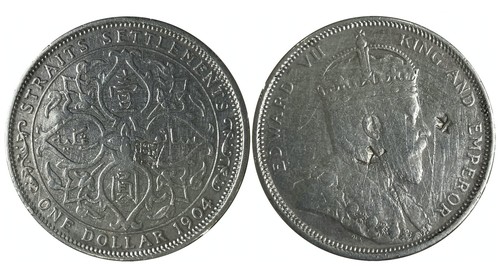
Straits Settlements Dollar
1904
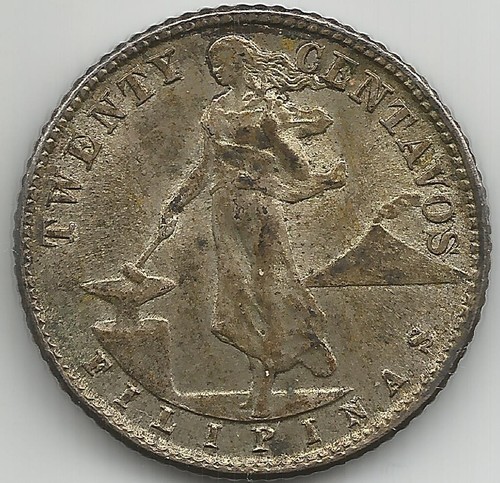
Philippines 20 Centavos
1937–1945 (this example dated 1944)
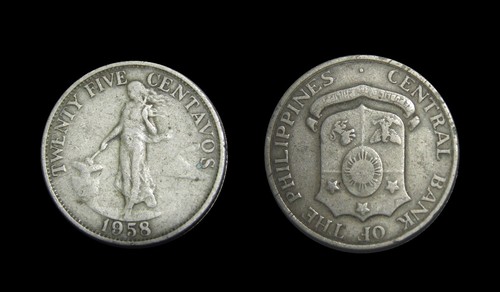
Philippines 25 Centavos
Dated 1958, part of the Republic of the Philippines "English Series" coinage struck from 1958 to 1966
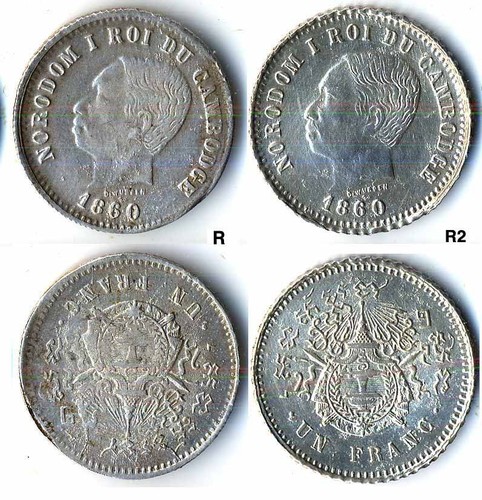
Cambodia One Franc
1950s–1960s
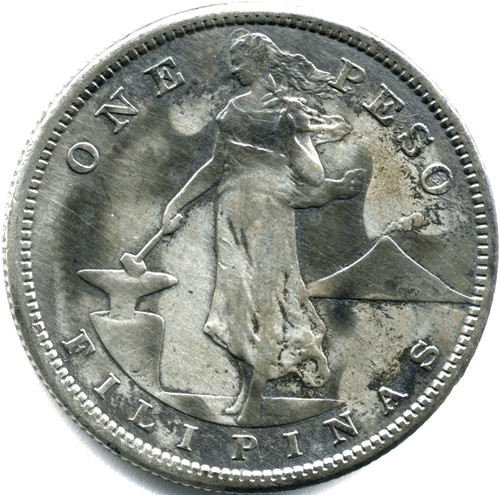
Philippines One Peso
1903–1912
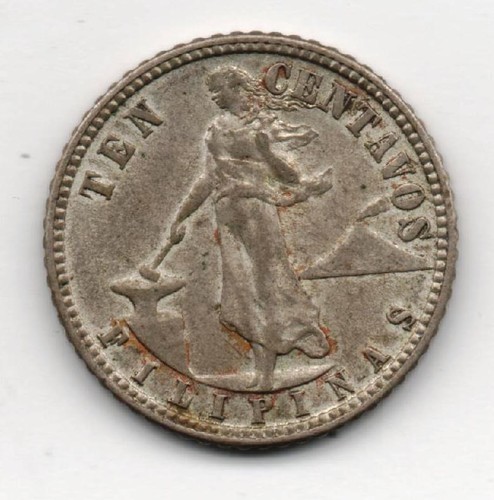
Philippines 10 Centavos
1907–1935 (this example dated 1911)
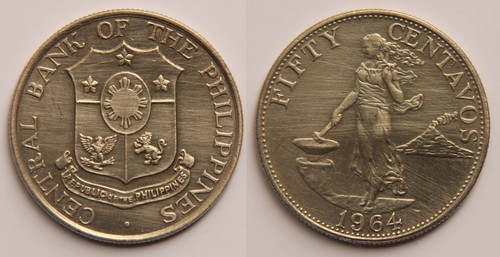
Philippines 50 Centavos
1958–1966 (English series); example dated 1964
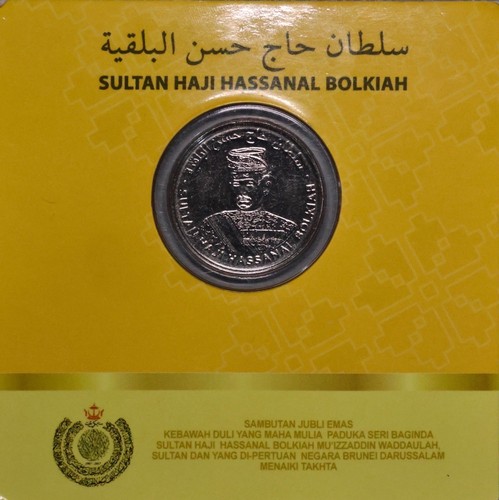
Brunei Golden Jubilee 50 Cents
Golden Jubilee issue, 2017
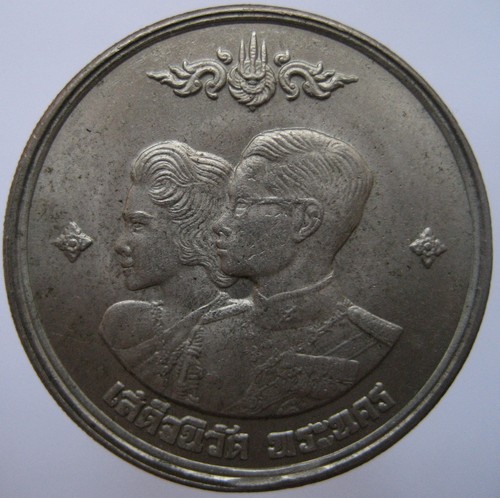
Thailand One Baht Commemorative
1961
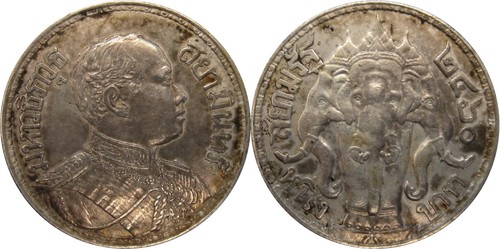
Thailand One Baht
1917
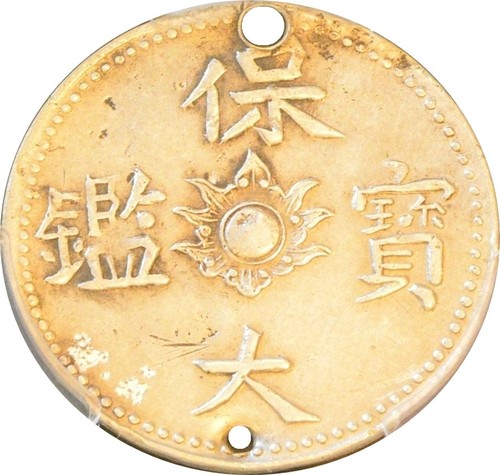
Vietnam 2 Tien - Bao Dai
1926-1945
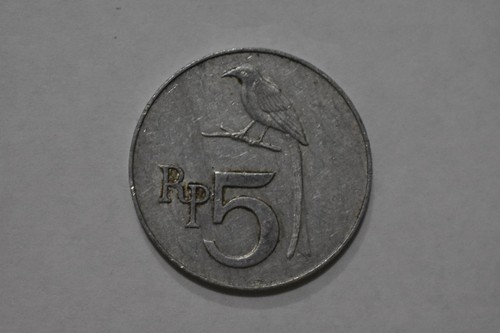
Indonesia 5 Rupiah
2003