
Broad
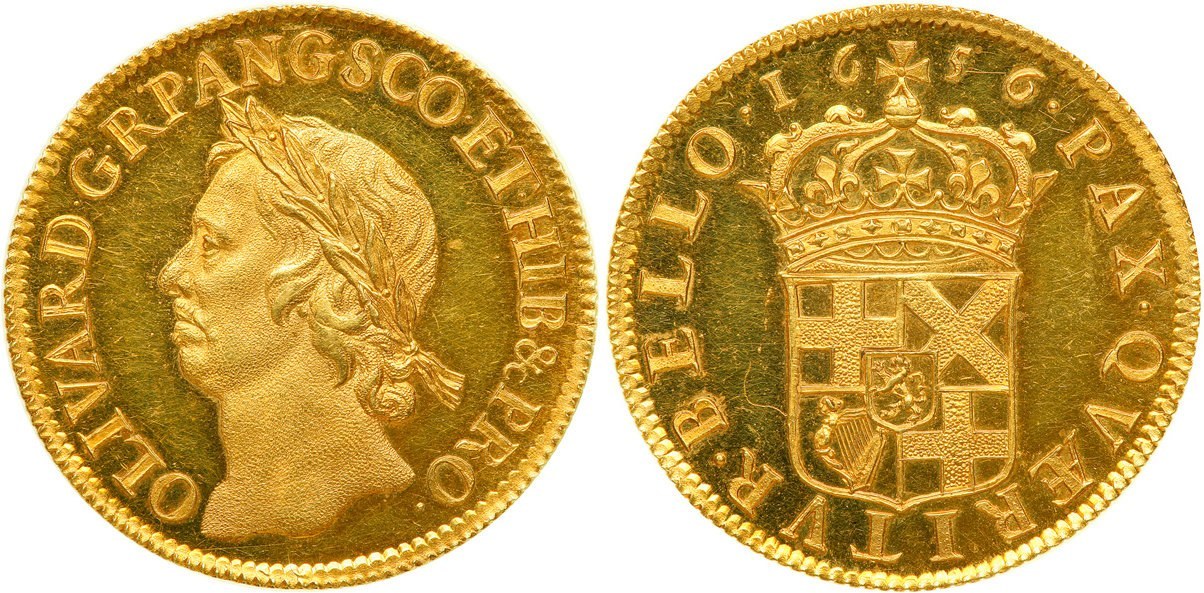
A gold twenty-shilling coin of the Protectorate bearing Oliver Cromwell's Roman-style profile and a crowned quartered shield, dated 1656.
- Country
- England
- Denomination
- Broad (20 shillings)
- Metal
- Gold
Got a coin like this?
Identify any coin from a photo, free.
Overview
The Broad is a gold coin valued at twenty shillings, struck in the mid-1650s during the Protectorate of Oliver Cromwell. It takes its name from its broad, thin flan and represents one of the most distinctive coins of English history, showing a living Lord Protector rather than a monarch in the manner of classical Roman portraiture.
The photographed example is dated 1656 and shows Cromwell's laureate profile facing left with the Latin legend OLIVER D.G. REP. ANGLO, and a crowned quartered shield of the arms of England, Scotland and Ireland on the reverse. As a hammered gold piece it was produced by hand from engraved dies, though the Cromwell coinage was among the finest and most carefully executed work of the late hammered era.
The Broad is scarce and highly prized, both for its gold content and for its unusual place in English coinage as a portrait coin of the republican Commonwealth period, when no king sat on the throne.
History & Background
Oliver Cromwell ruled as Lord Protector from 1653 until his death in 1658, following the execution of Charles I in 1649 and the abolition of the monarchy. Coinage bearing his portrait was prepared in the mid-1650s, and the gold Broad of twenty shillings dated 1656 belongs to this short, exceptional episode when a non-royal head of state appeared on English coins.
The portrait deliberately echoes classical Roman models, presenting Cromwell laureate and in profile like a Caesar, a choice that lent authority to the new republican regime. The dies for the Cromwell coinage are traditionally associated with the engraver Thomas Simon, whose work is regarded as among the highest artistic achievement in English coinage of the period.
Cromwell died in 1658 and the monarchy was restored under Charles II in 1660, bringing the Protectorate to an end. Because the coinage was issued only briefly and in limited quantity, surviving Broads are scarce, and the type is closely studied by collectors of Commonwealth and early modern British gold.
How to Identify
The obverse shows Oliver Cromwell as a laureate bust facing left, rendered in a Roman classical style, with the Latin legend reading OLIVER D.G. REP. ANGLO on the photographed coin — an abbreviated form of Oliver, by the grace of God Protector of the Republic of England, Scotland and Ireland. The laureate head and this legend are the primary diagnostic of the type.
The reverse carries a crowned shield bearing the quartered arms of England, Scotland and Ireland, encircled by a Latin legend and dated 1656. The combination of the Roman-style Cromwell portrait with the crowned quartered shield distinguishes the Broad from royal gold coins of the Stuart kings that carry crowned busts and different heraldry.
The coin is broad and thin in gold, from which it takes its name, and as hammered work it may show slight irregularity of flan and centering. The Cromwell dies, however, are unusually well cut, so genuine pieces display crisp, confident engraving and finely modeled portraiture rather than crude lettering.
Value & Collectibility
The Cromwell Broad is a scarce gold coin of considerable historical importance, and genuine examples command high prices well beyond their gold content. Value depends heavily on grade, strike, provenance, and the absence of damage or tooling, and figures for authenticated pieces reach into the substantial four- and five-figure range at auction.
Because the type is famous, valuable, and struck in small numbers, it has been widely copied and restruck over the centuries, including later official restrikes and numerous replicas. This makes authentication essential; an unattributed or unprovenanced piece cannot be assumed to be an original 1650s striking.
Anyone assessing a specific coin should rely on recent auction records for comparable Cromwell gold and on expert examination, treating any single quoted figure as broad context rather than a firm valuation.
Frequently asked questions
What is a Broad?
The Broad is a gold coin worth twenty shillings, struck during the Protectorate of Oliver Cromwell in the mid-1650s. It is named for its broad, thin flan and shows Cromwell's profile with a crowned quartered shield.
Why does a coin from republican England show a portrait?
Cromwell was presented in the classical Roman manner, laureate and in profile like a Caesar, to lend authority to his rule as Lord Protector. It is unusual because it shows a non-royal head of state rather than a king.
What does the legend OLIVER D.G. REP. ANGLO mean?
It is an abbreviated Latin inscription naming Oliver, by the grace of God Protector of the Republic (Respublica) of England and the associated realms. The full legend continues around both sides of the coin.
Is the Broad rare?
Yes. It was issued only briefly during the Protectorate and in limited numbers, so genuine examples are scarce and highly sought after by collectors of Commonwealth-era gold.
Are there fakes and copies of the Broad?
Many. Because the type is famous and valuable it has been restruck and reproduced over the centuries. Authentication by a specialist is essential before treating any piece as a genuine 1650s striking.
Broad guides
In-depth guides for identifying, valuing, and collecting Broad.
Other coins you may enjoy
English Sixpence
Early 1600s (James I, 1603-1625)
Sixpence of James I
1603-1625
Thistle Merk
1567–1625
James VI Ryal
1567–1571
Quarter Merk
c. 1580–1691
Sixpence of Elizabeth I
1560–1603
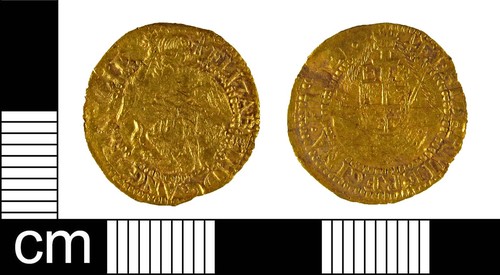
Quarter Angel of Elizabeth I
1581-1583
Laurel
1619-1625
Mary I Groat
1553-1558
Medieval Coin
c. 500–1500 (Medieval)
Half Thistle Merk
1567-1625
Irish Pistole
1640s (17th century)