
How to Identify the Broad
A collector's guide to recognizing the Cromwell gold Broad by its Roman-style portrait, crowned quartered shield, 1656 date, and telltale fabric.
Read the full Broad encyclopedia entry →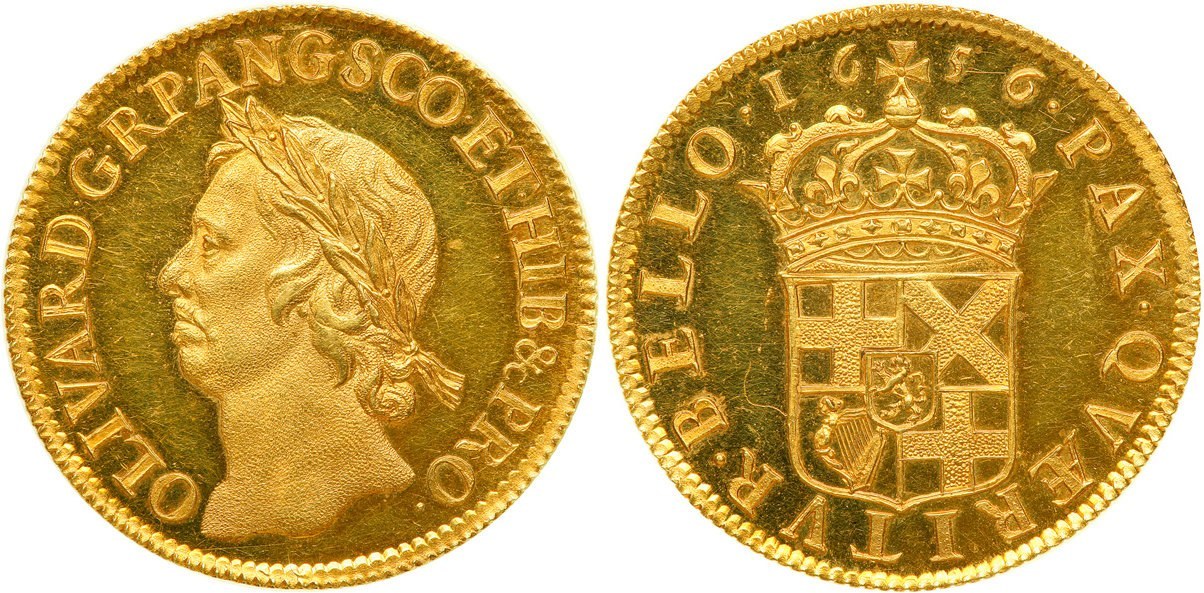
Start with the portrait. The obverse of a Broad shows Oliver Cromwell as a laureate bust facing left, deliberately styled after Roman emperors rather than an English king. Around the rim runs the Latin legend OLIVER D.G. REP. ANGLO, naming him Protector of the Republic. A laureate, non-royal profile with this legend is the single most important confirmation of the type and separates it immediately from Stuart royal gold.
Check the reverse. Look for a crowned shield bearing the quartered arms of England, Scotland and Ireland, surrounded by a Latin legend and carrying the date 1656. The pairing of the Roman-style Cromwell portrait with this crowned quartered shield is the core diagnostic; both sides should be read together before attributing a coin, since royal coins of the same era use different busts and heraldry.
Assess fabric, metal, and size. The Broad is a broad, thin gold coin worth twenty shillings, and its name refers to that wide, flat flan. Weigh and measure the piece and compare against published specifications for the denomination. Genuine Cromwell coinage was struck from exceptionally well-cut dies, so expect crisp, confident engraving and finely modeled portraiture; crude or mushy detail is a warning sign.
Distinguish it from related coins and restrikes. Cromwell gold was also issued as a Fifty Shillings (Broad multiple) and there are milled patterns of similar design, so confirm the denomination by size and weight. Be especially aware that official restrikes and later copies of the Broad exist, some struck from re-engraved or transferred dies, and these can closely resemble originals.
Authenticate carefully. Given the coin's fame and value, cast copies, electrotypes, and modern replicas are common. Look for casting seams, bubbles, unnaturally smooth fields, incorrect weight or dimensions, and lettering that lacks the sharpness of Simon's engraving. For any coin of meaningful value, obtain an opinion from a specialist in English hammered gold or a reputable grading service before purchase.
Frequently asked questions
Which side is the obverse?
The side with the laureate, left-facing portrait of Oliver Cromwell and the OLIVER D.G. REP. ANGLO legend is the obverse. The crowned quartered shield dated 1656 is the reverse.
How do I tell a Broad from royal gold of the same period?
The Broad shows a laureate, Roman-style bust of Cromwell and names him Protector of the Republic, not a king. Royal gold coins carry a crowned monarch's bust and different legends and heraldry.
How can I tell an original from a restrike or copy?
Originals show the crisp, finely engraved work of the Cromwell dies with correct weight and dimensions. Restrikes, casts, and replicas may show seams, bubbles, soft detail, or wrong specifications; specialist authentication is essential.
Does the broad, thin shape mean it is genuine?
The wide flan is expected for the type and gives the coin its name, but shape alone proves nothing. Because the Broad is heavily copied, confirm metal, weight, engraving quality, and provenance before relying on it.