
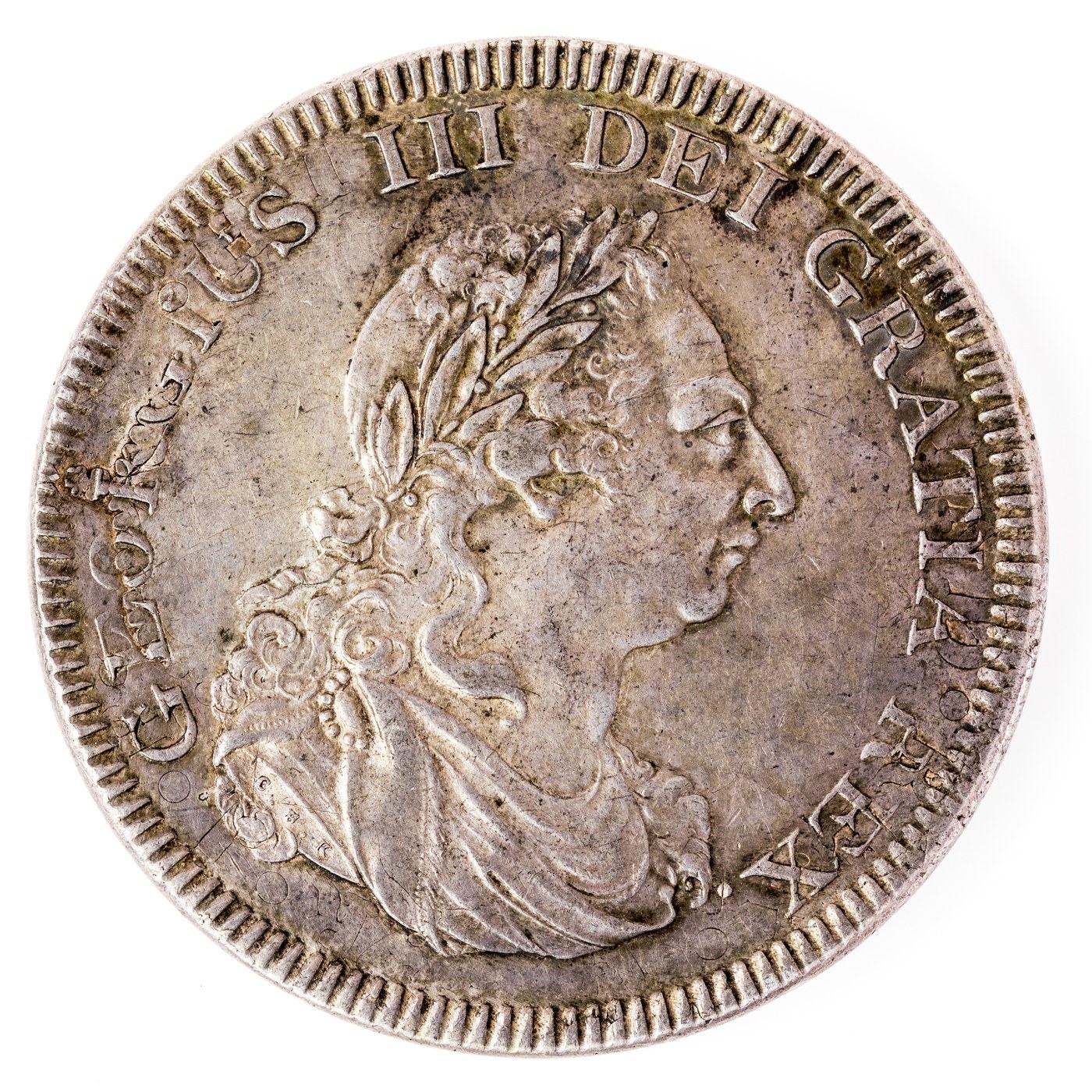
Bank of England Dollar
A George III silver dollar issued by the Bank of England in 1804, struck over Spanish eight-reales coins, with a laureate bust and a crowned shield reverse.
- Country
- Great Britain
- Denomination
- Dollar
- Metal
- Silver
Got a coin like this?
Identify any coin from a photo, free.
Overview
The Bank of England Dollar is a large silver coin issued by the Bank of England in 1804 during the reign of George III. The photographed piece shows a laureate bust of the king facing right with the legend GEORGIUS III DEI GRATIA on the obverse, and a crowned coat of arms within a shield on the reverse, dated 1804. It was valued at five shillings and served as emergency currency during a period when regular British silver was scarce.
Rather than being struck from fresh blanks, these dollars were made by overstriking captured or imported Spanish colonial eight-reales pieces ("pieces of eight") with new British designs. On many surviving examples faint traces of the underlying Spanish coin can still be seen beneath George III's portrait, which is one of the type's most distinctive features.
The coin is roughly the size of a crown, made of sterling-standard silver, and was produced using steam-powered machinery at Matthew Boulton's Soho Mint near Birmingham. It is a well-known and widely collected type that bridges the gap between hand-struck and fully modern British coinage.
History & Background
By the early 1800s Britain faced a severe shortage of circulating silver coin, worsened by wartime demand and the hoarding and melting of official issues. To supply commerce with a reliable large silver piece, the Bank of England issued its own dollar in 1804, giving it a fixed value of five shillings. The Bank, rather than the Royal Mint, sponsored the issue, which is why the coin carries the Bank's name in its reverse legend rather than a conventional royal denomination.
The dollars were produced at Matthew Boulton's Soho Mint, where steam-driven presses allowed captured Spanish eight-reales coins to be overstruck cleanly with the new British types. Spanish colonial silver was abundant through trade and the naval war with Spain and France, making it a practical host coin. The result was a distinctly modern-looking coin at a moment when much British money was still crude or in short supply.
The Bank of England Dollar of 1804 was the principal and best-known issue of this emergency silver, and it was followed in later years by lower-value Bank of England tokens. As a stopgap measure it helped keep trade moving until the Royal Mint's great recoinage and the introduction of a new modern coinage later in George III's reign.
How to Identify
The obverse shows a laureate bust of George III facing right, surrounded by the Latin legend GEORGIUS III DEI GRATIA ("George III, by the Grace of God"). This portrait style, with the king wearing a laurel wreath, together with the 1804 date, is the primary identifier of the type.
The reverse displays Britannia seated on the standard issue, but the coin in these photographs shows the crowned shield of the royal coat of arms as its main device; the surrounding legend names the Bank of England and states the five-shilling value. The presence of the Bank's name in the reverse legend, rather than a normal royal denomination, is a key diagnostic that sets this coin apart from regular Royal Mint crowns and dollars.
The coin is a large silver piece, close to a crown in diameter, struck on the sterling silver standard. A hallmark of the type is the frequent survival of undertype: faint lettering or design elements from the original Spanish eight-reales host coin can often be seen beneath the British designs, especially in the fields and around the edge.
Value & Collectibility
Bank of England Dollars are widely collected and are more available than many contemporary British silver coins, so most circulated examples trade in a moderate range typical of large early-19th-century crowns. Condition is the main driver of value: worn pieces are relatively affordable, while sharp, high-grade or proof examples command significant premiums.
Because each coin was overstruck on a Spanish host, the visibility of the underlying undertype affects desirability. Some collectors specifically seek examples with clear traces of the original Spanish eight-reales, and unusual or well-preserved undertypes can add to a coin's interest and price. Damaged, cleaned, or heavily worn pieces sit at the lower end.
Because values vary with grade, eye appeal, and market conditions, treat any single figure as broad context rather than a fixed price. For a specific coin, compare recent sales of similar examples and, for a high-grade or valuable piece, seek an opinion from a specialist dealer or grading service.
Frequently asked questions
What is a Bank of England Dollar?
It is a large silver coin issued by the Bank of England in 1804, valued at five shillings and bearing a laureate bust of George III. It was emergency currency made to relieve a shortage of British silver.
Why was it struck over a Spanish coin?
Spanish colonial eight-reales pieces were abundant through trade and wartime capture, so the Bank overstruck them with British designs instead of making new blanks. Faint traces of the Spanish undertype often remain visible.
What is it made of and how big is it?
It is a sterling-standard silver coin, roughly the size of a British crown. It was struck on steam presses at Matthew Boulton's Soho Mint near Birmingham.
Is the Bank of England Dollar valuable?
Most circulated examples are moderately valued for a large early-19th-century silver coin, while sharp high-grade or proof pieces are worth considerably more. Visible Spanish undertype can add collector interest.
Why does it say Bank of England and not a royal denomination?
Because the Bank of England, not the Royal Mint, sponsored the issue as emergency money. The reverse legend names the Bank and states the five-shilling value, which distinguishes it from regular royal coinage.
Bank of England Dollar guides
In-depth guides for identifying, valuing, and collecting Bank of England Dollar.
Other coins you may enjoy
Spade Guinea
1760-1820
Two Guineas of George II
1738–1753
Shilling of Victoria
1838-1901
Sovereign of George IV
1821-1830
Sovereign of William IV
1831–1837
Penny of William IV
1831-1837
Shilling of George III
1816-1820
Milled Sixpence of Elizabeth I
1561-1571
Shilling of George II
1727-1758
Shilling of Anne
1702-1714
Charles II Twopence
1660-1685
Charles II Half Crown
1660–1685