
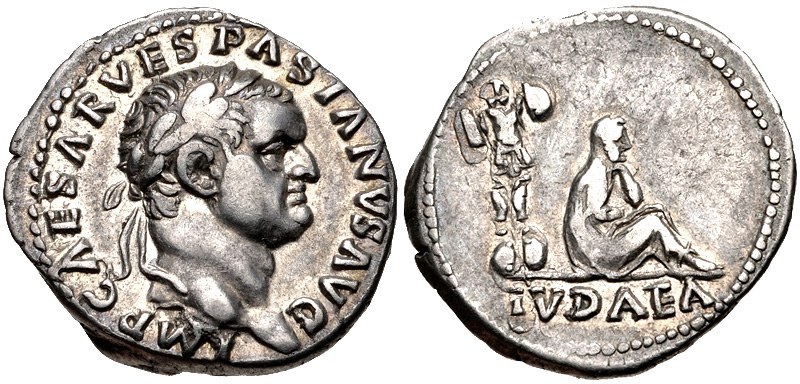
Vespasian Judaea Capta Denarius
Silver denarius of Emperor Vespasian (71–79 AD) with his laureate bust and a Judaea Capta reverse showing a mourning seated captive.
- Country
- Roman Empire
- Denomination
- Denarius
- Metal
- Silver
Got a coin like this?
Identify any coin from a photo, free.
Overview
This is a silver denarius struck under the Roman emperor Vespasian, founder of the Flavian dynasty. The obverse carries his laureate head facing right, encircled by a Latin legend giving his imperial titles. The reverse belongs to the famous "Judaea Capta" propaganda series, here showing a seated female captive personifying the defeated province of Judaea in an attitude of mourning.
The coin is a small, thin silver piece about the diameter of a modern dime, and it was a standard unit of daily Roman commerce. Its enduring fame comes from the reverse subject rather than the denomination: the Judaea Capta issues were minted to commemorate the Roman suppression of the First Jewish Revolt and the fall of Jerusalem in 70 AD. Because they connect directly to a pivotal historical event, these denarii are among the most sought-after and widely recognized coins of the entire Roman imperial series.
History & Background
Vespasian was proclaimed emperor in 69 AD and reigned until 79 AD, restoring stability after the civil wars that followed Nero's death. His son Titus completed the siege and destruction of Jerusalem in 70 AD, ending the main phase of the First Jewish Revolt. To publicize this victory, the imperial mints issued an extensive "Judaea Capta" coinage in gold, silver, and bronze across much of Vespasian's reign, roughly 71 to 79 AD.
The reverse legend and imagery vary within the series. Silver denarii commonly render the theme with a seated captive woman, sometimes accompanied by a trophy of captured arms or a bound male prisoner, and the reverse may read IVDAEA or a related inscription. The mourning posture of the seated woman — head resting on hand, or seated beneath a trophy — became a standard visual formula for a conquered province in Roman art.
These coins were struck in large numbers as instruments of state messaging, celebrating Flavian military legitimacy. Their historical resonance, tied to the destruction of the Second Temple, has made the Judaea Capta series one of the most studied and collected of all ancient issues.
How to Identify
Confirm the metal and size first: a genuine denarius is silver, typically around 17–20 mm across and light in the hand, noticeably smaller and thinner than a sestertius or other large bronze from the same series. The obverse shows a laureate (wreathed) male head facing right, surrounded by an abbreviated Latin legend that includes the name and titles of Vespasian, often opening with IMP CAES VESP or a similar formula.
The reverse is the key diagnostic: a seated female figure in flowing drapery, posed in mourning, personifying captured Judaea. Depending on the exact variety she may sit beneath a trophy of arms or beside a palm tree or bound captive, and an inscription such as IVDAEA may appear in the field or exergue. Roman legends are abbreviated and read clockwise; expect worn or partially struck lettering on many surviving pieces.
Because the design was struck from hand-cut dies, no two examples are identical, and centering, wear, and flan shape vary widely. Focus on the combination of a laureate Vespasian portrait in silver with a mourning seated captive reverse to place the coin within the Judaea Capta denarius group rather than a later or unrelated type.
Value & Collectibility
Judaea Capta denarii of Vespasian are prized both as ancient silver and as historically significant artifacts, so they generally sell well above the level of common Roman denarii. Values depend heavily on the specific reverse variety, the strength and centering of the strike, surface quality, and the clarity of the portrait and legends. Well-worn or off-center examples are the most affordable, while sharp, well-centered pieces with clear Judaea imagery command substantial premiums.
As a broad guide, collectable circulated examples typically trade in the mid hundreds of dollars, with especially attractive or scarce varieties reaching well into the four figures at auction. Toning, absence of corrosion or cleaning marks, and provenance all influence price. Exact figures vary with the market and should be checked against recent auction results rather than treated as fixed.
Because of their fame and value, these coins are frequently faked, so authentication matters as much as grade. A denarius accompanied by credible provenance or a reputable dealer's attestation will always be worth more, and safer, than an unverified piece.
Frequently asked questions
What does "Judaea Capta" mean on this coin?
It is Latin for "Judaea captured," referring to Rome's suppression of the First Jewish Revolt and the fall of Jerusalem in 70 AD. The seated mourning woman on the reverse personifies the conquered province of Judaea.
Who is the man on the obverse?
It is Vespasian, the Roman emperor who reigned from 69 to 79 AD and founded the Flavian dynasty. He is shown as a laureate head facing right, with a Latin legend giving his imperial titles.
Is this coin made of real silver?
The denarius was struck in silver during Vespasian's reign. Genuine examples are small, thin silver pieces roughly 17 to 20 mm across, though centuries of handling and toning can dull the metal's appearance.
Why are Judaea Capta coins so famous?
They commemorate a major historical event — the Roman destruction of Jerusalem and the Second Temple — and were issued as state propaganda. That direct link to a pivotal moment makes them among the most collected of all ancient Roman coins.
Are these denarii commonly counterfeited?
Yes. Because of their fame and value, both modern fakes and tourist replicas exist. Buying from a reputable dealer and seeking provenance or expert authentication is strongly recommended.
Vespasian Judaea Capta Denarius guides
In-depth guides for identifying, valuing, and collecting Vespasian Judaea Capta Denarius.
Other coins you may enjoy
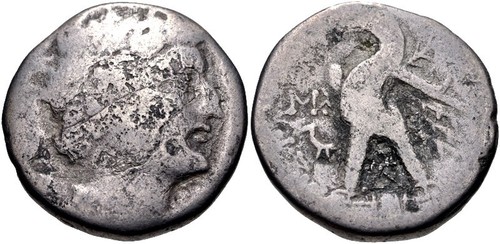
Tetradrachm of Ptolemy XII
80-51 BC
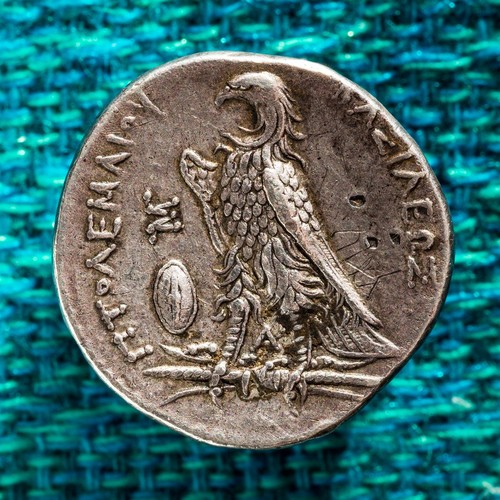
Tetradrachm of Ptolemy I
305-283 BC
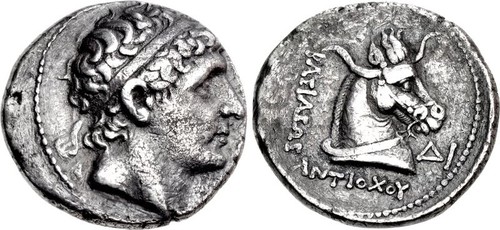
Tetradrachm of Antiochos I Soter
281-261 BC
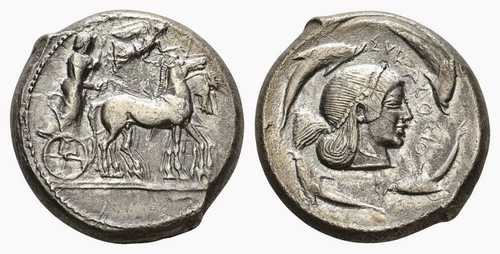
Syracuse Tetradrachm
c. 5th-4th century BC (Classical period)
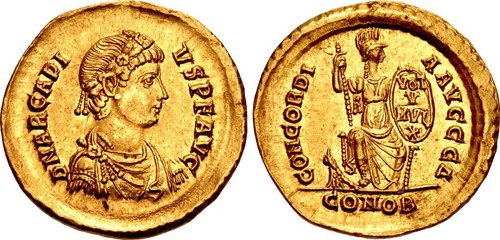
Solidus of Arcadius
AD 395-402
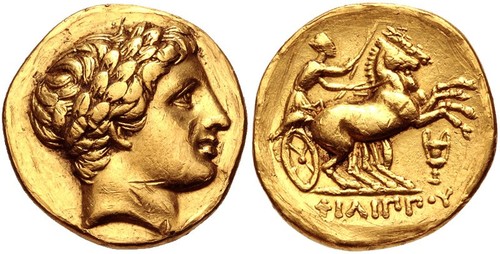
Philip III Gold Stater
323-317 BC
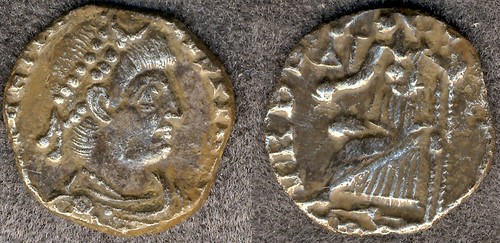
Siliqua of Gratian
AD 367-383
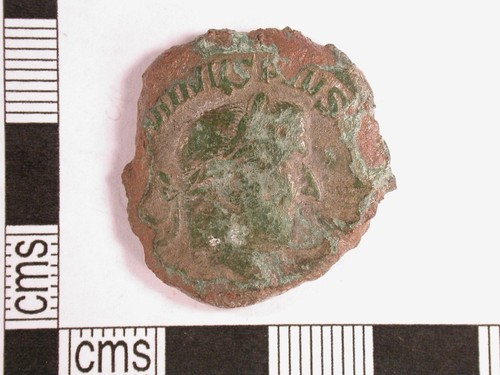
Sestertius of Maximinus Thrax
235-238 AD
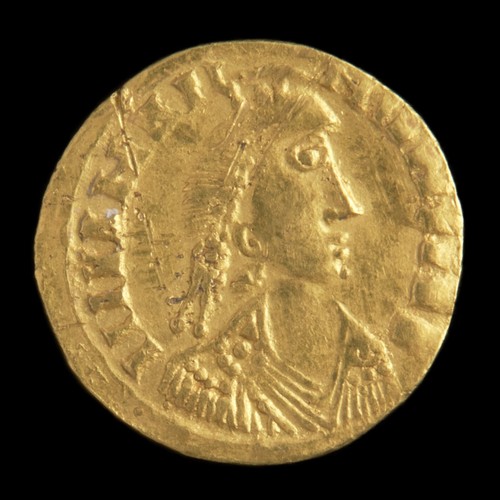
Solidus of Valentinian III
AD 425-455
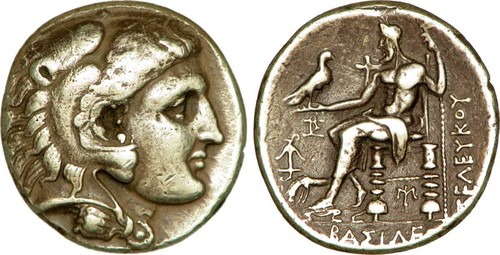
Seleucus I Nicator Tetradrachm
Late 4th-3rd century BC
Nummus of Magnentius
AD 350-353
Follis of Galerius
AD 308-310