
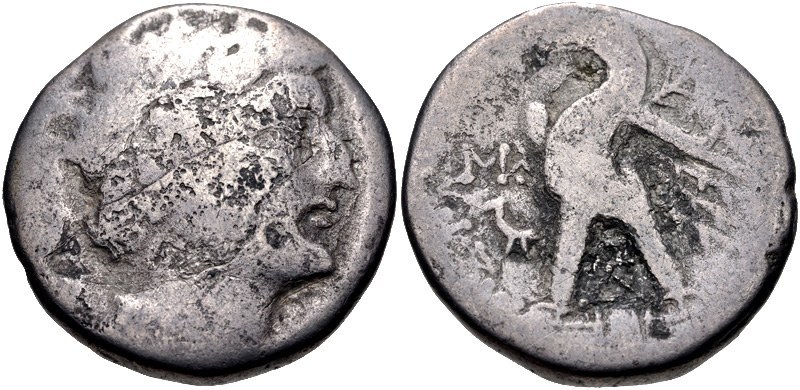
Tetradrachm of Ptolemy XII
Silver tetradrachm struck under Ptolemy XII of Egypt, father of Cleopatra VII, bearing a diademed royal Ptolemaic head and the dynasty's eagle-on-thunderbolt reverse.
- Country
- Ancient Egypt
- Denomination
- Tetradrachm
- Metal
- Silver
Got a coin like this?
Identify any coin from a photo, free.
Overview
This is a silver tetradrachm struck under Ptolemy XII, king of Ptolemaic Egypt and the father of Cleopatra VII. Like the royal silver of the whole dynasty, it keeps a fixed design formula: a diademed Ptolemaic royal head in profile on the obverse and an eagle standing on a thunderbolt on the reverse, framed by a Greek legend naming King Ptolemy.
By Ptolemy XII's reign in the mid-first century BC, Egypt was the last major Hellenistic kingdom still standing and was falling ever deeper into Rome's orbit. The tetradrachm was the workhorse of the royal economy, and the coins of this period are typically struck in visibly debased silver, so they often look pale or greyish rather than bright white.
The piece is identified as a Ptolemaic tetradrachm by its diademed royal profile, its distinctive standing eagle reverse, its Greek royal legend, and its weight and module on the reduced Ptolemaic standard. Its attribution to Ptolemy XII rests on the reign, the debased late-dynasty fabric, and any regnal date or mint marks in the fields.
History & Background
Ptolemy XII ruled Egypt from about 80 to 51 BC, with a period of exile in the middle when he was driven from Alexandria and later restored with Roman military help. He carried the popular nickname Auletes, "the Flute Player," and the grander royal cult title Neos Dionysos, "the New Dionysos." His reign is remembered above all as the immediate prelude to Cleopatra VII, who was his daughter and successor.
His kingdom was politically fragile and financially strained. Ptolemy XII spent lavishly to buy Roman friendship and to secure his throne, borrowing heavily and leaning on Roman power brokers. That pressure shows in the coinage: the silver of the late Ptolemies was progressively debased, so tetradrachms of this era carry less fine metal than the bright royal silver of the dynasty's earlier centuries.
Against this backdrop the mint at Alexandria, along with Ptolemaic mints on Cyprus, continued to strike tetradrachms in the traditional dynastic types. Keeping the founder's imagery and the eagle reverse unchanged projected continuity and legitimacy at a moment when the dynasty's real independence was slipping away. When Ptolemy XII died in 51 BC he left the throne to Cleopatra VII and a younger Ptolemy, and Egypt's absorption by Rome followed within a generation.
How to Identify
The obverse shows a diademed royal head in profile facing right, wearing the plain royal diadem tied behind the head. On Ptolemaic tetradrachms this portrait perpetuates the image of the dynasty's founder, Ptolemy I Soter, rather than a fresh likeness of the reigning king, so the head looks broadly similar across many reigns; the attribution to Ptolemy XII comes from the coin's date, fabric, and controls rather than from a personal portrait.
The reverse carries the signature Ptolemaic device: an eagle standing left on a thunderbolt, wings usually closed, with the Greek royal legend ΠΤΟΛΕΜΑΙΟΥ ΒΑΣΙΛΕΩΣ ("of King Ptolemy") running around it. Late issues frequently include a regnal date and letters or monograms in the fields that identify the year and mint, such as Alexandria or the Cypriot mints. A seated figure or sphinx is not the standard reverse for these tetradrachms, so a well-preserved specimen should show the standing eagle.
In hand the coin is a tetradrachm on the reduced Ptolemaic weight standard, on the order of roughly 12.5 to 14 grams and about 24 to 27 mm across, struck by hand so the flan is somewhat irregular. The metal of Ptolemy XII's silver is noticeably debased, giving a paler, greyer surface than early Ptolemaic tetradrachms. The combination of a diademed royal head, the standing eagle on thunderbolt, the King Ptolemy legend, and this late debased fabric is the core identifier.
Value & Collectibility
As genuine late-Ptolemaic royal silver tied to the era of Cleopatra VII and her father, this tetradrachm holds steady collector demand. Worn but clearly identifiable examples commonly trade from roughly the low hundreds of dollars upward, while well-centered coins with a strong eagle, a clear legend, and a readable date can reach higher, particularly when the metal has attractive toning rather than heavy debasement pitting.
Value is shaped by the sharpness of the portrait and eagle, the completeness of the Greek legend, the presence and legibility of a regnal date and mint controls, the flan's centering, and overall surface quality. The debased silver of this period can be porous or dull, which caps the grade of many survivors, so clean, firmly struck coins stand out. The Cleopatra-adjacent history adds broad collector appeal.
These ranges are general context, not appraisals. Any specific coin's price depends on condition, mint and date, eye appeal, and authenticity, and higher-value ancient silver is best bought with specialist cataloguing or third-party certification.
Frequently asked questions
Who was Ptolemy XII?
He was king of Ptolemaic Egypt from about 80 to 51 BC, nicknamed Auletes ("the Flute Player") and titled Neos Dionysos. He is best known as the father of Cleopatra VII, and he ruled with heavy reliance on Roman support.
Whose portrait is on the coin?
The diademed royal head follows the standard Ptolemaic type, which perpetuates the image of the dynasty's founder Ptolemy I Soter rather than a personal likeness of Ptolemy XII. The reign is identified from the coin's date, fabric, and mint controls.
What is the eagle on the reverse?
The eagle standing on a thunderbolt is the emblem of the Ptolemaic dynasty, associated with Zeus. It appears on Ptolemaic royal silver for centuries, encircled by the Greek legend ΠΤΟΛΕΜΑΙΟΥ ΒΑΣΙΛΕΩΣ, "of King Ptolemy."
How big and heavy is the coin?
It is a tetradrachm on the reduced Ptolemaic standard, on the order of roughly 12.5 to 14 grams and about 24 to 27 mm across. It is hand-struck, so shape and centering vary, and the late silver is often pale from debasement.
Why does the silver look pale or grey?
Late Ptolemaic silver was progressively debased with base metal to stretch strained royal finances, so tetradrachms of Ptolemy XII contain less fine silver than earlier issues and can appear greyish, dull, or slightly porous.
Tetradrachm of Ptolemy XII guides
In-depth guides for identifying, valuing, and collecting Tetradrachm of Ptolemy XII.
Other coins you may enjoy
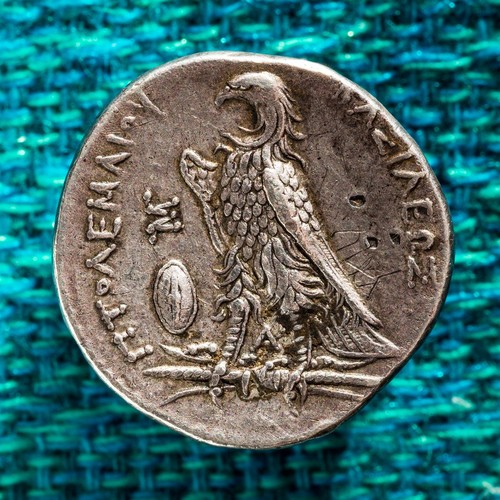
Tetradrachm of Ptolemy I
305-283 BC
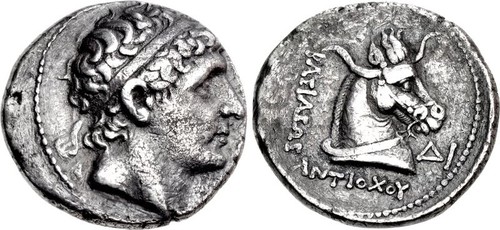
Tetradrachm of Antiochos I Soter
281-261 BC
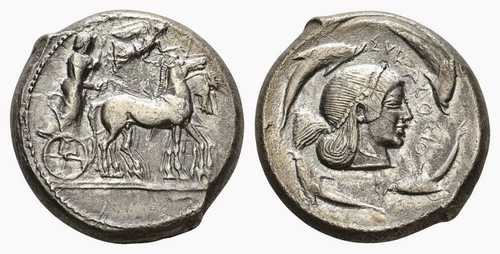
Syracuse Tetradrachm
c. 5th-4th century BC (Classical period)
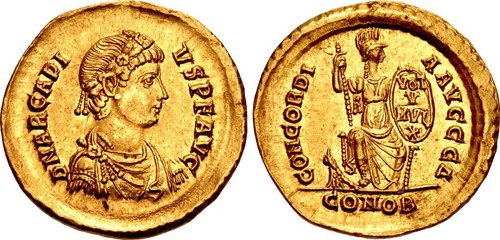
Solidus of Arcadius
AD 395-402
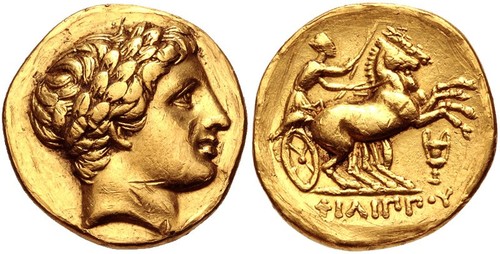
Philip III Gold Stater
323-317 BC
Siliqua of Gratian
AD 367-383
Sestertius of Maximinus Thrax
235-238 AD
Solidus of Valentinian III
AD 425-455
Seleucus I Nicator Tetradrachm
Late 4th-3rd century BC
Nummus of Magnentius
AD 350-353
Follis of Galerius
AD 308-310
Follis of Licinius I
AD 320-321