
How to Identify the Tetradrachm of Ptolemy XII
A collector's guide to recognizing this late-Ptolemaic tetradrachm by its diademed royal head, eagle-on-thunderbolt reverse, Greek legend, debased silver, and dates.
Read the full Tetradrachm of Ptolemy XII encyclopedia entry →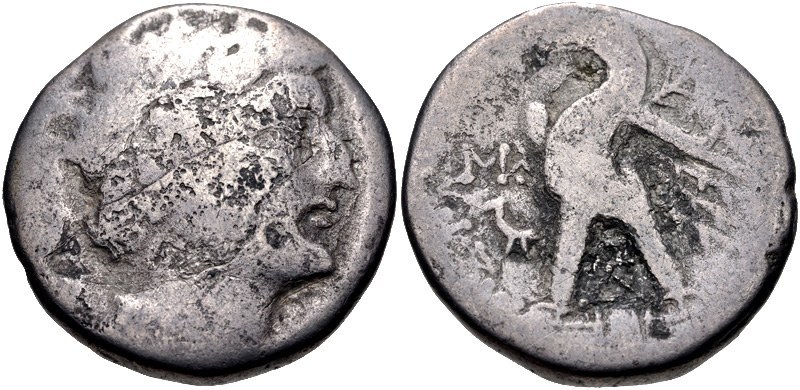
Begin with denomination and metal. This is a silver tetradrachm on the reduced Ptolemaic standard, on the order of roughly 12.5 to 14 grams and about 24 to 27 mm wide. Weigh and measure any candidate first: lighter or smaller silver of the same style will be a smaller Ptolemaic denomination, and a very different weight rules out a full tetradrachm before you study the types. Expect the metal to look paler and greyer than early Ptolemaic silver, because late-dynasty tetradrachms are noticeably debased.
Read the obverse. You want a diademed royal head in profile facing right, wearing a plain tied diadem, in the traditional Ptolemaic style. It is important to know that this portrait perpetuates the founder Ptolemy I Soter and is not a personal likeness of Ptolemy XII, so you cannot attribute the coin from the face alone. A laurel or radiate crown, or a portrait in a different Hellenistic style, points to a non-Ptolemaic coin.
Turn to the reverse, which should show the eagle standing left on a thunderbolt with the Greek legend ΠΤΟΛΕΜΑΙΟΥ ΒΑΣΙΛΕΩΣ around it. This standing eagle is the single most diagnostic feature of Ptolemaic royal silver. A seated deity or a sphinx is not the normal reverse for these tetradrachms, so if a clear coin shows something other than the eagle, reconsider the identification rather than forcing it.
Attribute the reign from dates and mint controls, not the portrait. Late Ptolemaic tetradrachms often carry a regnal year and letters or monograms in the fields that indicate the year and the mint, most commonly Alexandria or the Cypriot mints such as Paphos. Record only the marks that are genuinely present; these small controls, read against a specialist reference, are what separate Ptolemy XII's issues from the very similar coins of other Ptolemies.
Finally, weigh authenticity. Ptolemaic silver is faked, and the debased late fabric can complicate judgment. Watch for a seam around the edge, a soft or bubbly surface, and an unnaturally uniform, non-metallic tone, all signs of a cast copy; tooled coins show scratchy, over-sharp detail added to worn relief. Because the dynasty reused the same types for centuries, a secure attribution rests on weight, fabric, legend, and controls together, and for a significant purchase you should rely on specialist cataloguing or third-party certification and documented provenance.
Frequently asked questions
How do I tell a Ptolemy XII tetradrachm from those of earlier Ptolemies?
The obverse portrait barely changes across reigns, so rely on the regnal date and mint controls in the reverse fields and on the fabric. Ptolemy XII's late silver is visibly debased and paler, and specialist references match the date letters to his reign.
The reverse looks like a seated figure or sphinx, not an eagle. What does that mean?
The standard reverse for these tetradrachms is an eagle standing on a thunderbolt. Wear, off-centering, or a worn eagle can be mistaken for a seated form. If a clear coin genuinely shows a seated figure or sphinx, it may be a different type or issue, so re-check the attribution.
How do I confirm it is a tetradrachm and not a smaller coin?
Weigh and measure it. A Ptolemaic tetradrachm sits on the order of roughly 12.5 to 14 grams and about 24 to 27 mm across. Lighter, smaller silver of the same design is a lower denomination, so the weight settles it.
What are the main warning signs of a fake?
A seam around the edge, a soft or bubbly surface, and a dull, uniform non-metallic tone suggest a cast copy, while scratchy over-sharp detail on worn relief suggests tooling. For valuable examples, seek specialist attribution or certification.