
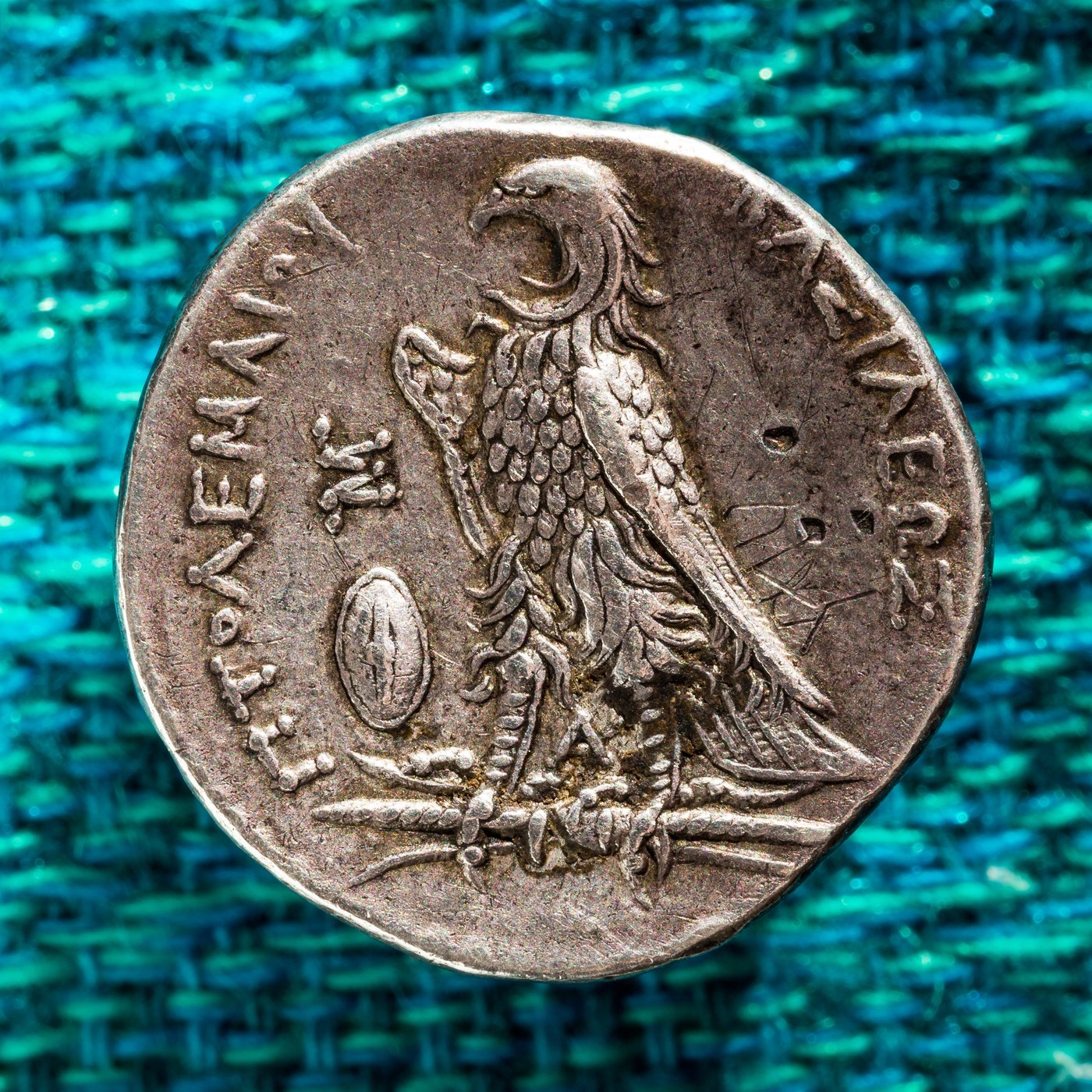
Tetradrachm of Ptolemy I
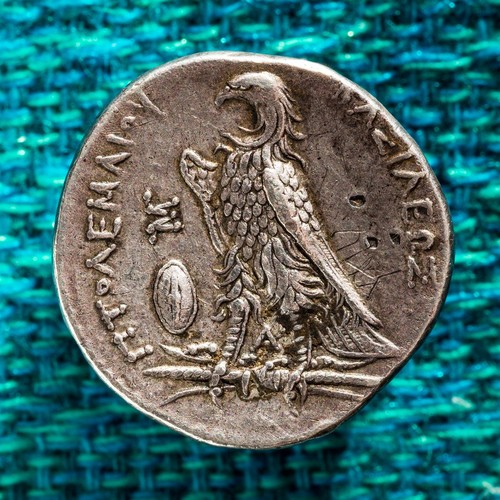
Silver tetradrachm of Ptolemy I Soter of Egypt, c. 305-283 BC, with his diademed portrait and the Ptolemaic eagle standing on a thunderbolt.
- Country
- Ancient Egypt
- Denomination
- Tetradrachm
- Metal
- Silver
Got a coin like this?
Identify any coin from a photo, free.
Overview
This is a large silver tetradrachm of Ptolemy I Soter, the Macedonian general who founded the Ptolemaic dynasty that ruled Egypt after the death of Alexander the Great. The coin pairs a realistic diademed portrait of the king on the obverse with an eagle perched on a thunderbolt on the reverse, the emblem that would define Ptolemaic coinage for nearly three centuries.
The example shown belongs to the years roughly 305 to 283 BC, the period after Ptolemy took the royal title of king and struck coinage in his own name and image. Unlike the pan-Hellenic Alexander types that most successors continued to copy, Ptolemy created a distinct national coinage for Egypt, with his own portrait and the eagle badge instead of the familiar Herakles-and-Zeus formula.
The coin is identified by its bold, individualized royal head wearing a diadem, its eagle-on-thunderbolt reverse, and its weight and fabric. Ptolemaic tetradrachms were struck on a lighter, thicker standard than most Greek silver, giving them a compact, chunky look that is itself a recognition clue.
History & Background
Ptolemy, son of Lagos, was one of Alexander the Great's closest companions and generals. After Alexander died in 323 BC, Ptolemy secured Egypt as his satrapy and, in 305 BC, declared himself king, founding a dynasty that would rule from Alexandria until the death of Cleopatra VII in 30 BC. He earned the surname Soter, meaning Savior, and built Egypt into one of the wealthiest Hellenistic kingdoms.
Early in his rule Ptolemy issued coins in the name and types of Alexander, but he progressively transformed the coinage into something uniquely Ptolemaic. He introduced his own lifelike portrait, a striking departure that made him one of the first living rulers to place his own face on Greek coinage, and he adopted the eagle on a thunderbolt as the dynasty's enduring reverse emblem, linking the house to Zeus.
He also placed Egypt on a distinct, reduced weight standard, lighter than the Attic standard used across most of the Greek world. This created a closed monetary zone: foreign coin entering Egypt was reminted into Ptolemaic money, keeping royal silver dominant at home. The diademed-head tetradrachm struck from about 305 to 283 BC established the visual language that Ptolemy's successors would repeat, often keeping his portrait long after his death.
How to Identify
The obverse shows a diademed head of Ptolemy I in profile, a realistic and individual portrait rather than an idealized deity. Look for the royal diadem, a narrow band tied around the head with trailing ends, a strong jaw and neck, and often the aegis (a scaly or fringed mantle) around the shoulder on many issues. This lifelike ruler portrait is the single most distinctive obverse feature.
The reverse displays an eagle standing on a thunderbolt, usually facing left with folded or partly spread wings, surrounded by the Greek legend that names Ptolemy as king (basileus). Control marks, monograms, or small symbols often appear in the field, and these help attribute the coin to a particular mint and phase of striking.
In hand the coin is a full tetradrachm of good silver, but struck on the reduced Ptolemaic standard, so it typically weighs on the order of roughly 14 to 15.5 grams rather than the 17 grams of an Attic tetradrachm, and it tends to be smaller and thicker, about 24 to 28 mm across. It is hand-struck, so the flan is irregular and centering varies, and the silver usually carries old grey or iridescent toning. The combination of a diademed realistic portrait and the eagle-on-thunderbolt reverse is the core identifier.
Value & Collectibility
As genuine ancient silver of a famous founding king, and one of the earliest true ruler portraits in coinage, the Ptolemy I tetradrachm has a strong and steady collector market. Worn but clearly identifiable examples typically trade from the low-to-mid hundreds of dollars, while well-centered, sharply struck coins with a bold portrait and clean surfaces can reach well into the four figures.
Value is driven by the quality and style of the portrait, the sharpness of the eagle and legend, the flan's centering, the presence and legibility of control marks, and overall eye appeal and toning. Attractive early style, strong metal, and documented provenance add meaningful premiums, as does secure attribution to a specific mint such as Alexandria.
The ranges here are general context, not appraisals. Any specific coin's price depends heavily on condition, style, authenticity, and attribution. Because high-grade Ptolemaic silver is both valuable and widely imitated, significant examples are often sold with specialist cataloguing or third-party certification.
Frequently asked questions
Who was Ptolemy I Soter?
Ptolemy was a Macedonian general and companion of Alexander the Great who took control of Egypt after Alexander's death and declared himself king in 305 BC. He founded the Ptolemaic dynasty, which ruled Egypt from Alexandria until 30 BC.
Why is there an eagle on the back?
The eagle standing on a thunderbolt was the emblem of the Ptolemaic dynasty, linking the royal house to Zeus. Ptolemy I adopted it as the reverse type, and it remained the signature Ptolemaic device for nearly three centuries.
Is the portrait really Ptolemy himself?
Yes. Unlike the idealized or divine heads on most Greek coins, this is a realistic individual portrait of the living king, making Ptolemy one of the first rulers to put his own recognizable face on Greek coinage.
Why is this tetradrachm lighter than others?
Ptolemy placed Egypt on a reduced weight standard, lighter than the Attic standard used elsewhere. As a result a Ptolemaic tetradrachm usually weighs around 14 to 15.5 grams rather than about 17 grams, and looks smaller and thicker.
Were these coins struck only during his reign?
The diademed portrait of Ptolemy I was used during his own reign from about 305 to 283 BC, but his successors continued striking eagle-reverse tetradrachms bearing his portrait for generations, so similar-looking coins span the whole dynasty.
Tetradrachm of Ptolemy I guides
In-depth guides for identifying, valuing, and collecting Tetradrachm of Ptolemy I.
Other coins you may enjoy
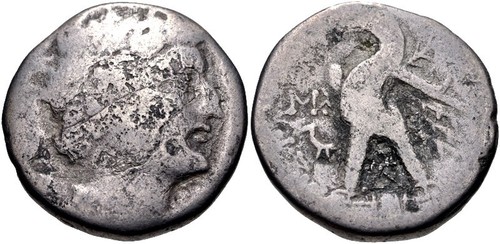
Tetradrachm of Ptolemy XII
80-51 BC
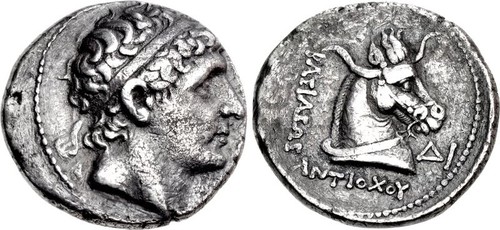
Tetradrachm of Antiochos I Soter
281-261 BC
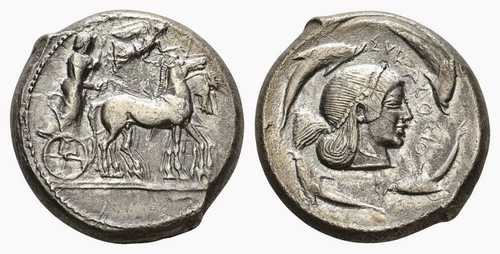
Syracuse Tetradrachm
c. 5th-4th century BC (Classical period)
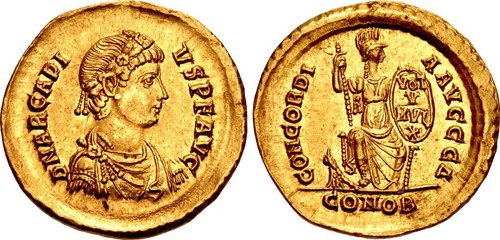
Solidus of Arcadius
AD 395-402
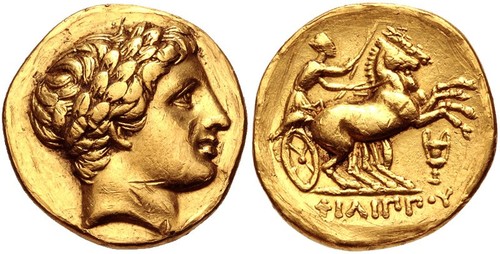
Philip III Gold Stater
323-317 BC
Siliqua of Gratian
AD 367-383
Sestertius of Maximinus Thrax
235-238 AD
Solidus of Valentinian III
AD 425-455
Seleucus I Nicator Tetradrachm
Late 4th-3rd century BC
Nummus of Magnentius
AD 350-353
Follis of Galerius
AD 308-310
Follis of Licinius I
AD 320-321