
How to Identify the Tetradrachm of Ptolemy I
A collector's guide to recognizing the Ptolemy I tetradrachm by its realistic diademed portrait, eagle-on-thunderbolt reverse, and reduced Ptolemaic weight.
Read the full Tetradrachm of Ptolemy I encyclopedia entry →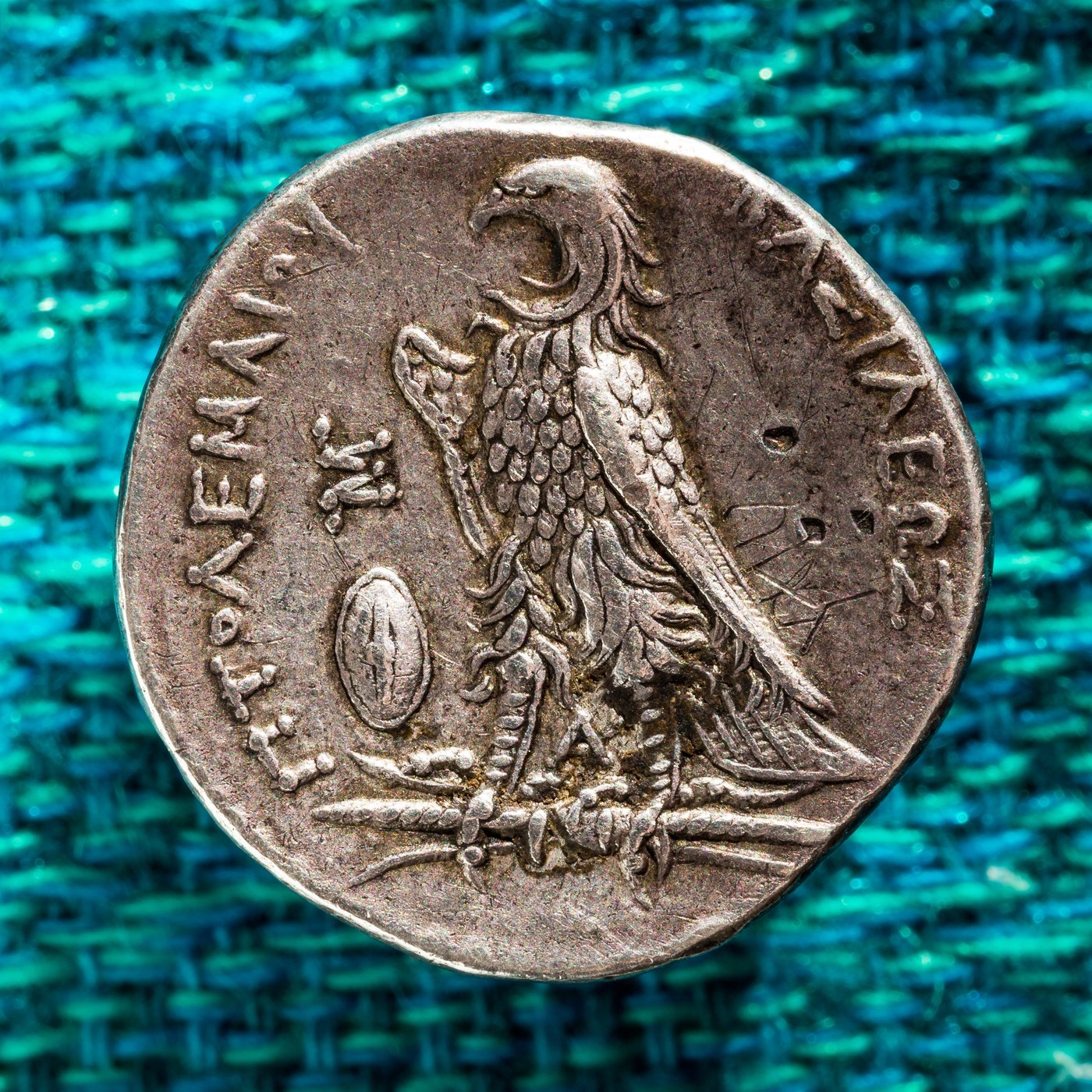
Start with the obverse portrait, because it is the most telling feature. This coin carries a realistic, individualized head of Ptolemy I wearing a royal diadem, a plain band tied around the head with short trailing ends at the back. The face is a true portrait with a heavy jaw, prominent brow, and thick neck, and on many issues an aegis (a scaly or fringed collar) drapes the shoulder. If the head is an idealized youthful deity or a lion-scalp Herakles, you are looking at an Alexander-type coin, not a Ptolemaic royal portrait.
Read the reverse. It should show an eagle standing on a thunderbolt, generally facing left, with a Greek legend naming Ptolemy as king around it. Confirm the eagle is perched on a horizontal thunderbolt rather than on a rock, wreath, or nothing at all, and note any monograms or control symbols in the field beside the eagle; these are the marks used to attribute the coin to a mint and issue.
Weigh and measure the coin, because the Ptolemaic standard is a key diagnostic. A genuine Ptolemy I tetradrachm typically sits around 14 to 15.5 grams and about 24 to 28 mm across, noticeably lighter than a roughly 17-gram Attic tetradrachm and often thicker and more compact in the hand. A coin with the eagle reverse that weighs a full 17 grams, or that is thin and broad, deserves a second look before you accept the attribution.
Mind the dynasty problem. The eagle-and-portrait formula outlived Ptolemy I by generations, and later kings kept striking tetradrachms with his portrait and even added regnal dates and mint letters over time. A plain, undated eagle reverse with early portrait style points to the founder's own reign of about 305 to 283 BC, whereas dated reverses, mint-city monograms, or a portrait that has hardened into a stylized mask usually indicate a later Ptolemaic issue in his name. Attribution therefore rests on style, legend, and control marks together, not the eagle alone.
Finally, weigh authenticity. Ptolemaic silver is widely faked, so watch for cast-copy tells: a seam around the edge, a soft or bubbly surface, and a dull, non-metallic tone. Tooled coins show scratchy, unnaturally sharp detail added to worn relief, and modern forgeries sometimes get the weight standard wrong. Genuine strikes are hand-made and slightly irregular, with old grey or iridescent toning over bright metal. For a significant purchase, rely on specialist cataloguing or third-party certification and documented provenance.
Frequently asked questions
How do I tell a Ptolemy I coin from an Alexander tetradrachm?
Look at the types. An Alexander tetradrachm shows a Herakles head in a lion scalp with an enthroned Zeus reverse. A Ptolemy I coin shows a realistic diademed royal portrait with an eagle on a thunderbolt. The eagle reverse and the true portrait are the clearest distinctions.
How can I confirm it is a genuine Ptolemaic tetradrachm by weight?
Weigh it. Ptolemy struck on a reduced standard, so a real tetradrachm usually falls around 14 to 15.5 grams and looks compact and thick, unlike a roughly 17-gram Attic tetradrachm. A wrong weight is a warning sign of a fake or a misattribution.
Does the portrait tell me it was struck in his lifetime?
Not by itself. His successors kept using his portrait for generations. Early, lifelike style with a plain undated eagle reverse points to his own reign, while dated reverses, mint letters, or a stiff stylized portrait usually mean a later issue struck in his name.
What are the main warning signs of a fake?
A seam around the edge, a soft or bubbly surface, and a dull non-metallic tone suggest a cast copy, while scratchy sharp detail on worn relief suggests tooling. An incorrect weight is another red flag. For valuable coins, seek specialist attribution or certification.