
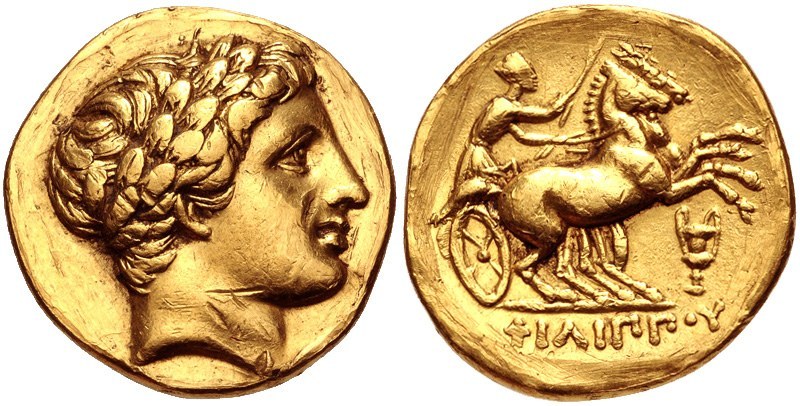
Philip III Gold Stater
A Macedonian gold stater struck under Philip III Arrhidaeus, half-brother of Alexander the Great, showing Heracles and an enthroned Zeus.
- Country
- Macedonia
- Denomination
- Stater
- Metal
- Gold
Got a coin like this?
Identify any coin from a photo, free.
Overview
The Philip III gold stater is a Macedonian gold coin issued in the name of Philip III Arrhidaeus, the half-brother of Alexander the Great who reigned jointly from 323 to 317 BC. The example seen here shows the youthful head of Heracles wearing the lion's-skin headdress on the obverse and a seated Zeus on the reverse, closely continuing the imperial coin types that Alexander had made standard across his empire.
As a stater, this was a high-value gold denomination used for major payments, military expenditure, and the movement of state wealth. Coins struck under Philip III belong to the earliest Hellenistic period, when the vast coinage machinery Alexander had built continued to operate under his successors while the empire was already being divided among rival generals.
Because its designs are so close to those of Alexander's own coinage, the Philip III stater is prized both as an ancient gold coin in its own right and as a document of the turbulent transition immediately following Alexander's death.
History & Background
When Alexander the Great died in 323 BC without a competent adult heir, his generals compromised by recognizing two kings: Alexander's unborn son (the future Alexander IV) and his half-brother Arrhidaeus, who took the throne name Philip III. Arrhidaeus was reportedly of limited mental capacity and served largely as a figurehead while real power lay with the regents and generals who governed in his name.
Coinage continued to be struck in Philip III's name at mints across Macedonia, Asia Minor, and the wider former empire, largely repeating the well-established Alexander types. This continuity kept the currency trusted and interchangeable during a period of intense instability, as the Wars of the Diadochi broke out among Alexander's successors.
Philip III's reign ended in 317 BC when he was executed on the orders of Olympias, Alexander's mother, amid the dynastic struggles of the age. Coins bearing his name were therefore produced in a narrow window, making them a compact record of the first phase of the Hellenistic successor states.
How to Identify
Look first at the two principal designs. The obverse of this coin shows the head of Heracles facing right, wearing the knotted lion-skin headdress, a type inherited directly from Alexander's coinage. The reverse shows Zeus seated on a throne, and coins in the royal Macedonian series typically render the god holding a scepter with an eagle or figure on his outstretched hand.
The defining attribution comes from the Greek legend, which names the issuing king rather than the god. Coins of this ruler carry the name of Philip (in Greek, forms of ΦΙΛΙΠΠΟΥ) in the reverse field or along the edge, distinguishing them from the very similar issues inscribed with the name of Alexander. Small control marks, monograms, or symbols in the field help specialists assign a coin to a particular mint and issue.
As a gold stater the coin is small but heavy for its size, generally in the range of roughly 8.5 grams and around 17-19 mm across, with the dense feel characteristic of high-purity ancient gold. Hand-struck manufacture means slightly irregular flans, off-center strikes, and minor edge splits are normal and not signs of a problem.
Value & Collectibility
Ancient gold staters in the name of Philip III are scarce and desirable, and as gold coins of a named historical king linked to Alexander the Great they command prices well above common bronze and silver ancients. Even worn or modestly preserved examples generally trade in the high hundreds to low thousands of dollars, while sharply struck, well-centered coins with clear portraits and legends can reach substantially higher.
Value is driven by the completeness and clarity of the Heracles portrait and the enthroned Zeus, the visibility of the king's legend and any control marks, the purity and surface quality of the gold, and secure attribution to Philip III rather than a look-alike Alexander issue. Provenance and the reputation of the attribution can add a meaningful premium.
The figures given here are broad context ranges, not appraisals. Individual coins vary widely, and because high-value gold ancients are frequently forged, a formal expert attribution or third-party authentication has a strong effect on realizable value.
Frequently asked questions
Who was Philip III?
Philip III Arrhidaeus was the half-brother of Alexander the Great. He was proclaimed king in 323 BC after Alexander's death and reigned largely as a figurehead until his execution in 317 BC during the wars among Alexander's successors.
Why does the coin look almost identical to Alexander's coins?
Coinage in Philip III's name deliberately continued Alexander's established types, including the Heracles head and enthroned Zeus, to keep the currency trusted and interchangeable. The main difference is the royal name in the Greek legend.
What was a gold stater used for?
The stater was a high-value gold denomination used for large payments such as military expenses and state transactions, not everyday purchases. It represented significant wealth in the ancient economy.
Are these coins rare?
Gold staters in the name of Philip III are scarce compared with the far more common silver and bronze coinage of the period, and as historical gold pieces they are actively sought by collectors.
Philip III Gold Stater guides
In-depth guides for identifying, valuing, and collecting Philip III Gold Stater.
Other coins you may enjoy
Tetradrachm of Ptolemy XII
80-51 BC
Tetradrachm of Ptolemy I
305-283 BC
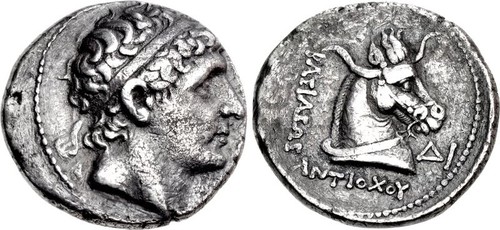
Tetradrachm of Antiochos I Soter
281-261 BC
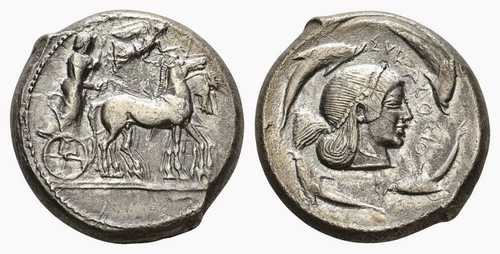
Syracuse Tetradrachm
c. 5th-4th century BC (Classical period)
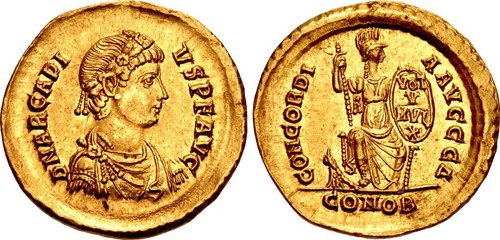
Solidus of Arcadius
AD 395-402
Siliqua of Gratian
AD 367-383
Sestertius of Maximinus Thrax
235-238 AD
Solidus of Valentinian III
AD 425-455
Seleucus I Nicator Tetradrachm
Late 4th-3rd century BC
Nummus of Magnentius
AD 350-353
Follis of Galerius
AD 308-310
Follis of Licinius I
AD 320-321