
How to Identify the Philip III Gold Stater
A collector's guide to reading the Heracles head, enthroned Zeus, royal legend, and gold fabric that mark a stater of Philip III.
Read the full Philip III Gold Stater encyclopedia entry →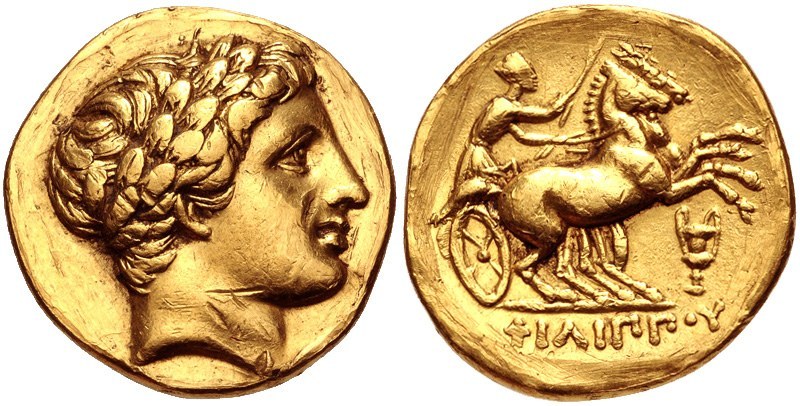
Begin with the two main images, because the type is instantly recognizable. The obverse should show the head of Heracles in right profile, wearing the lion-skin headdress with the paws knotted at the neck. The reverse should show Zeus seated on a throne, typically holding a long scepter, with the god's upper body bare and one arm extended. These designs were standardized under Alexander the Great and repeated under his immediate successors, so the images alone will not separate a Philip III coin from an Alexander coin.
The decisive step is reading the Greek legend, which names the king rather than the god. On coins issued for this ruler you are looking for the name of Philip in Greek letters (forms of ΦΙΛΙΠΠΟΥ), usually running vertically beside the enthroned Zeus or along the reverse. A coin with the same imagery but inscribed with the name of Alexander (ΑΛΕΞΑΝΔΡΟΥ) is a related but different issue. Also look in the field for small monograms, letters, or symbols; these control marks are how specialists attribute a coin to a specific mint and dating within the 323-317 BC window.
Check the physical properties. A genuine gold stater of this period is small but distinctly heavy, generally near 8.5 grams and roughly 17-19 mm in diameter, with the warm color and high density of nearly pure ancient gold. The coin is hand struck, so expect a slightly irregular flan, some flatness where the dies did not fully impress, and occasional minor edge cracks. A piece that is unusually light, pale, or magnetic, or that shows a seam around the rim, should raise immediate concern.
Be cautious about look-alikes and forgeries. The closest genuine confusion is with the far larger body of Alexander-name staters, so always confirm the king from the legend rather than the portrait. Beyond that, high-value gold ancients are heavily counterfeited, including cast copies, tooled coins, and modern struck fakes; warning signs include mushy or grainy detail, lettering that does not match known styles, incorrect weight, and file marks on the edge. For any significant purchase, rely on a formal attribution from a specialist in Greek and Hellenistic coinage or a coin with documented provenance and third-party authentication.
Frequently asked questions
How do I tell a Philip III stater from an Alexander stater?
The images are nearly identical, so read the reverse legend. A coin naming Philip in Greek (ΦΙΛΙΠΠΟΥ) is the Philip III issue, while one naming Alexander (ΑΛΕΞΑΝΔΡΟΥ) is a related but separate coin.
What should the coin weigh?
A gold stater of this period is generally around 8.5 grams and roughly 17-19 mm across, feeling heavy and dense for its small size. Significant deviation from that weight is a reason to be cautious.
Is an off-center or slightly cracked coin a problem?
Not usually. These coins were struck by hand on individually made flans, so off-centering, uneven relief, and small edge splits are normal for the period and do not by themselves indicate a fake.
How can I be confident a gold stater is genuine?
Because high-value gold ancients are frequently forged, confirm the weight and metal, check the style and lettering against published examples, and for any important coin seek a specialist attribution or third-party authentication and documented provenance.