
How to Identify the Vespasian Judaea Capta Denarius
A collector's guide to recognizing Vespasian's Judaea Capta silver denarius by its portrait, mourning-captive reverse, size, and legends.
Read the full Vespasian Judaea Capta Denarius encyclopedia entry →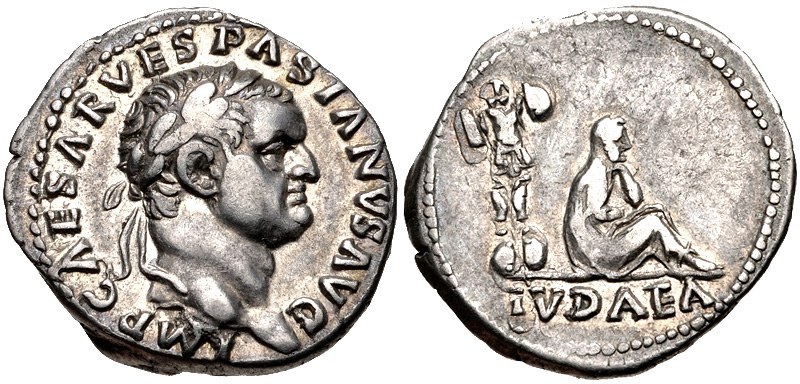
Begin with metal and module. A denarius is silver, small, and thin — roughly 17 to 20 mm in diameter and only a few grams in weight. If your coin is a large, heavy bronze with a mourning captive, you likely have a sestertius or as from the same Judaea Capta series, not the denarius. Genuine ancient silver often shows soft gray toning and a slightly irregular, hand-struck flan rather than a perfectly round modern edge.
Read the obverse. You should see a laureate (wreath-crowned) male head facing right, ringed by an abbreviated Latin legend naming Vespasian, commonly beginning with an element such as IMP CAES VESP AVG. The portrait style is realistic and mature, with a broad, lined face typical of Vespasian's coinage. Legends run clockwise and are heavily abbreviated, so expect to piece the titles together letter by letter.
The reverse is the decisive test. Look for a seated female figure in draped robes, posed in mourning — often with her head resting on one hand — personifying captured Judaea. Some varieties add a trophy of captured arms, a palm tree, or a bound prisoner, and an inscription such as IVDAEA may appear in the field or exergue. The specific arrangement varies by variety; what matters for attribution is the mourning-captive theme paired with a Vespasian silver portrait.
Watch for look-alikes and reissues. Titus and Domitian also struck Judaea Capta and related captive-reverse coins, so a similar reverse with a different emperor's name on the obverse is a related but distinct type. Provincial and later imitations exist as well; always match the obverse legend to Vespasian specifically.
Finally, treat authentication as essential. These are among the most faked of ancient coins, with cast copies, tooled surfaces, and outright replicas in circulation. Cast fakes may show a seam, bubbles, or an unnaturally uniform surface, while genuine strikes show crisp die detail and metal flow. Weight and diameter that fall outside the denarius range are a warning sign. When in doubt, rely on a reputable dealer, documented provenance, or professional authentication rather than the design alone.
Frequently asked questions
How do I tell the denarius from the bronze Judaea Capta coins?
The denarius is small, thin silver, about 17 to 20 mm across. The bronze sestertius and as versions are much larger and heavier. If the coin is a big, thick copper-colored piece, it is a bronze denomination, not the silver denarius.
What confirms the emperor is Vespasian and not Titus or Domitian?
Read the obverse legend around the laureate head. It should name Vespasian, typically with an element like IMP CAES VESP AVG. Similar captive reverses were struck for Titus and Domitian, so the obverse name is what settles the attribution.
Does the reverse always read IVDAEA?
Not always. The Judaea Capta theme appears in several varieties, some with an IVDAEA inscription and some without, and the captive may be shown with a trophy, palm, or prisoner. The mourning seated figure paired with a Vespasian portrait is the key identifier.
How can I spot a fake?
Check that weight and diameter fall in the denarius range and that detail looks struck rather than cast. Seams, surface bubbles, or a uniform sandy texture suggest a cast copy. Given how often these are faked, seek provenance or expert authentication before buying.