
Triple Unite
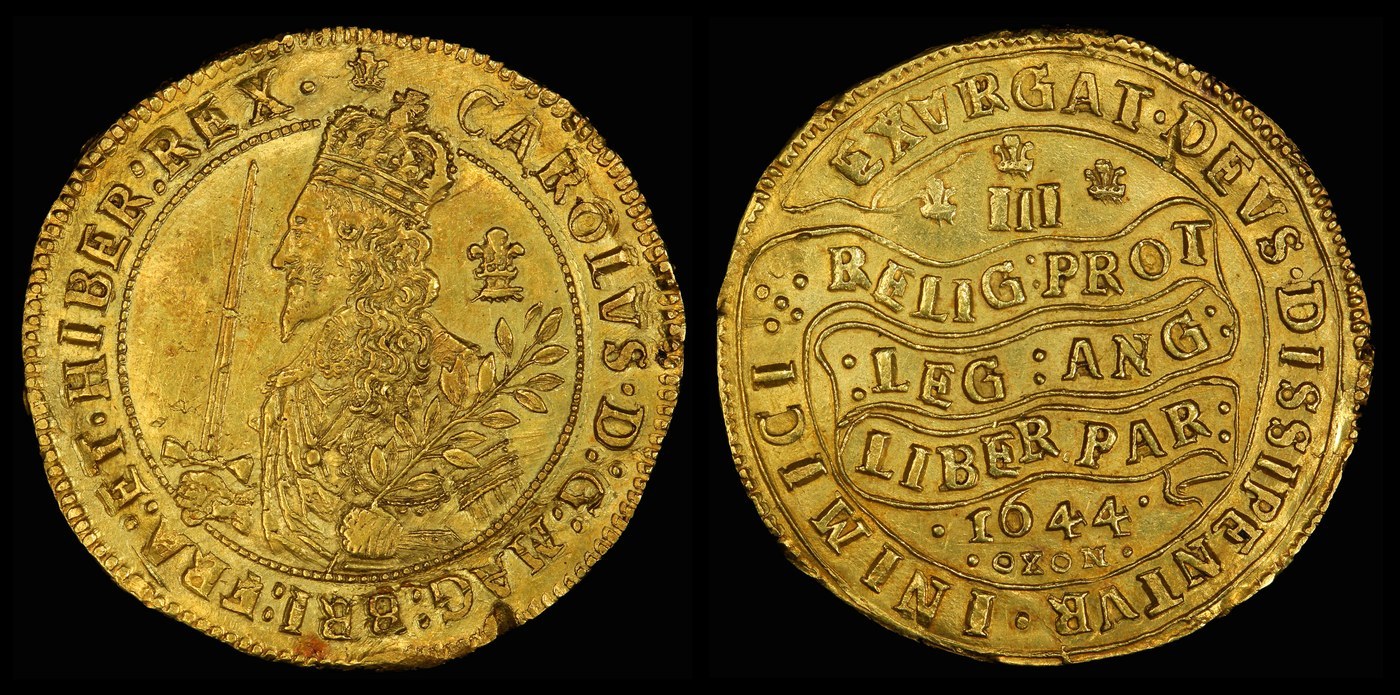
The largest English hammered gold coin, struck for Charles I during the Civil War and valued at 60 shillings (three pounds).
- Country
- England
- Denomination
- Triple Unite (60 shillings)
- Metal
- Gold
Got a coin like this?
Identify any coin from a photo, free.
Overview
The Triple Unite is a hammered gold coin of Charles I of England, valued at three unites, or 60 shillings (three pounds). It is the largest denomination and the largest gold coin ever produced by the English hammered coinage, and it was struck only during the years of the English Civil War.
The photographed example shows the king in armor holding a sword and an olive branch, with a crowned, curl-haired profile and a Latin legend around the rim. The reverse carries the royal motto with the date 1644 and a heraldic panel, features that immediately mark the piece as a wartime issue of Charles I rather than an ordinary circulating gold coin.
As a hand-struck coin, each surviving Triple Unite has a broad, slightly irregular flan and individually cut lettering. Its great size, high value, and strong association with the Civil War make it one of the most celebrated and sought-after coins in the entire English series.
History & Background
The Triple Unite was introduced in 1642 after Charles I lost control of the Tower mint in London and established royalist mints away from the capital, most importantly at Shrewsbury and then at Oxford. Cut off from the ordinary machinery of state, the king needed to convert plate and bullion into coin to pay his armies, and the large gold pieces served that purpose while also making a bold political statement.
The reverse legend, abbreviated on the coin, spells out Charles's wartime declaration: the religion of the Protestants, the laws of England, and the liberty of Parliament. This slogan was designed to answer parliamentary propaganda by presenting the king as the true defender of the established church and the constitution. The date on the photographed coin, 1644, places it in the middle of the conflict, when the Oxford mint was at its most active.
Production of the denomination was confined to these few Civil War years and ceased as the royalist cause collapsed. Because it was issued in limited numbers over a short span, and because much period gold was later melted, the Triple Unite survives only in small numbers today.
How to Identify
The obverse shows a crowned, armored half-length figure of Charles I with curled hair, holding a sword in one hand and an olive branch in the other, surrounded by a Latin royal legend of which BRIT and CAROLVS elements are typically visible around the rim. The combination of the standing armored king with sword and branch is highly diagnostic and is not found on ordinary gold coins of the reign.
The reverse displays the abbreviated declaration legend RELIG PROT LEG ANG LIBER PAR (the religion of the Protestants, the laws of England, the liberty of Parliament), commonly arranged around a central heraldic panel or scroll, with the date, here 1644, and a mark of value indicating three pounds. Wavy decorative bands and the compartmented shield-like layout seen on the photographed coin are characteristic of these large Oxford-style flans.
The coin is a broad, thin, hand-hammered piece of gold, far larger than a unite or half-unite, with hand-cut lettering and the soft, occasionally doubled relief typical of hammered striking. Genuine strikes show slightly uneven flans and irregular borders rather than the crisp uniform edges of machine-made coins.
Value & Collectibility
The Triple Unite is a rare and highly prized coin, and as the largest English hammered gold denomination it trades far above its considerable bullion content. Values are driven by grade, strength of strike, mint and date, flan quality, and provenance rather than any single fixed figure.
Genuine examples are scarce and typically realize very substantial five-figure sums at specialist auction, with the finest or rarest varieties reaching well beyond that. Even worn but authentic pieces command strong prices because of the denomination's fame, size, and Civil War associations.
Because the type is famous, valuable, and frequently faked or cast, condition and verified authenticity heavily influence what a given coin realizes. Anyone valuing a specific piece should rely on recent auction records for the matching mint, date, and variety and treat any single quoted figure as context rather than a guaranteed price.
Frequently asked questions
What was the Triple Unite worth?
It was valued at three unites, equal to 60 shillings or three pounds. This made it the highest-value and largest gold coin of the English hammered coinage.
Why was it made?
It was struck for Charles I during the English Civil War, after he lost the Tower mint and set up royalist mints at Shrewsbury and Oxford to turn plate and bullion into coin to pay his forces.
What does the reverse motto mean?
The abbreviated Latin legend states the religion of the Protestants, the laws of England, and the liberty of Parliament, Charles I's wartime declaration presenting himself as defender of church and constitution.
What years was it struck?
The denomination was produced only during the Civil War years, roughly 1642 to 1644. The photographed example is dated 1644, an Oxford-mint year.
Is it rare?
Yes. It was issued in limited numbers over a short period and much period gold was later melted, so genuine Triple Unites survive only in small numbers and are among the most sought-after English coins.
Triple Unite guides
In-depth guides for identifying, valuing, and collecting Triple Unite.
Other coins you may enjoy
English Sixpence
Early 1600s (James I, 1603-1625)
Sixpence of James I
1603-1625
Thistle Merk
1567–1625
James VI Ryal
1567–1571
Quarter Merk
c. 1580–1691
Sixpence of Elizabeth I
1560–1603
Quarter Angel of Elizabeth I
1581-1583
Laurel
1619-1625
Mary I Groat
1553-1558
Medieval Coin
c. 500–1500 (Medieval)
Half Thistle Merk
1567-1625
Irish Pistole
1640s (17th century)