
How to Identify the Triple Unite
A collector's guide to recognizing Charles I's 60-shilling Triple Unite by its armored king, declaration motto, huge flan, and Civil War mint marks.
Read the full Triple Unite encyclopedia entry →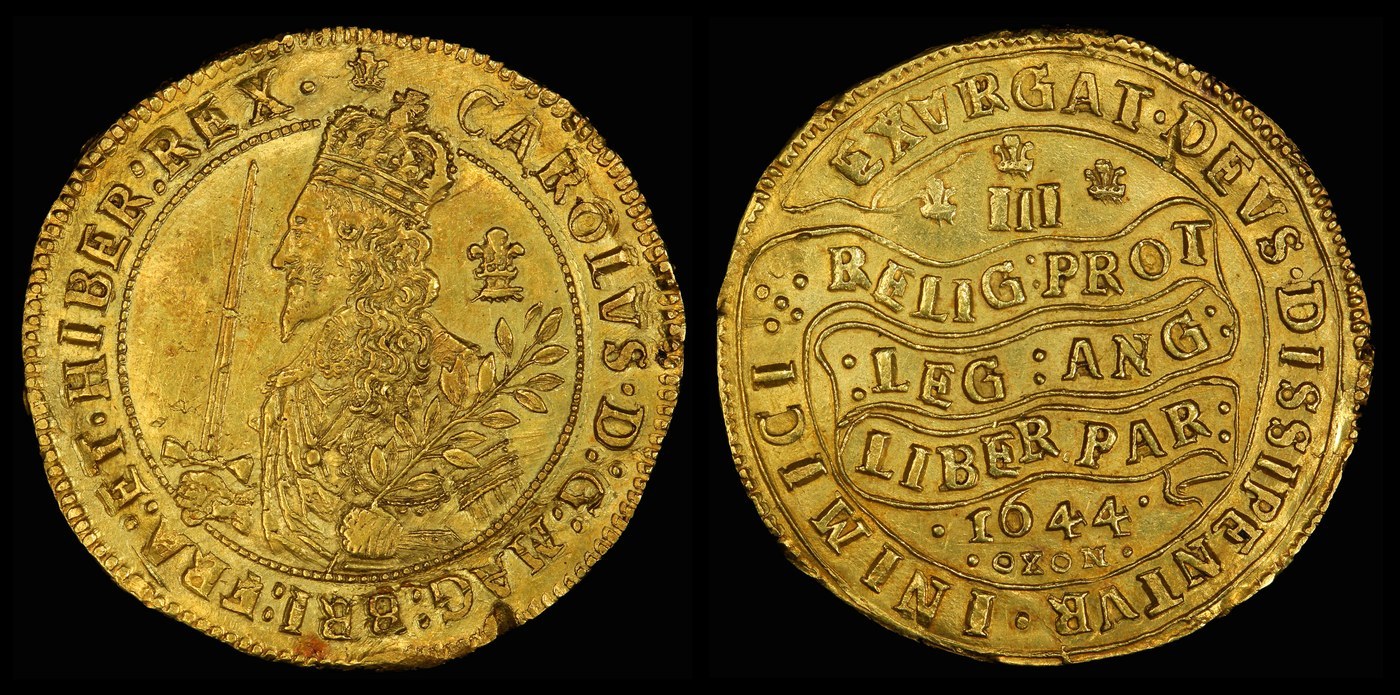
Begin with the obverse figure. A Triple Unite shows Charles I as a crowned, armored figure with curled hair holding a sword in one hand and an olive branch in the other, ringed by a Latin royal legend. This armed standing portrait, rather than a simple crowned bust, is the first strong clue that you are looking at a large Civil War gold piece and not an ordinary unite.
Read the reverse legend and date. The declaration RELIG PROT LEG ANG LIBER PAR, arranged around a central heraldic panel or scroll with a date such as 1644, is specific to Charles I's wartime issues. Look also for a mark of value indicating three pounds, which confirms the 60-shilling denomination and separates the Triple Unite from the smaller unite and half-unite that share related designs.
Assess size, weight, and fabric. The Triple Unite is exceptionally large and broad for a hammered coin, noticeably bigger than any unite, and struck on a thin gold flan with hand-cut lettering and slightly irregular borders. Weigh and measure any candidate against published specifications; a coin that is too small, too light, or too regular in its edges should be treated with suspicion.
Locate the mint mark and attribute the mint. Small symbols in the legend indicate the issuing mint and period, with Oxford and Shrewsbury being the relevant royalist mints. Cross-reference the mark, the exact wording and spacing of the legends, and the layout of the reverse against a standard reference for Charles I hammered gold to pin down the variety.
Be cautious with authentication. Because the Triple Unite is famous and extremely valuable, it is among the most copied English coins, and cast reproductions, tooled surfaces, and outright fantasies exist. Watch for casting seams, bubbles, unnaturally smooth fields, and lettering that lacks hand-cut variation, and given the sums involved have any candidate examined by a specialist or submitted to a reputable grading service before purchase.
Frequently asked questions
How do I tell a Triple Unite from a plain unite?
The Triple Unite is far larger and heavier, shows the armored king with sword and olive branch rather than a simple bust, and carries a three-pound mark of value with the declaration legend. Size and the value mark are the quickest checks.
What does the date and mint mark tell me?
The date, such as 1644, and the small initial mark in the legend identify the issuing year and royalist mint, chiefly Oxford or Shrewsbury. Together they let you attribute the coin to a specific variety in the standard references.
How can I spot a fake?
Genuine pieces are hand-struck on broad, slightly uneven gold flans with hand-cut lettering. Casting seams, air bubbles, mushy or repetitive detail, incorrect weight, and overly smooth fields all point to a copy. Professional authentication is strongly advised for a coin of this value.