
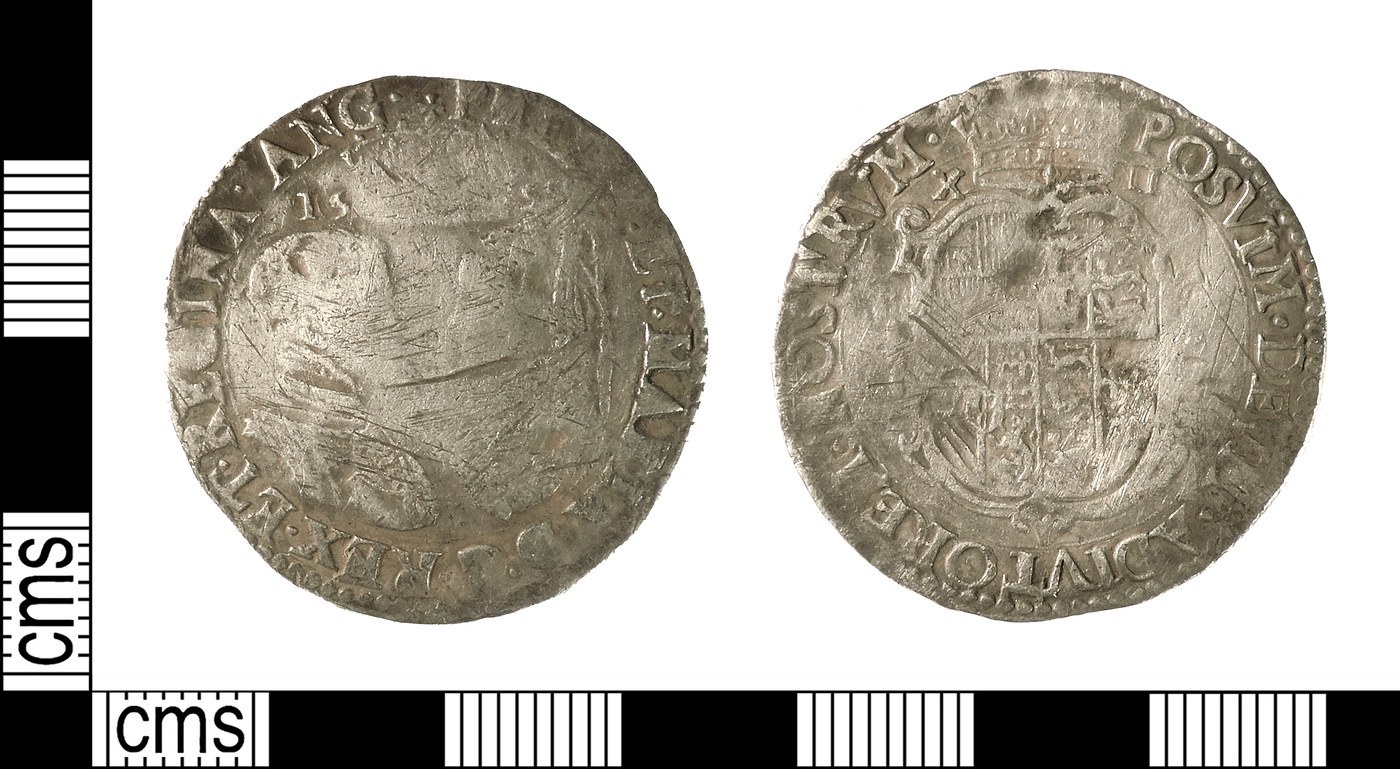
Philip and Mary Shilling
Hammered silver shilling of Philip II of Spain and Mary I (1554-1558), showing their paired royal busts and a crowned quartered shield of arms.
- Country
- England
- Denomination
- Shilling
- Metal
- Silver
Got a coin like this?
Identify any coin from a photo, free.
Overview
The Philip and Mary Shilling is a hammered silver coin worth twelve pence, struck for the joint monarchs Philip and Mary between their 1554 marriage and Mary's death in 1558. It is one of the most recognisable Tudor silver coins because it carries two royal portraits rather than one, reflecting the unusual co-monarchy of Mary I of England and her husband Philip, then Prince and later King of Spain.
The obverse shows the paired busts of Philip and Mary with royal regalia, surrounded by a Latin legend naming them both as king and queen. The reverse presents a crowned shield divided into four heraldic quarters, combining the arms of England with those of Philip. As a hand-struck coin from the Tower Mint, each example varies in centring, strike strength, and how much of the legend and portrait survives.
History & Background
Mary I married Philip of Spain in July 1554, and the marriage treaty gave Philip the style of king alongside Mary while she reigned. English coinage was adjusted to reflect this joint rule, and the higher silver denominations - the shilling and sixpence in particular - were redesigned to show both rulers together, a striking departure from the single-monarch portraits of earlier reigns.
The shilling itself was a relatively young denomination, having grown out of the testoon introduced under Henry VII and Henry VIII. Struck at the Tower Mint in London on a restored silver standard after the debasements of the previous two reigns, the Philip and Mary shilling circulated only during Mary's short lifetime. When she died in 1558 and Elizabeth I succeeded, the joint coinage ended and portraits returned to a single sovereign.
How to Identify
The decisive feature is the pair of royal busts on the obverse: two facing portraits of Philip and Mary shown together with regalia, rather than a single monarch. The legend names both, in a form such as PHILIP Z MARIA D G REX Z REGINA ("Philip and Mary by the grace of God King and Queen"). Some shillings carry a value mark XII (for twelve pence) and a date in the mid-1550s, while others are undated - the presence of a date and value helps confirm the type.
The reverse shows a crowned shield of arms quartered into four sections, impaling the royal arms of England with those of Philip. A common reverse legend is POSVIMVS DEVM ADIVTOREM NOSTRVM ("We have made God our helper"). The coin is a large, broad silver piece - roughly 30-33 mm across and around 6 grams - struck by hand, so the flan is frequently slightly irregular, oval, or off-centre with parts of the legend soft or missing.
Value & Collectibility
Value is driven above all by grade, strike quality, and how sharp the two portraits and legends remain. As a genuinely Tudor, dual-portrait issue tied to a short and historically notable reign, the Philip and Mary shilling is a desirable collector coin, and well-centred examples with clear busts and a legible date command a strong premium over worn, clipped, or weakly struck pieces.
Most circulated examples trade in the moderate-to-solid collector range typical of mid-sixteenth-century English hammered silver, while sharp, well-preserved specimens with full legends and a bold portrait sit considerably higher. Because eye appeal varies so much on hammered coins, treat any single figure with caution and compare recent auction results for coins in genuinely similar condition rather than relying on a fixed price.
Frequently asked questions
Why does this shilling show two people?
Mary I married Philip of Spain in 1554, and their marriage treaty made him king alongside her, so the higher silver coins were redesigned to show both rulers together.
What was a Philip and Mary shilling worth in its day?
A shilling was worth twelve pence, a substantial everyday silver denomination in Tudor England; some examples show the value mark XII.
Are all Philip and Mary shillings dated?
No. Some carry a date in the mid-1550s along with the value XII, while others are undated; a visible date is a helpful confirming feature when present.
What metal is the coin made of?
It is hammered silver, struck on a restored silver standard after the debasements of Henry VIII and Edward VI.
Where were these shillings made?
They were struck by hand at the Tower Mint in London during the joint reign, between 1554 and 1558.
Philip and Mary Shilling guides
In-depth guides for identifying, valuing, and collecting Philip and Mary Shilling.
Other coins you may enjoy
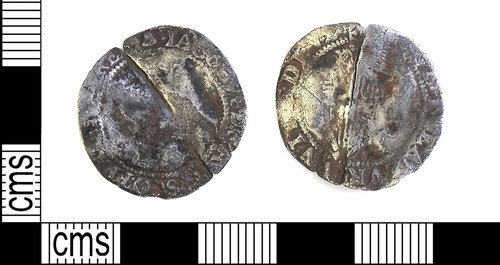
English Sixpence
Early 1600s (James I, 1603-1625)
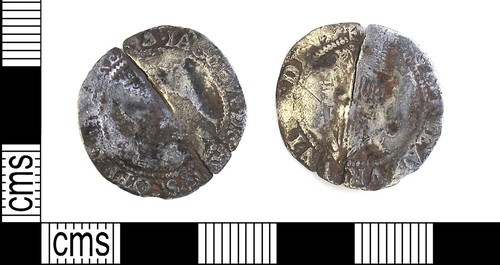
Sixpence of James I
1603-1625
Thistle Merk
1567–1625
James VI Ryal
1567–1571
Quarter Merk
c. 1580–1691
Sixpence of Elizabeth I
1560–1603
Quarter Angel of Elizabeth I
1581-1583
Laurel
1619-1625
Mary I Groat
1553-1558
Medieval Coin
c. 500–1500 (Medieval)
Half Thistle Merk
1567-1625
Irish Pistole
1640s (17th century)