
How to Identify the Philip and Mary Shilling
A collector's checklist for the Philip and Mary silver shilling: paired busts, legends, dates, the quartered shield, size, and look-alikes to rule out.
Read the full Philip and Mary Shilling encyclopedia entry →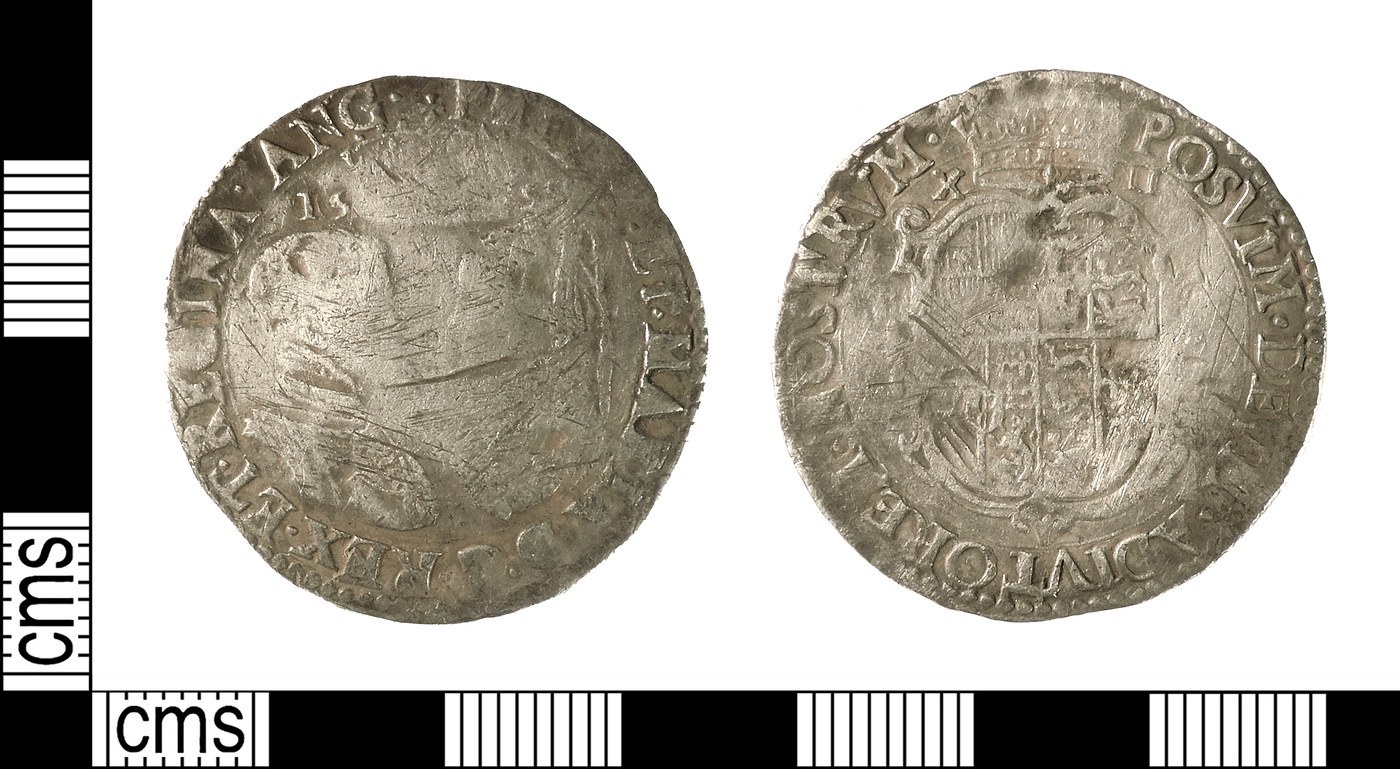
Start with the obverse portraits. The single most telling feature of this coin is that it shows two royal busts, Philip and Mary together with regalia, not a lone monarch. If you see a pair of facing crowned or draped busts on a large silver Tudor coin, you are almost certainly looking at a Philip and Mary issue rather than a sole-reign coin of Mary, Edward VI, or Elizabeth I.
Read the legends and look for a date and value. The obverse should name both rulers, in a form of PHILIP Z MARIA D G REX Z REGINA. Check the fields around the busts for a value mark XII (twelve pence) and, on dated examples, a year in the mid-1550s such as 1554 or 1555. On the reverse, look for the crowned quartered shield and a legend like POSVIMVS DEVM ADIVTOREM NOSTRVM. Hammered lettering is often uneven, so read what survives rather than expecting the whole legend.
Confirm the physical size and metal. The shilling is a large, broad silver coin, roughly 30-33 mm across and about 6 grams - noticeably bigger than the sixpence, groat, or smaller denominations of the same reign. A genuine hammered flan is usually a little irregular, sometimes oval, and often off-centre so that part of the border legend runs off the edge. Perfectly round, uniform pieces should raise suspicion.
Separate it from the look-alikes. The Philip and Mary sixpence uses the same twin-bust design but is smaller and lighter, and it too can be dated - use diameter and weight to tell the two apart. Do not confuse this coin with the sole-portrait Mary groat, half-groat, or penny, which show only Mary's single bust. Because Tudor hammered silver is collectible, cast copies and tooled pieces exist: watch for grainy or porous surfaces, an edge seam, incorrect weight or diameter, and lettering that looks unnaturally crisp. For any higher-value example, favour coins with clear provenance or third-party authentication.
Frequently asked questions
What is the quickest way to identify this coin?
Look for two royal busts, Philip and Mary shown together, on a large silver coin with a crowned quartered shield on the reverse - the paired portrait is the key giveaway.
How do I tell the shilling from the Philip and Mary sixpence?
Both share the twin-bust design, so use size and weight: the shilling is the larger coin at roughly 30-33 mm and about 6 grams, while the sixpence is distinctly smaller and lighter.
Does every example have a date and the value XII?
No. Some shillings are dated and marked XII, others are undated and lack the value; when a date or XII is present it is a useful confirmation, but their absence does not rule out the type.
How can I spot a fake or cast copy?
Be wary of grainy or porous surfaces, an edge seam, wrong weight or diameter, and lettering that looks too sharp and modern; when in doubt, seek third-party authentication.