
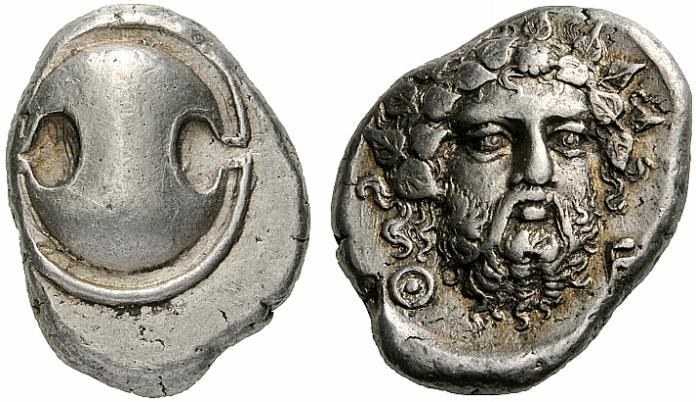
Thebes Stater
Silver stater of Thebes with the Boeotian shield and a bearded head of Dionysos, struck as federal coinage of the Boeotian League, c. 395-338 BC.
- Country
- Ancient Greece
- Denomination
- Stater
- Metal
- Silver
Got a coin like this?
Identify any coin from a photo, free.
Overview
The Thebes stater is a silver coin of the Greek city of Thebes in Boeotia, struck during the first half of the fourth century BC. Its constant emblem is the Boeotian shield, a distinctive oval shield with cut-away sides, shown as a round device that fills one face of the coin. This shield served as the badge of Thebes and of the wider Boeotian League that Thebes led.
The example described here belongs to the period roughly 395-338 BC, when Thebes was at the height of its power. It shows the circular Boeotian shield on the obverse and, within an incuse frame on the reverse, a bearded male head identified as Dionysos, his hair worn in tight curls and often bound with an ivy wreath. Dionysos was closely tied to Thebes, which claimed the god as a native son.
As a stater, the coin was a substantial silver piece and one of the principal denominations of Boeotian coinage. These staters are among the most recognizable civic issues of classical Greece and are prized for their bold shield design and their link to Thebes' brief supremacy over Greece.
History & Background
Thebes was the dominant city of Boeotia and the head of the Boeotian League, a federation of Boeotian communities. From the late fifth century into the fourth century BC the League issued a coordinated silver coinage on which the Boeotian shield acted as a shared federal emblem, while individual reverse types and magistrate names distinguished the issues.
The years around 395-338 BC covered by this type were pivotal for Thebes. After the Corinthian War the city grew in strength, and under the generals Epaminondas and Pelopidas it broke Spartan power at the Battle of Leuctra in 371 BC, ushering in a short-lived Theban hegemony over Greece. The abundant silver staters of this era financed Theban armies and asserted the city's leadership of the Boeotian federation.
The series effectively closed after 338 BC. Following the Battle of Chaeronea, where Thebes and Athens were defeated by Philip II of Macedon, Theban independence was curtailed, and in 335 BC Alexander the Great destroyed the city after a revolt. The federal shield coinage of this classical period therefore stands as a coinage of Thebes at its zenith and on the eve of its fall.
How to Identify
The unmistakable feature is the Boeotian shield. On the obverse it appears as a round emblem with the characteristic notches or openings cut into its sides, filling the flan. This shield is the single most reliable marker of a Boeotian and Theban issue and separates these staters from most other Greek civic coins.
The reverse of this type shows a bearded male head, identified as Dionysos, facing right within an incuse square or circular frame. The hair is rendered in tight curls and is commonly bound with a wreath of ivy, the attribute of the wine god. Short Greek letters or an abbreviated magistrate's name may appear in the field beside the head; on many Boeotian staters the letters ThE (theta-epsilon) near the shield indicate Thebes.
In hand the coin is a thick silver stater, typically in the region of about 12 grams and roughly 18-23 mm across, struck by hand so that the flan and centering are often irregular. The metal is good silver with the grey-toned surfaces usual for ancient coins. The combination of a round shield on one side and a bearded, ivy-crowned head in an incuse on the other is diagnostic of this Theban type.
Value & Collectibility
Theban shield staters are actively collected and trade across a wide range depending on condition, style, and eye appeal. Worn or off-center examples with weak detail commonly change hands in the low-to-mid hundreds of dollars, while sharp, well-centered coins with a fully modeled Dionysos head and clean surfaces can reach the high hundreds to low thousands.
Value is driven by the clarity of the Dionysos portrait, the completeness of the shield, centering, surface quality, and any premium for pleasing archaic-to-classical style. Coins tied to a well-published magistrate issue or with notable provenance can carry additional premiums.
The figures here are broad context ranges rather than appraisals. Because ancient staters vary greatly by grade and because the market for classical Greek silver is condition-sensitive, an individual coin can fall well outside these bands. Specialist attribution and third-party authentication add confidence and can affect price.
Frequently asked questions
Why does the coin show a shield?
The Boeotian shield was the emblem of Thebes and of the Boeotian League it led. Placing the shield on the coinage marked these staters as federal Boeotian money and identified Thebes as the issuing power.
Who is the bearded head on the reverse?
It is identified as Dionysos, the god of wine, shown bearded with curled hair and often an ivy wreath. Thebes claimed Dionysos as a local god, so he was a fitting civic type for the city's coinage.
What metal and size is a Thebes stater?
It is a silver coin. A full stater usually weighs around 12 grams and measures roughly 18-23 mm, struck by hand so shape and centering vary from piece to piece.
When were these staters made?
The type described here dates to about 395-338 BC, the era of Theban ascendancy that ended with the defeat at Chaeronea in 338 BC and the destruction of Thebes in 335 BC.
Thebes Stater guides
In-depth guides for identifying, valuing, and collecting Thebes Stater.
Other coins you may enjoy
Tetradrachm of Ptolemy XII
80-51 BC
Tetradrachm of Ptolemy I
305-283 BC
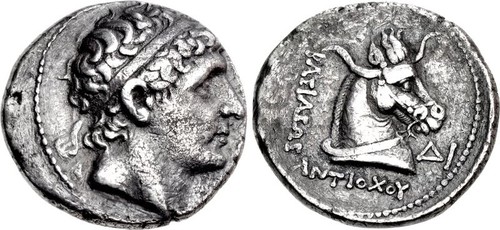
Tetradrachm of Antiochos I Soter
281-261 BC
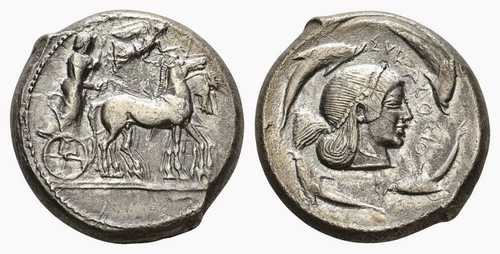
Syracuse Tetradrachm
c. 5th-4th century BC (Classical period)
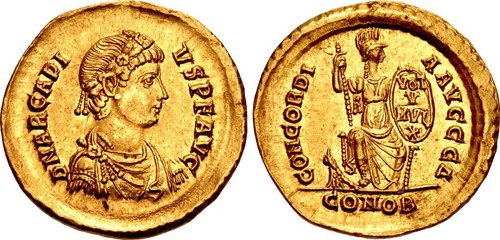
Solidus of Arcadius
AD 395-402
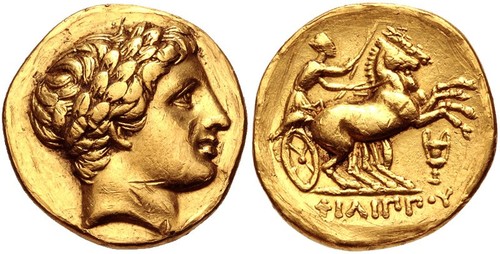
Philip III Gold Stater
323-317 BC
Siliqua of Gratian
AD 367-383
Sestertius of Maximinus Thrax
235-238 AD
Solidus of Valentinian III
AD 425-455
Seleucus I Nicator Tetradrachm
Late 4th-3rd century BC
Nummus of Magnentius
AD 350-353
Follis of Galerius
AD 308-310