
How to Identify the Thebes Stater
A collector's guide to recognizing the Boeotian shield obverse, the bearded Dionysos reverse, and the silver fabric of a Theban stater.
Read the full Thebes Stater encyclopedia entry →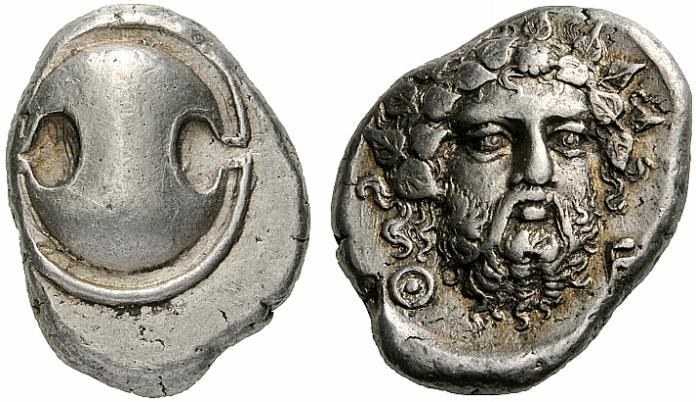
Begin with the shield side. A genuine Theban stater carries the Boeotian shield as a round emblem with distinctive cut-away notches on its sides, filling the face of the coin. This shield is the core diagnostic: it appears on Boeotian federal coinage led by Thebes and is not the round hoplite shield seen occasionally on other Greek issues. If the coin shows this notched oval-in-the-round shield, you are almost certainly looking at a Boeotian or Theban piece.
Turn to the reverse to confirm the specific type. This stater shows a bearded male head of Dionysos facing right, set within an incuse square or circular sinking rather than raised on an open field. Look for tightly curled hair and, frequently, an ivy wreath, the marker of the wine god. Search the field beside the head for short Greek letters or an abbreviated magistrate's name; the letters theta-epsilon (ThE) placed near the shield are the abbreviation for Thebes and help pin the mint.
Check the physical characteristics. A full stater is a chunky silver coin of roughly 12 grams and about 18-23 mm in diameter. Expect hand-struck fabric: an irregular flan, off-center strikes that push part of the design off the edge, and the natural grey toning of ancient silver. Smaller Boeotian denominations exist at lower weights, so weighing the coin helps confirm you have a stater rather than a fraction.
Watch for look-alikes and fakes. Other Boeotian towns also used the shield emblem, so the reverse type and any inscribed letters, not the shield alone, tell you the coin is of Thebes. Cast and struck forgeries of Greek silver are common; warning signs include a casting seam around the rim, a soft or granular surface, bubbles, an incuse that looks too shallow or too crisp, and weight that sits well outside the normal stater range. For a significant purchase, favor coins attributed by a specialist in Boeotian coinage or accompanied by reputable provenance or third-party authentication.
Frequently asked questions
What is the fastest way to recognize a Thebes stater?
Look for the round Boeotian shield with notched sides on one face and a bearded, ivy-crowned head of Dionysos set into an incuse on the other. That pairing on a silver stater points to Thebes.
How do I know it is Thebes and not another Boeotian town?
Many Boeotian cities used the shield, so rely on the reverse type and any letters in the field. The abbreviation theta-epsilon (ThE) near the shield stands for Thebes and confirms the mint.
Is a dull grey surface a problem?
No. Ancient silver normally tones to grey, and even toning can be a good sign. Be more cautious about a casting seam, a grainy or porous surface, or trapped bubbles, which can indicate a cast forgery.
How can I tell a stater from a smaller Boeotian coin?
Weigh and measure it. A stater is a thick piece near 12 grams and about 18-23 mm across, whereas fractional Boeotian silver is markedly lighter and smaller though it may share the shield design.