
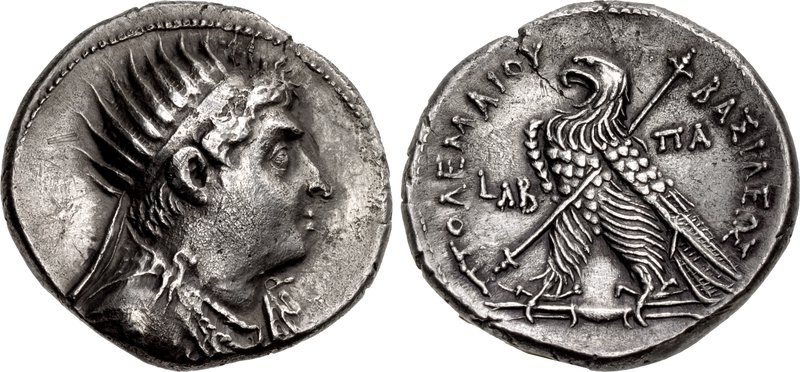
Tetradrachm of Ptolemy VIII
Silver tetradrachm of Ptolemy VIII of Egypt, c. 170-116 BC, with a diademed royal head on the obverse and an eagle on a thunderbolt reverse.
- Country
- Ancient Egypt
- Denomination
- Tetradrachm
- Metal
- Silver
Got a coin like this?
Identify any coin from a photo, free.
Overview
This is a silver tetradrachm of the Ptolemaic kingdom of Egypt, associated with Ptolemy VIII, who ruled in the second century BC. Like nearly all Ptolemaic silver of large denomination, it pairs a royal male head on the obverse with a standing eagle on the reverse, struck on the relatively thick, compact flan that is typical of Egyptian tetradrachms rather than the broad thin flans of many other Greek mints.
The example shown belongs to the long span of roughly 170 to 116 BC, the period in which Ptolemy VIII was active in Egyptian and Cyrenaican politics. The obverse head is rendered as a ruler with a diadem, here described from the coin as a radiate royal head, while the reverse shows the eagle with wings raised standing on a thunderbolt, the enduring emblem of the dynasty.
Because the Ptolemies kept the same core design for generations, this coin is recognized less by a unique picture than by its combination of a diademed royal portrait, the dynastic eagle reverse, and the distinctive weight and fabric of the Egyptian standard on which Ptolemaic silver was struck.
History & Background
Ptolemy VIII Euergetes II, nicknamed Physcon, was a member of the Macedonian-Greek dynasty founded by Ptolemy I, one of Alexander the Great's generals, who took Egypt after Alexander's death in 323 BC. Ptolemy VIII's career was long and turbulent, marked by rivalry with his brother Ptolemy VI, rule over Cyrene, periods of exile, and complicated joint reigns with his sister-wife and niece, both named Cleopatra.
Throughout the Ptolemaic period Egypt operated a closed monetary system on a lighter weight standard than the rest of the Greek world, and its mints, chiefly Alexandria and centers on Cyprus and in Phoenicia, turned out silver tetradrachms in enormous numbers. The consistent types, a royal head and an eagle on a thunderbolt, projected dynastic continuity across more than two centuries and made the coinage instantly identifiable as Ptolemaic.
The eagle of Zeus had been adopted as the badge of the house by Ptolemy I and never left the coinage. By the time of Ptolemy VIII the design was long established, so his tetradrachms continue a familiar formula rather than introducing new imagery, and they circulated within the tightly controlled economy of Hellenistic Egypt.
How to Identify
The obverse shows a royal male head in profile wearing a diadem, the ribboned band that marked Hellenistic kingship. On the photographed coin the head is described as radiate, with the hair and features rendered in bold relief filling most of the flan. Ptolemaic obverse portraits are often idealized and can echo the founder Ptolemy I, so the head is best read as a diademed royal type of the dynasty rather than a certain individual likeness.
The reverse carries the dynastic eagle standing on a thunderbolt, here with its wings raised, in the pose that defines almost all Ptolemaic silver. Around the eagle runs a Greek legend that on these coins names the king, typically reading PTOLEMAIOU BASILEOS, and the field may contain small control marks, letters, or monograms that helped the mint track its output.
In hand the coin is a tetradrachm of the Egyptian standard, struck on a thick, fairly compact flan rather than a broad thin one. Ptolemaic tetradrachms generally run somewhat lighter than the Attic standard used elsewhere, on the order of roughly 13 to 14 grams and about 24 to 27 mm across, struck by hand so the flan is irregular and the centering varies. Old grey or iridescent toning over silver is normal. The combination of a diademed royal head, the eagle-on-thunderbolt reverse, and Ptolemaic weight and fabric is the core identifier.
Value & Collectibility
As genuine ancient Greek silver of Ptolemaic Egypt tied to a named king, this tetradrachm has a steady collector market. Worn but clearly identifiable examples commonly trade from around the low hundreds of dollars, while well-centered, sharply struck coins with a strong portrait, a complete legend, and clean surfaces can reach several hundred to the low four figures.
Value is driven by the strength and style of the obverse head, the sharpness of the eagle, the completeness of the legend and any control marks, the flan's centering, and overall eye appeal and toning. Secure attribution to a specific reign and mint, along with documented provenance, adds meaningful premiums, since many Ptolemaic tetradrachms share the same types across different rulers.
The ranges here are general context, not appraisals. Any specific coin's price depends heavily on condition, style, mint, attribution, and authenticity, and higher-value ancient silver of this kind is often sold with specialist cataloguing or third-party certification.
Frequently asked questions
Who was Ptolemy VIII?
Ptolemy VIII Euergetes II, nicknamed Physcon, was a Ptolemaic king of Egypt in the second century BC, part of the Macedonian-Greek dynasty founded by a general of Alexander the Great. His reign was marked by rivalry with his brother, rule over Cyrene, and joint reigns with two queens named Cleopatra.
Why is there an eagle on the reverse?
The eagle standing on a thunderbolt was the badge of the Ptolemaic house, adopted by the founder Ptolemy I and kept on the silver coinage for centuries. It is the single most recognizable feature of Ptolemaic tetradrachms.
Is the head definitely Ptolemy VIII?
Not necessarily as a literal likeness. Ptolemaic obverse portraits are idealized and often recall the dynasty's founder Ptolemy I, so the head is best described as a diademed royal type of the dynasty. Secure attribution to a particular king relies on style, legend, and control marks rather than the face alone.
How big and heavy is this tetradrachm?
Ptolemaic tetradrachms were struck on a lighter standard than most Greek silver, on the order of roughly 13 to 14 grams and about 24 to 27 mm across, on a thick compact flan. Being hand-struck, the flan and centering vary from coin to coin.
Where were these coins made?
Ptolemaic silver was struck chiefly at Alexandria along with mints on Cyprus and in Phoenicia, within Egypt's closed monetary system. Control marks and letters in the reverse field can help attribute a coin to a particular mint and issue.
Tetradrachm of Ptolemy VIII guides
In-depth guides for identifying, valuing, and collecting Tetradrachm of Ptolemy VIII.
Other coins you may enjoy
Tetradrachm of Ptolemy XII
80-51 BC
Tetradrachm of Ptolemy I
305-283 BC
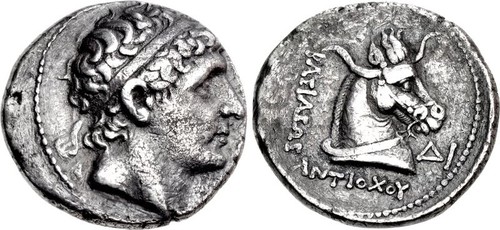
Tetradrachm of Antiochos I Soter
281-261 BC
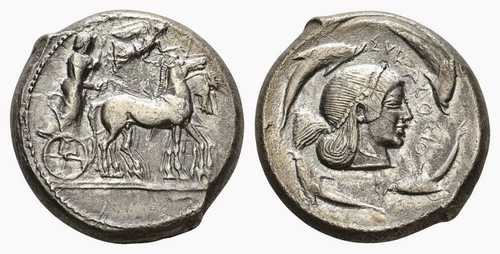
Syracuse Tetradrachm
c. 5th-4th century BC (Classical period)
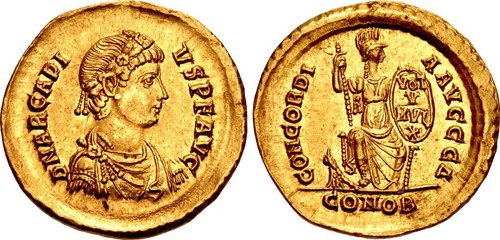
Solidus of Arcadius
AD 395-402
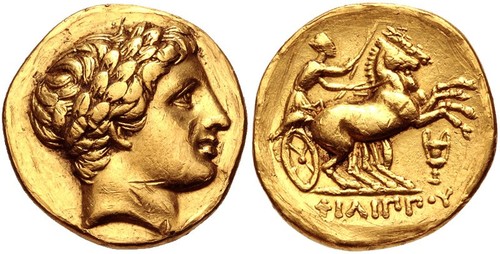
Philip III Gold Stater
323-317 BC
Siliqua of Gratian
AD 367-383
Sestertius of Maximinus Thrax
235-238 AD
Solidus of Valentinian III
AD 425-455
Seleucus I Nicator Tetradrachm
Late 4th-3rd century BC
Nummus of Magnentius
AD 350-353
Follis of Galerius
AD 308-310