
How to Identify the Tetradrachm of Ptolemy VIII
A collector's guide to recognizing a Ptolemaic tetradrachm of Ptolemy VIII by its diademed royal head, eagle reverse, silver fabric, and weight.
Read the full Tetradrachm of Ptolemy VIII encyclopedia entry →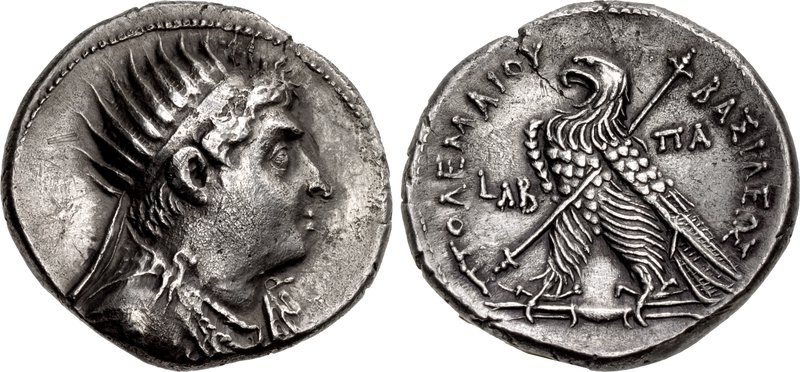
Start with denomination, metal, and weight. This is a silver tetradrachm on the Ptolemaic standard, which is lighter than the Attic silver used elsewhere in the Greek world. Expect roughly 13 to 14 grams and about 24 to 27 mm across, on a thick, fairly compact flan rather than a broad thin one. Weigh and measure any candidate first: a much heavier or broader coin points to a different standard, and a much lighter or smaller piece is a fraction rather than a full tetradrachm.
Read the obverse. You are looking for a royal male head in profile wearing a diadem, the ribboned band of Hellenistic kingship, with the hair and features in bold relief filling most of the flan. On the photographed coin the head is described as radiate. Treat it as a diademed royal type of the dynasty rather than trying to name the individual from the image alone, because Ptolemaic portraits are idealized and frequently echo the founder Ptolemy I.
Turn to the reverse, which is the strongest diagnostic. It should show an eagle standing on a thunderbolt, here with wings raised, surrounded by a Greek legend that on these coins names the king, typically PTOLEMAIOU BASILEOS. Confirm the eagle-on-thunderbolt pose and the royal legend; a different reverse animal, a seated deity, or a civic symbol means the coin is not Ptolemaic. Small letters, monograms, or control marks in the field help pin down the mint and issue.
Check fabric and legend carefully. Genuine strikes are hand-made and slightly irregular, with an oval or off-round flan, uneven edges, and centering that can crop part of the design at the rim. The reverse legend and any control marks are important for attribution, but they are often weak or partly off the flan and should not be invented from a hopeful reading. Old grey or iridescent toning over metallic silver is normal and reassuring.
Finally, weigh authenticity and attribution. Ptolemaic silver is widely imitated, so watch for the signs of a cast copy: a seam around the edge, a soft or bubbly surface, and a dull, non-metallic tone. Tooled coins show unnaturally sharp, scratchy detail added to worn relief. Because the same head-and-eagle formula was used across many Ptolemaic reigns, assigning a coin specifically to Ptolemy VIII rests on style, legend, mint, and control marks; for a significant purchase, rely on specialist cataloguing or third-party certification and documented provenance.
Frequently asked questions
How do I know it is Ptolemaic and not another Greek tetradrachm?
Look for the eagle standing on a thunderbolt with a royal Greek legend on the reverse, paired with a diademed royal head, all on a thick compact flan of lighter weight than Attic silver. That combination is distinctively Ptolemaic; a different reverse type points elsewhere.
How do I confirm it is a tetradrachm and not a smaller coin?
Weigh and measure it. A Ptolemaic tetradrachm sits on the order of roughly 13 to 14 grams and about 24 to 27 mm across. Lighter, smaller silver of the same types is a fraction such as a didrachm or drachm, so the weight settles the denomination.
Can I identify Ptolemy VIII from the portrait alone?
Usually not. Ptolemaic obverse heads are idealized and often recall the founder Ptolemy I, and many reigns share the same types. Describe it as a diademed royal head and rely on the legend, style, mint, and control marks for attribution to a specific king.
What are the main warning signs of a fake?
A seam around the edge, a soft or bubbly surface, and a dull non-metallic tone suggest a cast copy, while unnaturally sharp, scratchy detail on otherwise worn relief suggests tooling. For valuable examples, seek specialist attribution or third-party certification.