
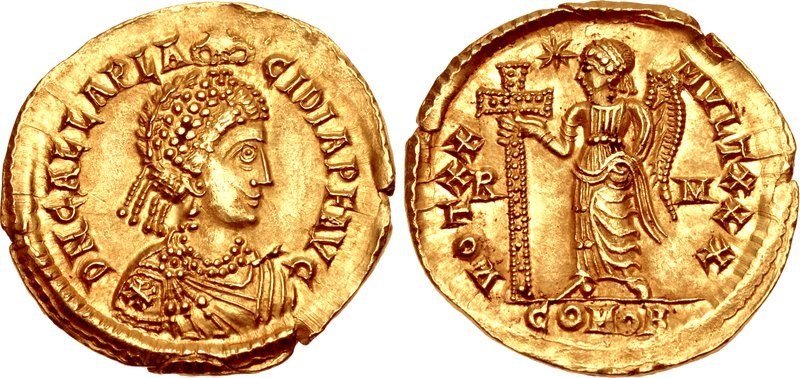
Solidus of Galla Placidia
A late Roman gold solidus struck in the name of Galla Placidia, empress and regent, showing her diademed bust and a Victory holding a long cross.
- Country
- Roman Empire
- Denomination
- Solidus
- Metal
- Gold
Got a coin like this?
Identify any coin from a photo, free.
Overview
The solidus of Galla Placidia is a late Roman gold coin issued in the name of Aelia Galla Placidia, daughter of the emperor Theodosius I and mother of the western emperor Valentinian III. As Augusta and regent for her young son from AD 425, her name and portrait appeared on the empire's premier gold denomination, the solidus.
The coin observed here belongs to the early years of her regency, around AD 425-426. The obverse presents a richly adorned bust of Placidia wearing an ornate imperial headdress and jewelry, while the reverse shows a standing or advancing Victory holding a long cross and a shield, a Christian-era reworking of older Roman victory imagery.
As a gold coin bearing the portrait of an imperial woman who wielded real political power, the solidus of Galla Placidia is prized both as fine late-Roman gold and as a document of the Theodosian dynasty in the early fifth century.
History & Background
Galla Placidia (born about AD 388-392) lived one of the most dramatic lives of the late empire: half-sister of the emperors Arcadius and Honorius, captive of the Visigoths and briefly queen through marriage to their king Athaulf, and finally Augusta in the West. When Honorius died and the usurper Johannes was overthrown, her six-year-old son was installed as the emperor Valentinian III in AD 425, and Placidia governed as regent.
Gold solidi in her name were struck at western mints such as Ravenna and Aquileia, and coins honoring her were also produced at Constantinople in the East, reflecting the cooperation between the two courts that put her son on the throne. Her coinage dates chiefly to the years of her regency beginning in AD 425 and continuing through the following years.
The reverse designs of her gold express the increasingly Christian character of the late empire, most notably through the long cross carried by Victory and, on some types, the hand of God shown crowning the empress. These pieces sit at the intersection of classical Roman coin tradition and the new Christian iconography of the fifth century.
How to Identify
The defining feature is the obverse portrait: a bust of Galla Placidia facing right, wearing an elaborate pearl-and-jewel diadem, earrings, and a necklace, with the imperial mantle. A Latin legend running around the bust names her, typically in the form D N GALLA PLACIDIA P F AVG. On some issues a small hand of God (manus Dei) reaches down to crown her, an unmistakable diagnostic when present.
The reverse shows a winged Victory holding a long jewelled cross, frequently with a shield or the figure standing beside a shield, accompanied by a legend such as VOT XX MVLT XXX (vows for the emperor's reign) or a salus-type inscription. A star or Christogram often appears in the field, and the exergue carries a mint signature such as CONOB or COMOB indicating gold struck to the solidus standard.
In hand a genuine solidus is about 20-21 mm across and roughly 4.4-4.5 grams of high-purity gold, thin and broad with the flan and relief typical of fifth-century strikes. The bright, buttery color of nearly pure gold and the sharp, linear late-Roman engraving style are both part of the picture.
Value & Collectibility
Solidi of Galla Placidia are scarce and carry a strong premium over ordinary late-Roman gold, both because coins struck in the name of a female regent are uncommon and because her historical stature draws collector demand. Even worn or lightly clipped examples generally sell well into the hundreds to low thousands of dollars, while sharp, well-centered coins with full legends and attractive surfaces can reach several thousand and more.
Value is driven by the specific type and mint, the quality of the portrait, the completeness of the legends, centering, and any mounting, bending, or graffiti. Types featuring the hand of God or a particularly detailed headdress tend to attract the strongest interest.
The figures here are broad context, not appraisals. Because gold of this empress is closely studied and forgeries exist, a specialist attribution or reputable auction provenance materially affects both confidence and price for any individual coin.
Frequently asked questions
Who was Galla Placidia?
She was the daughter of the emperor Theodosius I and the mother of Valentinian III. After being an imperial hostage and briefly a Visigothic queen, she became Augusta in the West and ruled as regent for her young son from AD 425.
What is a solidus?
The solidus was the standard late Roman gold coin, introduced by Constantine I in the early fourth century. It weighed about 4.5 grams of nearly pure gold and remained the backbone of Roman and later Byzantine gold coinage for centuries.
Why does the reverse show a cross?
By the fifth century the empire was thoroughly Christian, and older Victory imagery was reinterpreted in Christian terms. On Placidia's solidi Victory holds a long jewelled cross, and some issues also show the hand of God crowning the empress.
Are these coins rare?
Yes. Gold struck in the name of an imperial woman and regent is far less common than coinage of reigning emperors, and Placidia's solidi are genuinely scarce, which is reflected in their value.
Solidus of Galla Placidia guides
In-depth guides for identifying, valuing, and collecting Solidus of Galla Placidia.
Other coins you may enjoy
Tetradrachm of Ptolemy XII
80-51 BC
Tetradrachm of Ptolemy I
305-283 BC
Tetradrachm of Antiochos I Soter
281-261 BC
Syracuse Tetradrachm
c. 5th-4th century BC (Classical period)
Solidus of Arcadius
AD 395-402
Philip III Gold Stater
323-317 BC
Siliqua of Gratian
AD 367-383
Sestertius of Maximinus Thrax
235-238 AD
Solidus of Valentinian III
AD 425-455
Seleucus I Nicator Tetradrachm
Late 4th-3rd century BC
Nummus of Magnentius
AD 350-353
Follis of Galerius
AD 308-310