
How to Identify the Solidus of Galla Placidia
A collector's guide to recognizing Galla Placidia's gold solidus by its jewelled portrait, cross-bearing Victory, weight, and mint marks.
Read the full Solidus of Galla Placidia encyclopedia entry →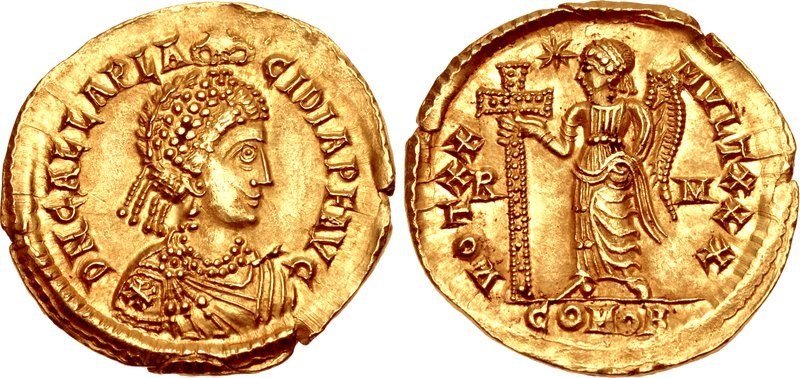
Begin with the obverse legend and portrait, because together they name the empress. Look for a right-facing bust wearing an ornate jewelled diadem, earrings, and necklace, encircled by a Latin inscription that should read some form of D N GALLA PLACIDIA P F AVG. The elaborate headdress and heavy jewelry are characteristic of how imperial women were shown in this period; if a hand of God (manus Dei) is reaching down to crown the bust, that is a strong confirming detail for certain of her issues.
Turn to the reverse and read the figure and its legend. Placidia's solidi commonly show a winged Victory holding a long jewelled cross, often with a shield present, and a legend such as VOT XX MVLT XXX or a salus-type inscription. Note any star or Christogram in the field and, crucially, the letters in the exergue beneath the design: CONOB points to Constantinople and the eastern gold standard, while COMOB is typical of western gold, helping place the coin at Ravenna, Aquileia, or a related mint.
Check the physical coin. A genuine solidus of this era is about 20-21 mm in diameter and roughly 4.4-4.5 grams of high-purity gold. The metal should have the soft, bright yellow color of nearly pure gold, and the fabric is thin and broad with crisp, linear late-Roman engraving. Weights well below standard may indicate ancient clipping, while a coin far off in size, weight, or color deserves caution.
Watch for look-alikes and fakes. Solidi of other Theodosian women, such as Aelia Eudoxia, Pulcheria, or Licinia Eudoxia, share the jewelled-bust format, so always read the name in the obverse legend rather than relying on the portrait style alone. Modern cast and struck forgeries of desirable empress gold exist; warning signs include mushy or granular surfaces, a casting seam on the edge, lettering that does not match known die styles, and incorrect weight. Given the value and the sophistication of some fakes, confirm any significant purchase through a specialist in late Roman gold or an established auction provenance.
Frequently asked questions
How do I tell Galla Placidia from other late Roman empresses on a solidus?
Read the obverse legend. Several Theodosian women were shown with similar jewelled busts, so the name spelled out around the portrait, in Placidia's case GALLA PLACIDIA, is what identifies her rather than the style of the headdress.
What do CONOB and COMOB in the exergue mean?
They are gold mint signatures marking coins struck to the solidus standard. CONOB is associated with Constantinople and eastern gold, while COMOB is typical of western mints such as Ravenna, helping you place where the coin was made.
What should the coin weigh?
A full-weight solidus is roughly 4.4 to 4.5 grams and about 20-21 mm across, in nearly pure gold. Noticeably lower weight can mean ancient clipping, and a large deviation in weight, size, or color is a reason to suspect a forgery.
Is the hand of God on the portrait significant?
Yes. On some of her issues a small hand of God reaches down to crown the empress, a distinctive Christian device of the period. When present it is a helpful confirming feature, though not every one of her solidi carries it.