
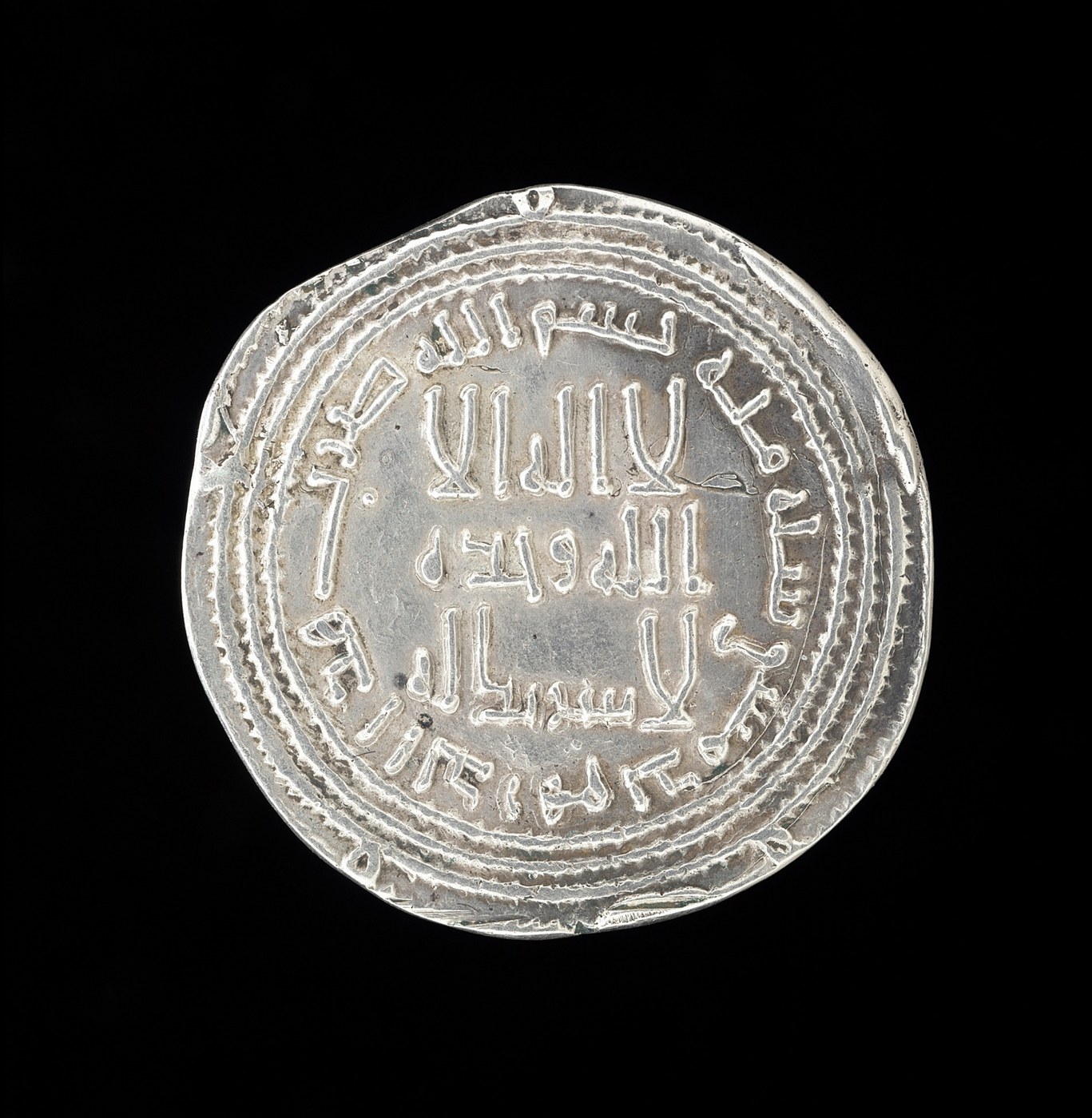
Silver Dirham (LACMA M.2002.1.437)
A thin, broad 8th-century Islamic silver dirham covered in Kufic Arabic inscriptions, with no portrait or image — only religious legends and decorative flourishes.
- Country
- Islamic Caliphate
- Denomination
- Dirham
- Metal
- Silver
Got a coin like this?
Identify any coin from a photo, free.
Overview
This coin is a silver dirham of the early medieval Islamic Caliphate, catalogued in the Los Angeles County Museum of Art as accession M.2002.1.437. The example shown is a thin, broad, roughly circular flan of white silver whose entire surface is given over to Arabic writing in the angular Kufic script, arranged as a central multi-line field legend framed by one or more circular marginal legends.
Like other reformed Islamic dirhams, it is wholly aniconic: it carries no ruler's portrait, no animal, and no figural imagery of any kind. Instead the design is purely epigraphic, made up of religious declarations and, in the surrounding margin, the formula that records where and when the coin was struck. On this piece the field is punctuated by small decorative devices — beaded circles and stylized vegetal or floral flourishes — that break up and ornament the text.
Because the visible face is dominated by inscription rather than pictures, the dirham reads more like a small metal document than a modern coin. It represents the standard silver money of the 8th-century Islamic world, a design tradition that spread across a vast territory from Spain to Central Asia.
History & Background
The silver dirham was one of the principal denominations of the early Islamic monetary system, paired with the gold dinar and the copper fals. Its purely epigraphic, imageless design descends from the coinage reforms carried out at the end of the 7th century CE, which replaced earlier coins bearing rulers' images with coins covered entirely in Arabic religious text. An 8th-century dirham such as this one belongs squarely to that reformed tradition.
Throughout the 700s the dirham was issued in enormous quantity across the caliphate, first under the Umayyad dynasty and, after the middle of the century, under the Abbasids, as well as by regional Umayyad authority in Spain (al-Andalus). Coins of this general type circulated widely and were struck at many different mints, so surviving dirhams record a broad range of cities and Hijri (AH) dates within the century.
The legends themselves proclaim the Islamic declaration of faith and related Quranic phrases, making the coinage a vehicle for religious and political messaging as much as a means of exchange. The marginal inscription — naming a mint and a year — is what ties any individual specimen to a specific place and moment within this long and productive era of dirham striking.
How to Identify
A dirham of this kind is recognizable first by its fabric: a thin, wide, lightweight silver disc, typically in the general range of about 23–28 mm across and only a few grams in weight, considerably broader and flatter than most later or modern coins. The metal is silver, so it is non-magnetic and shows a bright to lightly toned white or grey surface, sometimes with the natural roughness of hand striking.
The surest identifier is the design itself: dense Arabic inscription in Kufic script, laid out as a central field legend of several lines surrounded by a circular marginal legend, with the two commonly separated by a beaded or linear border. On the specimen shown, the central text is accompanied by ornamental flourishes — small rosettes, pellets and leaf-like devices — while the outer ring carries the running marginal formula. There is no image, date in Western numerals, or Latin lettering anywhere on the coin.
Attribution beyond "early Islamic dirham" depends on reading the legends. The central field carries the religious declarations; the margin carries the mint name and the Hijri year, which together fix the dynasty, city and date. Because the coin is hand-struck from dies and the flan is broad, strikes are often slightly off-center or unevenly impressed, and part of a legend may run soft or off the edge — normal features rather than damage.
Value & Collectibility
As a class, 8th-century Islamic silver dirhams are relatively available to collectors: they were struck in very large numbers across many mints, so ordinary examples in typical grade are among the more accessible pieces of medieval Islamic silver rather than rarities. This particular coin is a museum specimen in a public collection (LACMA), so it is not itself for sale; its interest is as a reference example of the type.
Within the broader series, value is driven mainly by the dynasty and mint, the specific Hijri date, the completeness and sharpness of the inscription, and overall condition and eye appeal. Coins from scarce or short-lived mints, unusual or rare dates, and exceptionally well-centered strikes that show the full legends command strong premiums, while common mints and worn, weakly struck pieces sit near the affordable end.
Because pricing for hand-struck early coins depends heavily on an accurate reading of the mint and year, any figure is best treated as general context rather than a fixed value. For a coin of this type, correctly identifying the mint and date is the single most important step in placing it within the market.
Frequently asked questions
What is a dirham?
A dirham was the standard silver coin of the early Islamic world, used alongside the gold dinar and copper fals. This example is an 8th-century caliphal dirham catalogued at LACMA as M.2002.1.437.
Why are there no pictures on the coin?
Reformed Islamic coinage was aniconic, avoiding portraits and figures. Instead the entire surface carries Arabic religious inscriptions in Kufic script, along with a mint-and-date formula, plus small decorative flourishes.
Is this coin made of real silver?
Yes. The dirham was a silver denomination, struck as a thin, broad flan of white silver. It is non-magnetic and typically shows a bright to lightly toned metallic surface.
What do the inscriptions say?
The central field carries Islamic religious declarations, while the surrounding marginal legend records the mint city and the Hijri (AH) year. Reading those legends is how a specific dirham is attributed to a dynasty, place and date.
How old is this dirham?
It dates to the 8th century CE, the 700s, an era when dirhams of this reformed, all-inscription type were struck in large numbers across the Umayyad and, later, Abbasid caliphate and in Islamic Spain.
Silver Dirham (LACMA M.2002.1.437) guides
In-depth guides for identifying, valuing, and collecting Silver Dirham (LACMA M.2002.1.437).
Other coins you may enjoy
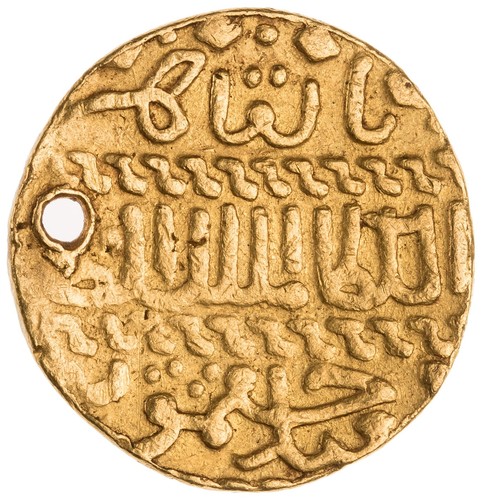
Gold Dinar of Jaqmaq
1438-1453 CE
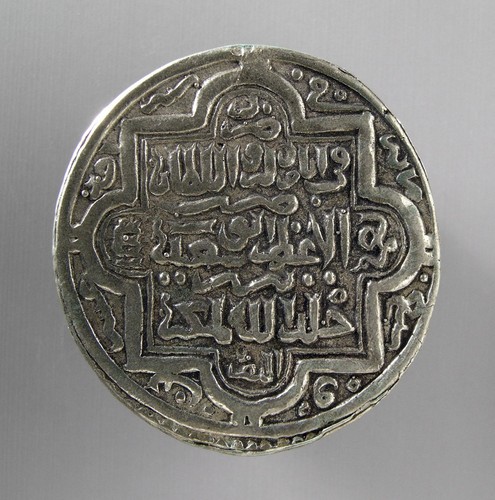
Ilkhanid Dirham
13th–14th century (Ilkhanate, c. 1256–1335 CE)
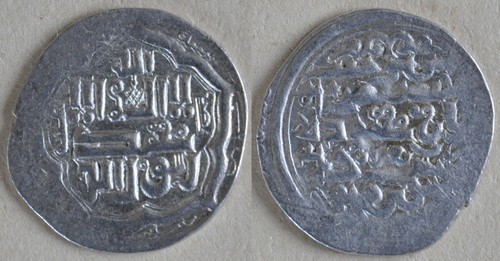
Ilkhanid Dirham of Ghazan
14th century (c. 1295-1304 CE)
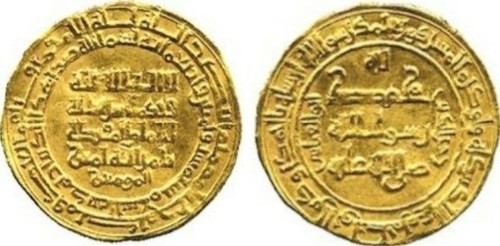
Gold Dinar of al-Muqtadi
c. 467-475 AH (1074-1082 CE)
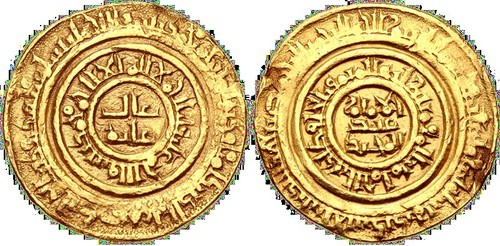
Gold Dinar of al-Hafiz li-Din Allah
AH 544 (AD 1149–1150)
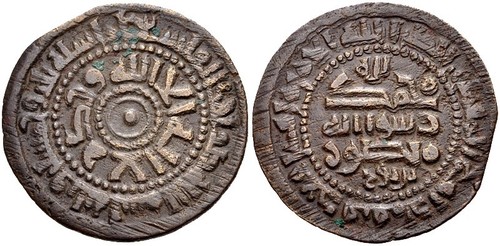
Samanid Dirham
9th–10th century CE (roughly AH 3rd–4th century)
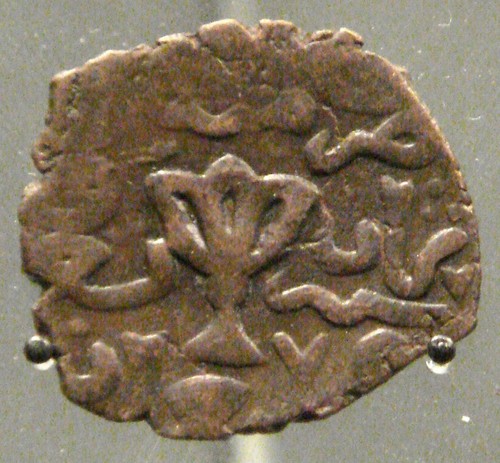
Copper Fals of Barquq
1382–1389 CE (first reign of Barquq)
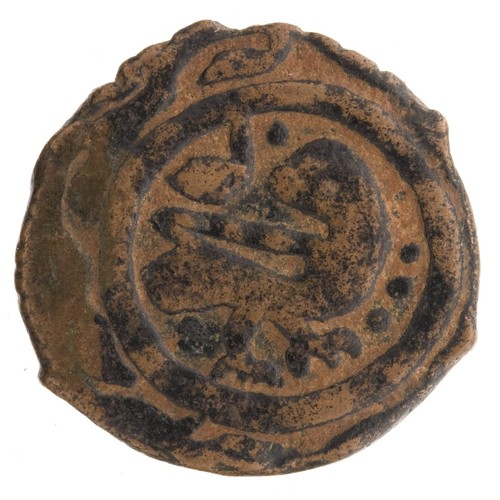
Copper Fals of as-Salih Salih
Mid-14th century CE (reign of as-Salih Salih, AH 752–755 / 1351–1354 CE)
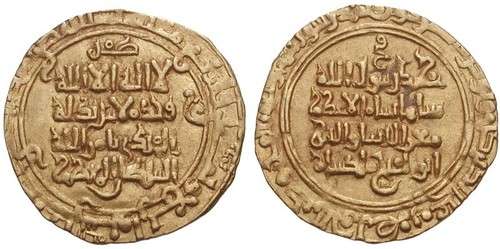
Gold Dinar of Malik Shah I
AH 465–485 (1072–1092 CE)
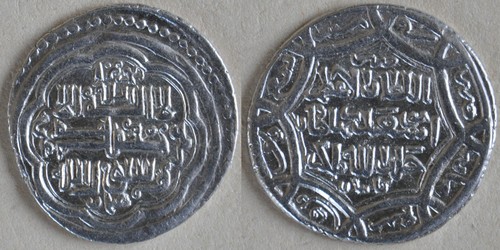
Ilkhanid Dirham of Abu Said
c. 1316-1335 CE (AH 716-736)
Silver Dirham of Salm ibn Ziyad
c. 682-683 CE
Imitation Abbasid Dirham
8th–9th century CE