
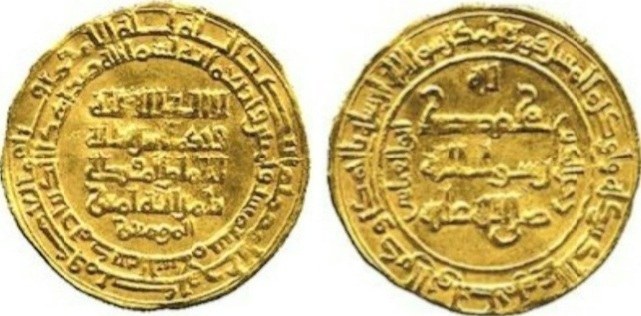
Gold Dinar of al-Muqtadi
An aniconic Abbasid gold dinar of Caliph al-Muqtadi, covered on both faces with Arabic calligraphy and ornamental borders, struck in the later 11th century.
- Country
- Islamic (Abbasid Caliphate)
- Denomination
- Dinar
- Metal
- Gold
Got a coin like this?
Identify any coin from a photo, free.
Overview
The Gold Dinar of al-Muqtadi is a medieval Islamic gold coin struck in the name of the Abbasid caliph al-Muqtadi bi-Amr Allah, who reigned in the later 11th century. The example photographed is a fully inscriptional coin: both the obverse and the reverse are filled with Arabic calligraphy arranged in a central field with concentric marginal legends, framed by an ornamental border. It carries no portrait or figural imagery of any kind.
The coin follows the standard reformed dinar layout that had governed Islamic gold for centuries. The central areas typically carry the Islamic profession of faith together with the names and titles of the caliph, while the surrounding marginal bands record the mint, the date, and Quranic phrases. Reading these legends is how a specialist attributes the piece to al-Muqtadi and to a particular mint and year.
Struck during the period of Seljuk ascendancy, when the sultans held real political power while the Abbasid caliph remained the religious figurehead, this dinar is a small, hand-struck gold disc that documents both the enduring authority of the caliphate and the layered politics of the medieval Islamic world.
History & Background
Al-Muqtadi bi-Amr Allah was the twenty-seventh Abbasid caliph, ruling from Baghdad in the later part of the 11th century (his reign is conventionally dated to 467–487 AH, roughly 1075–1094 CE). By this time the Abbasid caliphs had long ceased to wield direct political and military power; real authority in Iraq and the wider east rested with the Great Seljuk sultans, notably Malik-Shah I, while the caliph retained spiritual primacy as the head of Sunni Islam.
This division of power is often reflected on the coinage of the era, where the caliph is named as the ultimate religious sovereign and the reigning Seljuk sultan may also appear, acknowledging the temporal ruler. The dinar remained the flagship gold denomination of the Islamic world, its weight and inscriptional format descending directly from the reform coinage introduced by the Umayyad caliph Abd al-Malik in the late 7th century.
Coins in al-Muqtadi's name were produced at Abbasid-controlled mints during a period of relative stability and cultural flourishing in Baghdad. They belong to the long tradition of aniconic Islamic gold that carried religious and dynastic legitimacy through text rather than imagery.
How to Identify
The defining feature of this coin is that it is entirely calligraphic. Both faces are covered with Arabic script — a central legend surrounded by one or more circular marginal bands — enclosed by an ornamental border, with no human figure, animal, or symbol. This aniconic layout is the hallmark of the classic Islamic dinar and immediately distinguishes it from figural Byzantine or medieval European gold.
The coin is struck in gold on a small, hand-made flan in the dinar tradition, generally in the region of about 4 grams and roughly 20–23 mm across, though later Abbasid and Seljuk-era dinars can be somewhat broad, thin, and irregular in shape, with weight and centering varying from coin to coin. The script is in an angular-to-cursive Arabic style typical of the 11th century.
Attribution to al-Muqtadi depends on reading the legends: the caliph's regnal name and titles appear in the field, while the marginal inscriptions give the mint and the Hijri date and quote the Qur'an. Because a Seljuk sultan's name may also be present, correct identification often means separating the caliph's name from that of the temporal overlord, a task best left to a specialist in Islamic epigraphy.
Value & Collectibility
Medieval Abbasid gold dinars are made of gold, are several centuries old, and carry clear historical interest, so they trade well above their bullion value. Coins of al-Muqtadi are collectible as named issues of a specific caliph from the Seljuk period, but as a group later Abbasid dinars are more available than the rare early Umayyad reform gold, and prices reflect that.
Value within the series is driven by the mint, the exact date, the completeness and legibility of the legends, centering, and overall preservation. A well-struck, fully legible coin with a clear mint-and-date reading — and, where present, an identifiable Seljuk sultan's name — will command more than a weakly struck, clipped, or off-center example. Broad, thin flans that show only part of the intended design are common and generally sell for less.
Because gold dinars are valuable and frequently reproduced, authenticity and provenance materially affect price. Precise figures vary widely by variety and market, so any given coin should be assessed individually by someone familiar with Islamic gold coinage rather than judged by weight alone.
Frequently asked questions
Who was al-Muqtadi?
Al-Muqtadi bi-Amr Allah was the twenty-seventh Abbasid caliph, ruling from Baghdad in the later 11th century (about 1075–1094 CE). He held religious authority as head of Sunni Islam while the Seljuk sultans wielded political and military power.
Why is there no picture on the coin?
Islamic dinars of this era were aniconic, meaning they avoided portraits and figures. Instead both faces carry only Arabic calligraphy — the profession of faith, the caliph's name and titles, and the mint and date — framed by ornamental borders.
How much gold is in the dinar?
The dinar followed the long-standing Islamic gold standard of roughly 4 grams. Individual hand-struck coins of this later Abbasid period vary around that weight and can be on broad, thin flans.
What do the inscriptions say?
Typically the central legends give the Islamic declaration of faith together with the caliph's name and titles, while the marginal bands record the mint city, the Hijri year, and Quranic phrases. A Seljuk sultan's name may also appear.
Are these dinars rare?
They are genuine medieval gold and are collectible, but later Abbasid dinars are more available than the earliest Islamic gold. Rarity and value depend on the mint, the date, and how completely and clearly the coin is struck.
Gold Dinar of al-Muqtadi guides
In-depth guides for identifying, valuing, and collecting Gold Dinar of al-Muqtadi.
Other coins you may enjoy
Gold Dinar of Jaqmaq
1438-1453 CE
Ilkhanid Dirham
13th–14th century (Ilkhanate, c. 1256–1335 CE)
Ilkhanid Dirham of Ghazan
14th century (c. 1295-1304 CE)
Gold Dinar of al-Hafiz li-Din Allah
AH 544 (AD 1149–1150)
Samanid Dirham
9th–10th century CE (roughly AH 3rd–4th century)
Copper Fals of Barquq
1382–1389 CE (first reign of Barquq)
Copper Fals of as-Salih Salih
Mid-14th century CE (reign of as-Salih Salih, AH 752–755 / 1351–1354 CE)
Gold Dinar of Malik Shah I
AH 465–485 (1072–1092 CE)
Ilkhanid Dirham of Abu Said
c. 1316-1335 CE (AH 716-736)
Silver Dirham of Salm ibn Ziyad
c. 682-683 CE
Silver Dirham (LACMA M.2002.1.437)
8th century CE (roughly AH 80s–190s)
Imitation Abbasid Dirham
8th–9th century CE