
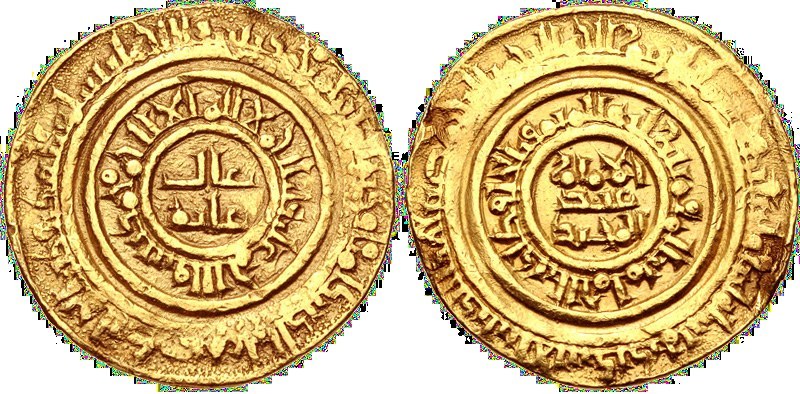
Gold Dinar of al-Hafiz li-Din Allah
A hand-struck Fatimid gold dinar of the caliph al-Hafiz li-Din Allah, carrying only Arabic calligraphy in concentric ring borders and dated AH 544.
- Country
- Egypt (Fatimid)
- Denomination
- Dinar
- Metal
- Gold
Got a coin like this?
Identify any coin from a photo, free.
Overview
The gold dinar of al-Hafiz li-Din Allah is a hand-struck high-purity gold coin of the Fatimid Caliphate, issued in Egypt in the name of the caliph al-Hafiz. The example shown is dated AH 544 (AD 1149–1150) and displays the distinctive Fatimid layout: multiple concentric circular bands of Arabic calligraphy arranged around a short central legend on each face, giving the strong bull's-eye or target-like appearance for which these dinars are famous.
Like all Fatimid dinars, the coin is entirely aniconic — it bears no portrait or figural image, only religious and dynastic inscriptions in Arabic script. The obverse and reverse both use the same concentric-circle design, so the two sides can look very similar at first glance; they are distinguished by their inner legends, which name the caliph and record the mint and date.
Fatimid gold was renowned in the medieval Mediterranean for its fineness and consistency, and dinars of this type circulated widely as a trusted trade coin. This piece belongs to the very end of al-Hafiz's reign, making it a compact record of Fatimid Egypt in its later period.
History & Background
Al-Hafiz li-Din Allah (reigned AH 526–544 / AD 1132–1149) was the eleventh Fatimid caliph, ruling from Cairo over an Isma'ili Shia dynasty that governed Egypt and, at its height, parts of North Africa, the Levant and the Hijaz. His accession was contested, and much of his reign was marked by court factionalism and the growing power of the wazirs, yet Fatimid gold coinage continued to be struck to its long-established high standard throughout.
The Fatimid dinar was one of the principal gold currencies of the medieval world, prized from Egypt to Italy for its reliability. The concentric-circle format seen here had become the hallmark of Fatimid gold from the reign of al-Mustansir onward, replacing the earlier horizontal-line arrangement and setting these coins visually apart from Abbasid, Umayyad and later Ayyubid issues.
A dinar dated AH 544 falls in the final year of al-Hafiz's reign; he died in AH 544 and was succeeded by his son al-Zafir. Within a few decades the Fatimid state itself would fall, abolished by Saladin in 1171, after which Egypt's gold coinage passed to the Ayyubids. Coins like this one therefore document the mature Fatimid monetary system shortly before that transition.
How to Identify
A dinar of al-Hafiz is a small, thin, bright-yellow gold coin, typically around 20–24 mm across and near the classic dinar weight of roughly 4.0–4.3 grams. The gold is high-purity, so genuine examples have a rich, soft golden color rather than the paler tone of low-carat alloy. Because the coins were struck by hand, the flan is often slightly irregular and the strike can be a little uneven or off-center.
The defining feature is the design: two or more concentric circular inscriptions on each face surrounding a short central legend, producing a target-like pattern on both obverse and reverse. This is quite different from the block-of-text layout of many other Islamic dinars. Attribution to al-Hafiz depends on reading his caliphal name and titles within the inscriptions, while the mint name and the date — here AH 544 — are woven into the surrounding rings.
There is no image, coat of arms, or Latin lettering anywhere on the coin, only Arabic calligraphy expressing the Shia profession of faith and Fatimid dynastic formulae. Correctly reading the central legends is the surest way to separate a genuine al-Hafiz dinar from the outwardly similar dinars of other Fatimid caliphs, which share the same concentric-circle style.
Value & Collectibility
Fatimid dinars are collected both as historic gold trade coins and as fine examples of Islamic calligraphic design. Because they are struck in high-purity gold, even common examples carry a substantial base value from their metal content, and well-preserved pieces trade at a premium above that for their historical and artistic interest.
Value within the series is driven mainly by the caliph, the mint, the specific date, the completeness and clarity of the concentric inscriptions, and overall condition. Sharp, well-centered strikes with fully legible legends and attractive surfaces are worth considerably more than weak or clipped examples. Coins from scarcer mints or rarer dates within a reign also command higher prices.
As with all hand-struck medieval gold, precise pricing depends on grade, eye appeal and specialist demand, so figures here are general context rather than fixed values. An accurate reading of the caliph, mint and date is the single most important factor in placing an individual dinar within the market.
Frequently asked questions
Who was al-Hafiz li-Din Allah?
Al-Hafiz li-Din Allah was the eleventh Fatimid caliph, ruling Egypt from AD 1132 to 1149. This gold dinar was struck in his name; the example dated AH 544 belongs to the final year of his reign.
Is this dinar made of real gold?
Yes. Fatimid dinars were struck in high-purity gold and were famous across the medieval Mediterranean for their fineness. A genuine dinar of this type is essentially gold, not a base-metal alloy.
Why do both sides look almost the same?
Fatimid dinars use the same concentric-circle design on obverse and reverse, so the two faces resemble each other. They are told apart by their inner legends, which name the caliph on one side and give the mint and date on the other.
What does AH 544 mean?
AH refers to the Islamic Hijri calendar. AH 544 corresponds to about AD 1149–1150, placing this coin at the very end of al-Hafiz's reign.
Is the central pattern a cross?
No. What can look like a central cross is simply the arrangement of the short Arabic inscription and dividing elements at the middle of each concentric design. Fatimid dinars are aniconic and carry no Christian or figural symbolism.
Gold Dinar of al-Hafiz li-Din Allah guides
In-depth guides for identifying, valuing, and collecting Gold Dinar of al-Hafiz li-Din Allah.
Other coins you may enjoy
Gold Dinar of Jaqmaq
1438-1453 CE
Ilkhanid Dirham
13th–14th century (Ilkhanate, c. 1256–1335 CE)
Ilkhanid Dirham of Ghazan
14th century (c. 1295-1304 CE)
Gold Dinar of al-Muqtadi
c. 467-475 AH (1074-1082 CE)
Samanid Dirham
9th–10th century CE (roughly AH 3rd–4th century)
Copper Fals of Barquq
1382–1389 CE (first reign of Barquq)
Copper Fals of as-Salih Salih
Mid-14th century CE (reign of as-Salih Salih, AH 752–755 / 1351–1354 CE)
Gold Dinar of Malik Shah I
AH 465–485 (1072–1092 CE)
Ilkhanid Dirham of Abu Said
c. 1316-1335 CE (AH 716-736)
Silver Dirham of Salm ibn Ziyad
c. 682-683 CE
Silver Dirham (LACMA M.2002.1.437)
8th century CE (roughly AH 80s–190s)
Imitation Abbasid Dirham
8th–9th century CE